A Direct Mail Hiring Playbook for High-Volume Caregiver Recruiting

For high-volume caregiver hiring, use direct mail as an ongoing, measurable recruiting channel rather than only a one-time response to an open role. This workflow is for home care, long-term care, and other employers hiring CNAs, HHAs, and caregivers within a defined service area.
1. Define the caregiver hiring problem
Start with the staffing need you need the campaign to address. A clear definition keeps the audience, card, landing page, and follow-up process aligned.
- Choose the role or roles to promote: CNA, HHA, caregiver, or a related position.
- Document why hiring is needed. The issue may be recurring openings, high turnover, a difficult shift, a hard-to-staff location, or an upcoming hiring event.
- Decide whether the campaign supports immediate hiring, continuous recruiting, event attendance, or long-term pipeline building.
- Set one primary objective. For example, a campaign can focus on building interest for caregiver openings in one service area, rather than trying to promote every role at once.
One objective makes later response data easier to interpret. If one card promotes multiple unrelated jobs and actions, it becomes harder to tell what prompted a scan or visit.
2. Set the target license, specialty, and geography
Define who should receive the campaign before writing the message. RecruitCard campaigns use matching by license type, specialty, and geography rather than a broad demographic audience.
- Specify the relevant caregiver category, such as CNA, HHA, or caregiver.
- Define the geographic area around the facility, office, or service territory you need to staff.
- Separate audiences when the role, location, shift, or message differs in a meaningful way.
- Organize multi-location or nationwide hiring by market, role, or employer location.
This is not the same as purchasing a generic mailing list. The goal is to make the audience relevant to the actual hiring need. For example, a home care employer with openings in two service areas may need separate audiences and separate card versions if the locations or role details are different.
3. Build the campaign message around the role
Write for the caregiver opportunity, not for a general employer announcement. Recipients should quickly understand what type of work is being promoted and why it may be relevant to them.
- Lead with the specific CNA, HHA, or caregiver opportunity.
- State practical details that matter to the intended audience when they are available, such as the care setting, shift, location, or type of work.
- Use a role-specific message instead of a broad statement such as “we are hiring.”
- Keep each card focused on one audience and one primary action.
A card for caregivers supporting clients at home should not read like a message for a facility-based CNA opening unless both opportunities truly share the same audience and next step. Avoid unapproved compensation statements, employment promises, or claims about campaign performance.
4. Create the card using four essential components
Build the card so a recipient can recognize the opportunity and act without sorting through competing messages. RecruitCard uses four core components.
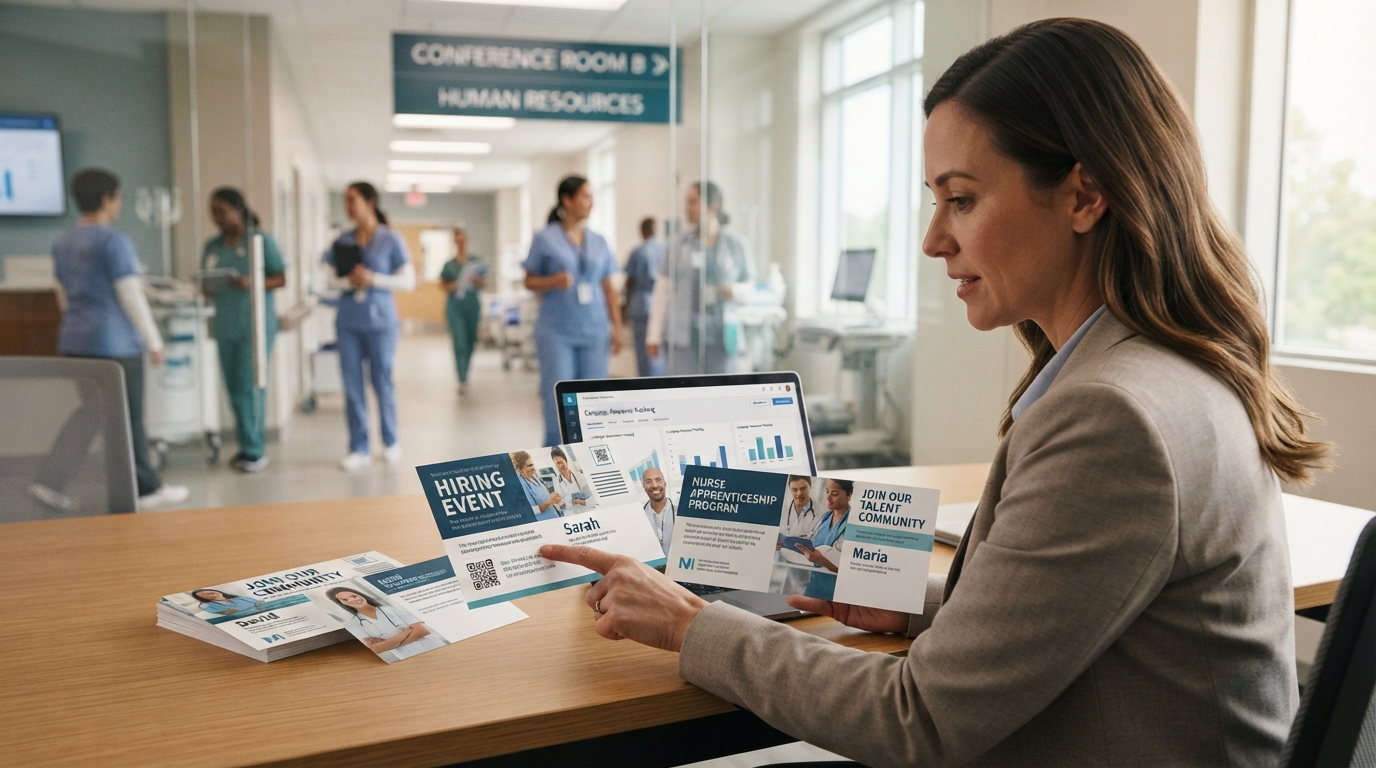
Personalized name
Address the recipient by their actual first name. Personalization helps make the message feel directed to the person receiving it rather than to a broad household audience.
Specialty-specific message
Make the copy relevant to CNA, HHA, or caregiver work and the stated hiring need. A night-shift facility role, a home care service area, and a hiring event may each require different copy.
Credible employer branding
Use the employer’s logo, visual identity, and a plain description of the opportunity. The card should make clear who is hiring and what the recipient is being invited to consider.
One clear action
Include a QR code and short URL that lead to the intended response destination. Ask recipients to take one next step, such as reviewing the role, expressing interest, or starting an application.
Before approval, review the full card for accurate role details, readable type, correct branding, and a clear path from the message to the response page.
5. Send candidates to a focused response page
Direct the QR code and short URL to a landing page created for the caregiver campaign. The landing page is where interest becomes an identifiable recruiting action.
- Match the landing-page headline and role details to the card.
- Make the next step simple: review the opportunity, express interest, or begin an application.
- Keep the caregiver opening easy to find and understand.
- Confirm that the page works well on a mobile device before the campaign is mailed.
A crowded careers page can make a recipient search for the role they just scanned to learn about. A focused page reduces that friction by carrying the card’s message through to the intended action.
6. Coordinate printing, postage, and delivery
Confirm the production details before the campaign is released. An end-to-end process covers audience targeting, creative, printing, postage, delivery, and response tracking.
- Confirm the final audience and any audience segments.
- Approve the card design, employer details, QR code, short URL, and landing page.
- Create separate versions when different locations, shifts, or caregiver roles need different messages.
- For agency campaigns, decide whether the work will be delivered under the agency’s brand through a white-label arrangement.
Timing should be planned for the requirements of the specific campaign. Do not rely on a fixed turnaround assumption before the audience, creative, production, and response destination have been confirmed.
7. Launch the campaign as a hiring workflow
Mail should connect to a prepared recruiting process. Decide who will see responses, who will follow up, and what happens after a caregiver signals interest.
- Assign an owner to monitor campaign responses and route interested candidates to the recruiting team.
- Prepare recruiters and hiring managers to respond consistently to scans, visits, and inquiries.
- Coordinate the campaign with open roles, hiring events, interview availability, and application follow-up.
- Use repeat mailings when your need is continuous rather than waiting for each vacancy to become urgent.
For high-volume caregiver staffing, direct mail can be a repeatable channel within a broader recruiting process. It can help reach qualified, already-employed people who may not be actively browsing job boards or responding to paid search ads.
8. Measure scans and landing-page traffic
Direct mail recruiting can be measured. Use the QR code and response page to understand engagement generated by the campaign.
- Track QR-code scans.
- Track visits to the campaign landing page, including traffic associated with the short URL when available.
- Compare activity by market, role, location, or creative version when the campaign is structured for those comparisons.
- Connect campaign activity with your own applicant and hiring workflow where appropriate.
Use these signals to evaluate engagement and improve future audience selection, message relevance, and follow-up. They should not be presented as unapproved response, cost-per-hire, or return-on-investment figures.
9. Review fit and improve the next mailing
Review the campaign after launch and apply what you learn to the next version. This is especially important when caregiver hiring is ongoing.
- Identify which audiences, locations, shifts, and messages produced the most useful engagement.
- Check whether the landing page and recruiting follow-up made it easy for interested people to take the next step.
- Adjust the audience or message when the campaign needs greater relevance, clearer employer branding, or a more direct call to action.
- Continue mailing when recurring caregiver hiring calls for pipeline building rather than one-time recruitment.
If you need targeting, creative, production, delivery, and response tracking managed together, an end-to-end campaign partner can keep those connected pieces coordinated.
10. Choose the next step
Use this approach when you have a defined caregiver hiring need, a small or already-employed qualified pool, recurring openings, or a hiring event to promote. It can support a local service area, multiple locations, or a broader rollout organized by market and role.
Recruitment marketing agencies can also use the same workflow as a white-label direct mail service without building an in-house print, postage, and tracking operation.
For help planning a caregiver campaign, book a 15-minute call.
Enjoyed this? There's more from RecruitCard.
Book a 15-minute call →