
Can a Recruiting Postcard Tell You Exactly Who Scanned the QR Code?
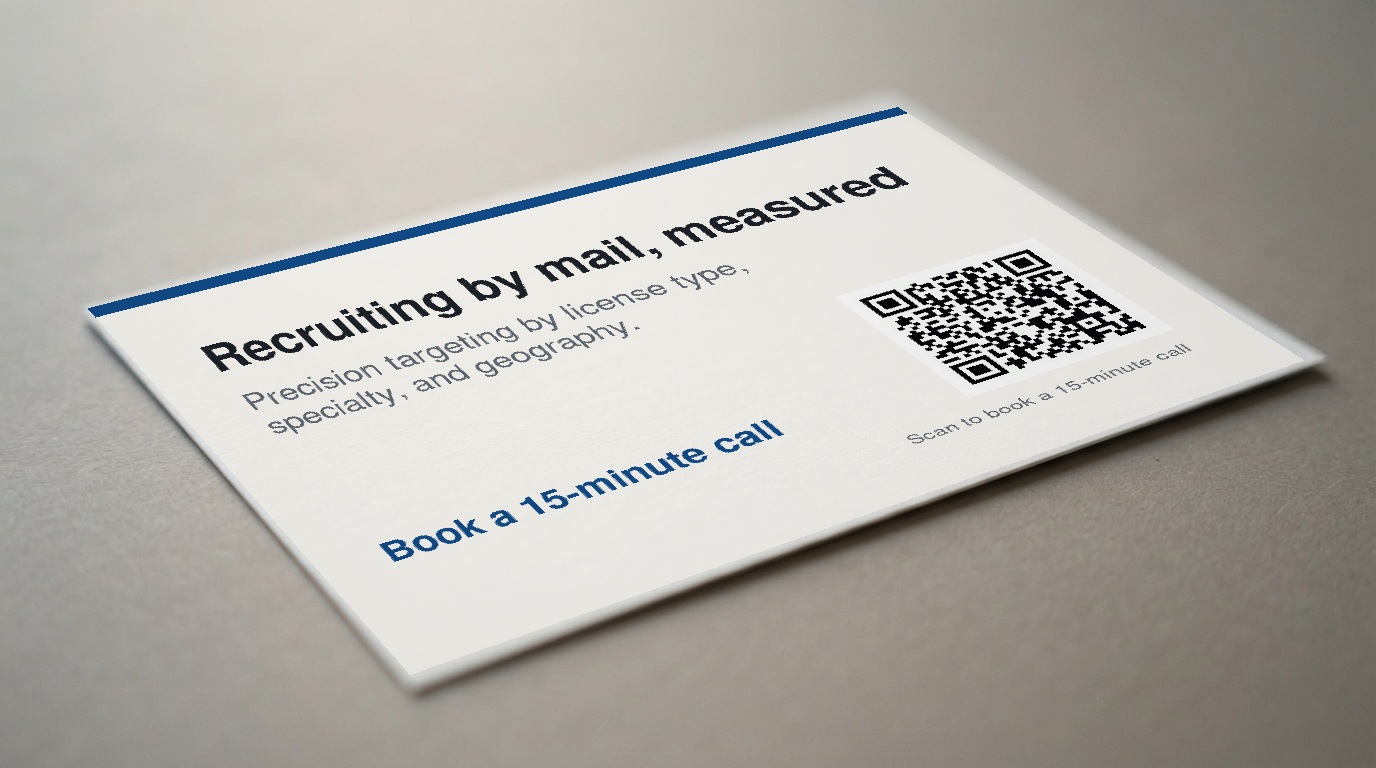
Usually, no. A recruiting postcard can record that a personalized campaign code was scanned and associate that activity with the intended recipient associated with the personalized code. It should not be described as proof of exactly which person scanned it. This distinction matters for healthcare HR and talent-acquisition teams that want measurable direct-mail recruiting without overstating what the data means.
Can a recruiting postcard tell you exactly who scanned the QR code?
A personalized QR code can make direct-mail response more attributable than an untracked postcard. When the code is scanned, campaign reporting can connect the activity to the mailed piece and the intended recipient associated with that code.
That is not the same as identity verification. The named recipient may have scanned the code, but the scan alone does not prove they personally held the phone or completed the action. A household member, colleague, or another person with access to the card could scan it instead.
Responsible reporting treats a QR scan as campaign activity associated with a mailed piece. It does not treat the scan as guaranteed proof that a particular individual responded.
What QR-code tracking can show
QR and landing-page measurement can show useful stages of engagement, depending on how the campaign is configured. Common reporting signals include:
- QR-code scans
- Landing-page traffic
- Voluntary form submissions
- Application starts or other configured next steps
- Calls or other response actions when those events are set up to be measured
A personalized code can connect a scan to a particular mailed audience record or recipient association. This gives your team a clearer view of which audience segment or mailing piece generated activity than an untracked mailer would provide.
Each signal should remain distinct. A scan is not automatically a landing-page visit, a form submission, a qualified lead, an application, or a hire. Reporting is most useful when it shows the steps separately and describes them as campaign-attribution signals rather than identity verification.
What QR-code tracking cannot prove by itself
A QR scan alone cannot prove that the intended recipient personally scanned the postcard. It also cannot independently confirm the scanner's identity, hiring interest, licensure, or application status.
In practical terms, a postcard can be shared or forwarded, scanned by another household member, or opened on a different device. Those possibilities are why a scan should not be reported as a definitive response from a named person.
If someone later chooses to identify themselves through a form, an application flow, or another voluntary action, your team may have more context about that response. Even then, the appropriate interpretation depends on the information the person voluntarily provides and the campaign workflow. The scan itself remains an attribution signal, not proof of identity.
How a personalized recruiting postcard works
RecruitCard campaigns are built around a defined licensed or certified audience, not a generic demographic mailing. Targeting is based on license type, specialty or trade, and geography.
A recruiting card has four core elements:
- A personalized name: the recipient's actual first name.
- A specialty-specific message: copy that speaks to the role, unit, shift, or hiring need.
- Credible employer branding: your employer brand and logo on the card.
- One clear action: a QR code and short URL that direct attention to the next step.
For example, a health system hiring for an ICU night-shift opening can use a message written for that setting rather than a broad healthcare hiring appeal. The same approach can support an OR role, a rural position, or another hard-to-fill specialty.
Personalization helps connect campaign activity to the intended recipient associated with the personalized code. It does not turn a scan into verified proof of an individual's identity.
What happens after someone scans
The intended flow is straightforward: someone scans the QR code, reaches the campaign landing page, reviews the opportunity, and may choose to take a further action.
The landing page can be configured to support response measurement through traffic and voluntary actions, such as submitting interest information or beginning an application. The precise next step should match the hiring goal. A hard-to-fill RN requisition may lead to an interest form or application path, while a hiring-event campaign may direct people to registration details.
Use privacy-conscious reporting language throughout the workflow: activity is associated with the intended recipient associated with the personalized code. Confirm the exact technical workflow, tracked events, and final privacy wording for each campaign before it is launched.
How employers should interpret the reporting
Treat QR scans as an early engagement indicator, not as confirmed applicants or hires. Review scans alongside landing-page traffic and the downstream actions your team can legitimately measure.
When the campaign setup supports it, you may compare response activity by:
- Role or license type
- Specialty or unit
- Geography or location
- Shift, such as night shift
- Message or creative version
This can help you understand whether a hard-to-fill requisition is receiving attention from the audience you intended to reach. It should not be used to claim a response rate, cost per hire, return on investment, or a confirmed individual identity unless your own independently measured process supports a separate conclusion.
How this differs from a generic mailing list
RecruitCard positions direct-mail recruiting around license type, specialty or trade, and geography rather than a broad purchased-list handoff. That audience definition gives the creative a practical starting point: an ICU message should not read like a generic healthcare hiring advertisement.
The service is managed end to end. It includes audience targeting, creative, printing, postage, delivery, and QR-code or landing-page response tracking. Your team is not left to coordinate a list, printer, mail operation, and reporting process separately.
This approach is intended for passive candidates who may not be reached through active job-search channels alone. Someone who is already employed and not searching may never see your posting, but can still receive a relevant recruiting message at home.
Questions to ask before launching a tracked postcard campaign
- What exactly will the report show: scans, landing-page visits, form completions, or other events?
- How will activity associated with a personalized code be described without implying that identity was proven?
- What information will the landing page request, and which actions are voluntary?
- How will the campaign distinguish an initial scan from a qualified lead or applicant?
- Can the creative include your logo, specialty-specific copy, the recipient's first name, a QR code, and a short URL?
- Can the campaign support one market, multiple locations, or a nationwide rollout?
- Which role, specialty, geography, shift, or message comparisons will the campaign setup support?
Who this approach is a fit for
This approach is primarily for hospital and health-system HR and talent-acquisition teams hiring RNs and LPNs for hard-to-fill units, including ICU, ED, OR, L&D, oncology, case management, and night-shift roles.
It can also fit targeted hiring needs in long-term care, home care, outpatient care, rehabilitation, allied health, physician hiring, dental, pharmacy, and behavioral health. RecruitCard's deepest stated expertise is licensed healthcare hiring. The same model also extends to engineering and skilled-trade employers seeking licensed or certified candidates.
Common uses include:
- A specific requisition that is not closing through normal channels
- Recurring, high-volume local hiring needs
- Hiring events and open houses
- Awareness for an apprenticeship or training program
- Long-term candidate pipeline building before the next vacancy opens
Recruitment marketing agencies can also use RecruitCard's white-label option to offer a direct-mail channel without building an in-house print, postage, and tracking operation.
Bottom line: measurable does not mean personally identified
A personalized QR code can make recruiting postcard activity more attributable. It can associate a scan with the intended recipient associated with the personalized code. It should not be presented as definitive proof of exactly who scanned it.
QR scans and landing-page traffic are useful signals for recruitment marketing decisions, particularly when you are trying to create attention for a difficult licensed role. The strongest interpretation combines campaign attribution with voluntary candidate actions and privacy-safe reporting language.
If you are considering direct mail for a hard-to-fill licensed role, a short conversation can help clarify the target audience, postcard personalization, landing-page measurement, and intended reporting workflow.
Call to action
Book a 15-minute call to discuss targeting, personalization, landing-page measurement, and the intended reporting workflow.
Call RecruitCard.
Enjoyed this? There's more from RecruitCard.
Book a 15-minute call →