How to Build Bench Strength Across Multiple Care Settings

For hospital and health-system talent teams, bench strength means building a qualified pipeline before every care setting reaches a staffing crisis. This workflow helps you identify recurring needs across units, prioritize licensed specialties, reach passive candidates, and measure interest for both immediate openings and future roles.
1. Map your hiring needs across care settings
Start with a practical view of where staffing pressure appears repeatedly. Bench strength is not one general candidate pool. It is a set of role-specific pipelines connected to the care settings where you expect demand.
- List the care settings, units, and locations that regularly need qualified professionals. This may include acute care, outpatient clinics, rehabilitation, long-term care, home care, and behavioral health.
- Separate urgent requisitions from recurring needs. An ICU night-shift opening calls for a different outreach message than an ongoing need for CNAs, home health aides, or caregivers.
- Record the license type, specialty, shift, work setting, location, and likely hiring volume for each need.
- Flag roles that have not closed through normal channels, particularly where the qualified local pool is small or many potential candidates are already employed.
A useful planning record might distinguish an RN opening in an emergency department from a future outpatient physical therapy need, even when both sit within the same health system. The audience, message, and next step may be different.
2. Group candidates by license, specialty, and geography
Build each audience around the qualifications that matter for the role. Do not treat a broad healthcare-worker audience as interchangeable with a specialty-specific candidate group.
- Use license type, specialty or trade, and geographic location as the core matching criteria.
- Create separate groups when the opportunity or message differs. ICU nurses, outpatient physical therapists, and home care aides should not automatically receive the same card.
- Keep local and nationwide needs distinct. A single-market search may focus on nearby candidates, while a broader rollout can support several facilities or locations.
- Document what makes each group relevant to the opportunity, including care setting, shift, and location.
This is different from a generic mailing list approach. The goal is precision around the licensed role, specialty, and geography you need, so the outreach reflects a real opportunity rather than a broad employment message.
3. Match each audience to a clear pipeline purpose
Decide what you want each audience to do before you create the message. A campaign should have one defined purpose that guides the card, landing page, and tracking plan.
- Fill a current requisition.
- Drive awareness or registration for a hiring event.
- Introduce an apprenticeship or training program.
- Support continuous, high-volume hiring.
- Build awareness before the next vacancy opens.
For hard-to-fill roles, lead with the detail that makes the opening relevant. That may be the unit, specialty, shift, care setting, or location. For long-term pipeline work, explain the type of opportunity and why a qualified professional may want to stay connected.
Direct mail can help you speak to passive, already-employed professionals who may not be searching job boards or responding to paid search. That makes it useful when your target audience is structurally less visible through active-jobseeker channels.
4. Build the card around one relevant opportunity
Give the recipient a card that can be understood quickly. The strongest structure keeps the message focused on a single relevant opportunity or pipeline purpose.
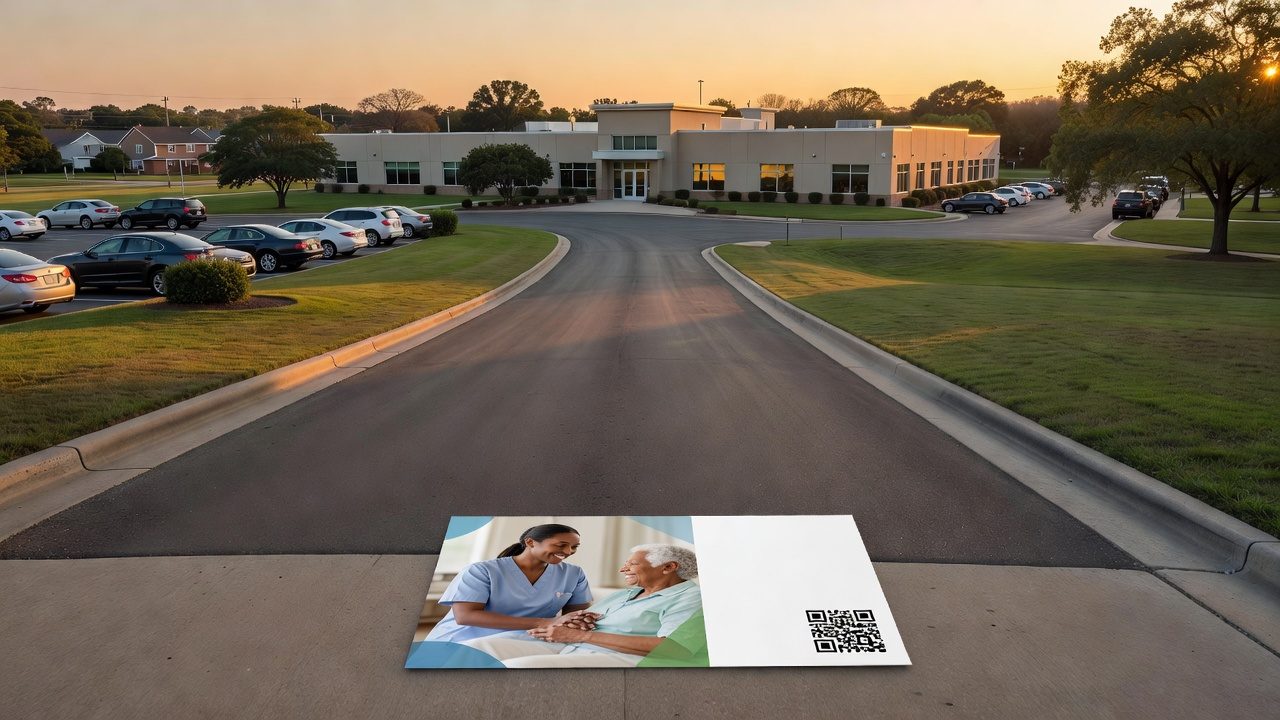
Include the four essential card components
- Personalized name: Use the recipient's actual first name.
- Specialty-specific message: Reflect the care setting, role, shift, or location.
- Credible employer branding: Make it clear who is hiring.
- One clear action: Use a QR code and short URL that lead to the relevant next step.
A card for ICU night-shift RNs should not try to also promote outpatient therapy, a general careers page, and a hiring event. Combining unrelated roles, facilities, or calls to action makes the message harder to understand and the response harder to interpret.
5. Create a landing page for the next decision
Continue the card's message after the scan. Send recipients to a landing page built for that opportunity, rather than asking them to navigate a generic careers homepage.
- State the role or pipeline purpose clearly.
- Include relevant qualification and location information.
- Provide a straightforward way to express interest or take the next step.
- Make a hiring event or apprenticeship program the primary action when that is the campaign's purpose.
- Use separate landing pages or tracking structures when you need to compare care settings, specialties, or locations.
For example, a candidate receiving an invitation to learn about a rehabilitation leadership opportunity should arrive at content about that opportunity. They should not need to search through unrelated job categories to determine why they received the card.
6. Coordinate the complete campaign workflow
Direct mail recruiting works best as one connected process, not as a list handoff followed by separate design, print, and tracking decisions.
- Confirm the audience criteria, including license type, specialty, and geography.
- Approve the role-specific message, employer branding, and one call to action.
- Confirm the QR destination and the delivery geography.
- Review the card for specialty accuracy, personalized name treatment, location details, and a clear next step.
- Coordinate targeting, creative, printing, postage, delivery, and response tracking together.
Your campaign can be designed for a focused market or a nationwide rollout, depending on the hiring plan. Recruitment marketing agencies can also use a white-label workflow to offer this channel without building their own print, postage, and response-tracking operation.
7. Measure interest and connect it to hiring activity
Response tracking gives your team a way to see engagement with the campaign. Track QR scans and landing-page traffic for each campaign, audience, care setting, specialty, and location when your tracking structure supports that comparison.
- Compare response activity with the campaign's original purpose.
- Review which messages and audiences generate interest.
- Use those observations to refine later audience definitions, messages, and landing pages.
- Keep your applicant review and hiring process separate from campaign engagement data.
A hiring-event campaign and a long-term pipeline campaign should not be evaluated with the same immediate hiring measure. A scan or landing-page visit is an engagement signal. It does not replace qualification review, interviews, or the rest of your hiring process.
8. Turn one campaign into an ongoing bench-strength plan
Once you have a clear workflow, use it repeatedly around the needs that are most likely to create staffing pressure.
- Schedule follow-up activity around recurring vacancies, seasonal needs, hiring events, and known expansion plans.
- Refresh the audience and message when the specialty, location, shift, or hiring objective changes.
- Apply the same framework across care settings while keeping every message relevant to its intended audience.
- Start with the role or care setting that will not close through normal channels, then expand the approach to other licensed healthcare hiring needs.
RecruitCard manages targeted direct mail campaigns that combine audience matching by license type, specialty, and geography with personalized creative, printing, postage, delivery, and QR-code and landing-page response tracking. To discuss a campaign for current openings or future pipeline building, book a 15-minute call.
Enjoyed this? There's more from RecruitCard.
Book a 15-minute call →