How to Recruit Paramedics for Night, Weekend, and Rotating Shifts

Recruiting paramedics for night, weekend, and rotating shifts requires more than posting an open job and waiting for active applicants. The stronger approach combines a clear, shift-specific offer with precise outreach to qualified paramedics in the geography you need, including professionals who are already employed and not searching job boards. This guide is for EMS organizations, hospitals, health systems, municipalities, and staffing teams hiring paramedics for difficult schedules.
Why Night, Weekend, and Rotating Paramedic Roles Are Difficult to Fill
Nonstandard schedules narrow an already specific candidate pool. A paramedic may be qualified for the role but decide that overnight work, weekend coverage, rotating days and nights, commute logistics, family responsibilities, or fatigue concerns do not fit their situation.
Experienced paramedics may also have choices. If your message does not explain why this particular shift, location, and operating environment could be worth considering, it can be easy to overlook.
This is why the challenge is not only finding qualified candidates. It is also positioning the opportunity clearly. A generic “Paramedic Wanted” message does not answer the practical questions that shape a decision about a night or rotating role.
Active job seekers and passive candidates are different audiences
An active job seeker is currently checking job boards, searching online, or responding to recruiting ads. A passive candidate is already employed and may not be looking at all. They may still consider a role with the right schedule, location, compensation structure, team, clinical setting, or advancement path.
For difficult paramedic shifts, passive candidates matter because the people you most want to reach may not be in the active applicant pool. Your outreach needs to make the role understandable enough for them to decide whether it is worth a closer look.
Start With the Shift, Not Just the Job Title
Define the schedule before building the audience or writing the creative. “Paramedic” is the job title. The shift arrangement is often the deciding factor.
Be specific about whether the role involves:
- Dedicated overnight coverage
- Weekend-only or concentrated weekend coverage
- Rotating days and nights
- 12-hour shifts or another defined shift length
- On-call expectations
- A fixed pattern or a schedule that changes over time
Candidates should also be able to see the location, service area, call environment, team structure, and required credentials or experience early in the process. Clear information lets people self-select. It also reduces confusion after an initial scan, form submission, or recruiter conversation.
Present the role around its actual fit. For example, you might describe a defined weekend schedule, a dedicated night team, or a rotation with plainly stated expectations. Do not use broad language such as “flexible scheduling” unless you can explain exactly what that means for this role.
Identify the Paramedic Audience Precisely
Direct mail recruiting should not begin with a generic healthcare mailing list. The audience should reflect the actual requisition: qualified paramedics, the relevant role or specialty context, and the geography where you need to hire.
RecruitCard builds audiences through matching by license type, specialty or role, and geography. That is different from broad demographic targeting or a mass mailing. The goal is to focus the outreach on people who are more relevant to the role.
Match the geography to the hiring plan
An urban service area, rural community, regional EMS operation, and multi-location employer may each need a different geographic approach. A rural or hard-to-reach site may need a wider radius. A system with several locations may need separate messages or clearly organized options by site.
If relocation is part of your hiring plan, outreach can introduce the opportunity to candidates outside the immediate area. The message should make the location, shift pattern, and role details clear so recipients can assess the fit without guessing.
Build a Message That Makes the Schedule Understandable
Lead with the shift-specific opportunity, not a broad employer statement. A paramedic deciding whether to consider overnight, weekend, or rotating work needs to understand what is being offered quickly.
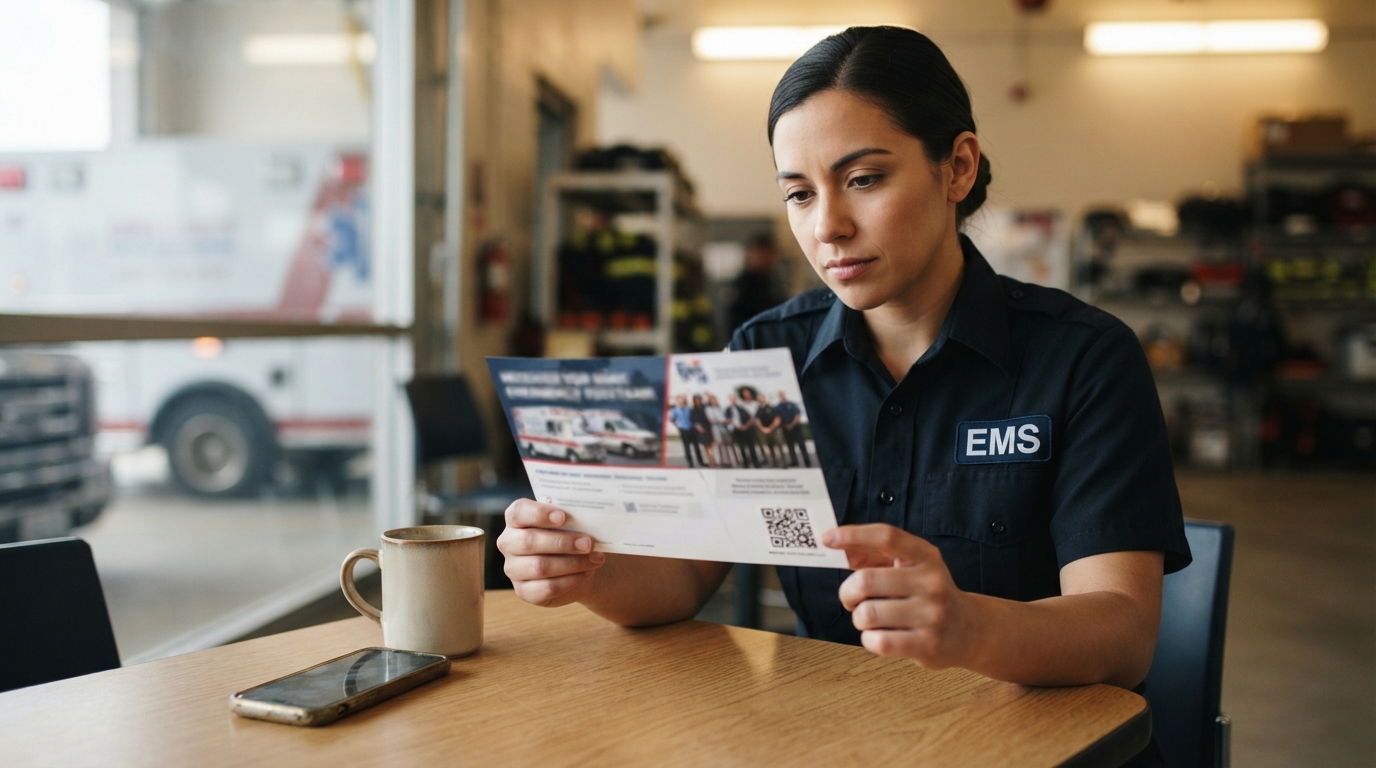
A useful direct mail card has four essential parts:
- The recipient’s actual first name. Personalization makes the outreach feel directed rather than generic.
- A role-specific message. State that the opportunity is for a paramedic and explain the relevant schedule or service context.
- Credible employer branding. Use your organization’s identity so recipients know who is contacting them.
- One clear action. A QR code and short URL should lead to a focused next step.
Useful message angles
The right angle depends on the real role. Examples include a plainly defined weekend schedule, an opening on a dedicated night team, a rotating schedule explained without jargon, or an opportunity serving a specific community or service area.
Avoid claims that sound attractive but do not convey useful information. “Great flexibility” is vague. “Weekend coverage with the schedule details on the role page” gives a candidate a reason to learn more.
Keep one primary call to action. Asking recipients to scan a QR code to review the role and express interest is clearer than sending them to a general careers page with many unrelated openings.
Make the Opportunity Competitive Without Overpromising
Base pay matters, but it is not the only factor a paramedic may weigh. A candidate may also evaluate schedule predictability, commute, call volume, equipment, clinical environment, leadership, training, team culture, and opportunities for advancement.
Use verified job facts in the campaign. If your organization has a genuine advantage, explain it specifically and accurately. Do not imply benefits, compensation details, workplace conditions, or outcomes that your team cannot support.
Adapt the message to the reason the role is hard to fill
An experienced paramedic may want a concise explanation of the clinical or operational environment. A candidate considering a move may need more location context. Someone interested in a more predictable schedule needs the actual pattern, not a general promise.
Do not reuse the same creative for every shift simply because the job title is the same. If nights are difficult because of schedule concerns, address the night schedule. If a rural location is the obstacle, explain the service area and location clearly.
Reach Passive Paramedics Outside the Job-Board Cycle
Job boards and paid search are important channels, but they primarily compete for attention among people who are already looking or responding to online prompts. That structure can leave already-employed paramedics outside your normal recruiting reach.
Personalized direct mail adds another channel. It can introduce a specific paramedic opportunity to qualified professionals at home, without depending on them to search for the role first. It is especially useful when a particular night, weekend, rural, or niche role is not closing through normal channels.
Direct mail is not a replacement for every recruiting channel. It can work alongside your postings, recruiter outreach, referral efforts, and events.
Uses beyond one open role
- Promote a paramedic hiring event or open house
- Build awareness for a new EMS operation or service area
- Support multiple difficult shifts across locations
- Begin a longer-term candidate pipeline before the next vacancy opens
Use a Landing Page Built for One Paramedic Role
The card should lead to a landing page focused on the specific shift and location, rather than a general careers page. The page should repeat the central promise made on the card and answer the questions a paramedic is likely to have before responding.
Include:
- The shift pattern and any on-call expectations
- The location and service area
- Role requirements and required credentials or experience
- Relevant team or operational context
- An application or interest form
- A clear next step after someone responds
Avoid placing multiple unrelated openings on the same page if they dilute the action you want the recipient to take. When several locations or shifts must be included, organize them clearly so the candidate can quickly find the relevant option.
Measure Interest With QR Scans and Landing-Page Traffic
Direct mail recruiting can be measured. A campaign-specific QR code and landing-page path can show scans and traffic connected to the outreach.
It is useful to separate delivery, engagement, and hiring outcomes. A QR scan shows an interaction with the card. Landing-page traffic shows interest in learning more. Applications, recruiter conversations, interviews, and hires require additional tracking through your recruiting process.
This measurement gives your team visibility into campaign activity without assuming a particular response rate, cost per hire, or return on investment.
When Direct Mail Is a Good Fit for Paramedic Recruiting
Direct mail is a strong fit when the role has remained open despite normal recruiting activity, the local qualified pool is small, or the schedule itself creates a meaningful barrier. It can also help when you are repeatedly hiring for the same difficult shift or need to make a hiring event visible to people who are not actively searching.
Common situations include:
- A night or weekend paramedic requisition that is not closing
- Repeated turnover on a specific shift
- A rural, remote, or otherwise hard-to-reach location
- A need to recruit across multiple locations
- A need to build awareness before an event or future hiring need
RecruitCard can support single-market and nationwide rollouts based on your audience and hiring plan. Its managed campaign model includes audience targeting, creative, printing, postage, delivery, and QR-code or landing-page response tracking. You are not simply handed a list to manage on your own.
A Practical Campaign Planning Checklist
- Define the exact paramedic license or role audience and geographic area.
- Document the shift pattern and the facts candidates need before responding.
- Choose one central message and one call to action.
- Prepare employer-branded creative that includes the recipient’s first name.
- Build or confirm a focused landing page and campaign-specific QR-code tracking.
- Decide whether the campaign supports one opening, a hiring event, multiple locations, or an ongoing pipeline.
- Review how your team will track responses and who will follow up with interested candidates.
If you have a paramedic role that is not closing through normal channels, a short conversation can help clarify whether a targeted mail campaign fits the schedule, geography, and audience. Book a 15-minute call.
Frequently Asked Questions
Can direct mail reach paramedics who are not actively looking?
Yes. A targeted, personalized mail piece can introduce a specific role to qualified professionals who are already employed and may not be checking job boards. It should complement, not automatically replace, your existing recruiting channels.
Can you target night-shift or weekend paramedics specifically?
Audience targeting is built around the relevant license or role, specialty or trade, and geography. The creative then explains the exact night, weekend, or rotating schedule so recipients can judge whether it fits.
How do we measure interest in a paramedic recruiting campaign?
QR scans and landing-page traffic can show campaign engagement. Your recruiting team can then track applications, conversations, interviews, and hires through its normal process.
Do you handle the design, printing, and mailing?
RecruitCard’s managed campaign model includes audience targeting, card design, printing, postage, delivery, and QR-code or landing-page response tracking.
Can this support a hiring event or an ongoing paramedic pipeline?
Yes. The same model can promote a hiring event, raise awareness of an opportunity candidates may not find through search, or support longer-term pipeline building before the next vacancy opens.
Enjoyed this? There's more from RecruitCard.
Book a 15-minute call →