How to Recruit Telemetry Nurses With Targeted Direct Mail

A targeted direct-mail campaign can help you recruit telemetry nurses by matching the audience to the right license type, specialty, and geography, then sending a personalized message with one clear response action. It is designed for hospital and health-system HR and talent-acquisition teams trying to fill telemetry roles that are not closing through job boards and paid search alone.
Direct mail does not replace your existing recruiting channels. It adds a way to put a relevant opportunity in front of qualified nurses who may already be employed and are not actively searching when your job posting appears. This article covers audience targeting, message strategy, card design, campaign operations, tracking, and the situations where this approach is most useful.
Why Telemetry Nurse Recruiting Requires More Than Another Job Posting
Telemetry roles are often specific by unit, shift, care setting, and location. A nurse who could be a strong fit may be working elsewhere, focused on their current schedule, and not browsing job boards today. A standard posting can only reach them if they enter an active search and encounter your opening.
That is the distinction between an active job seeker and a passive candidate. An active job seeker is reviewing openings, applying, or setting job alerts. A passive candidate may be open to the right opportunity but is not currently looking for one.
A broad RN posting can also make a telemetry opening compete with many unrelated nursing opportunities. Your message has to communicate what is distinct about the role without asking a busy nurse to sort through a general careers site first.
Direct mail is an additional channel for that work. It can present a specialty-relevant opportunity at home, outside the active job-search environment. Job boards and paid search may still have a role in your recruiting plan; a targeted mail campaign is intended to reach a different portion of the potential candidate pool.
What Targeted Direct Mail Means in Healthcare Recruiting
Targeted direct mail is a managed recruiting campaign built around license type, nursing specialty, and geographic location. It is not a generic demographic mailing, and it is not simply a broad list handed to your team without campaign support.
For a telemetry campaign, the audience is built through matching the relevant license, specialty criteria, and geography to the role you need to fill. RecruitCard does not position this as mailing every nurse in a market. The objective is to define an audience that is relevant to the opportunity and its location.
The same model can support:
- One telemetry opening in a local market.
- Several facilities with related telemetry needs.
- A regional or nationwide nursing recruitment rollout.
- A hiring event, open house, or broader awareness campaign connected to telemetry nursing.
- An ongoing effort to build awareness before the next vacancy opens.
How to Target Telemetry Nurses More Precisely
Start with a clear definition of the opportunity. The more clearly your team can describe the role, the more useful the audience and message development will be.
Define the role before defining the audience
For a telemetry nurse campaign, establish the core criteria first:
- The required license type.
- The telemetry experience or relevant specialty criteria.
- The geographic area connected to the position.
- The facility, unit, and care setting.
- The shift or schedule details that are important to the opening.
Then add the recruiting context that may make the opportunity meaningful. For example, your campaign might focus on a telemetry night-shift opening at one facility, or it might present several telemetry opportunities across multiple locations. The card and landing page should reflect the actual scope of the campaign.
Be specific without overstating the targeting
Specificity matters because a nurse considering a telemetry role needs to recognize the opportunity quickly. Mailing every nurse in a market with a generic message creates a less relevant experience than building the campaign around the role, specialty, and geography.
Licensing fields and specialty information are not presented identically in every state. For that reason, targeting language should remain accurate to the campaign criteria and the market involved. RecruitCard's audience approach is based on license, specialty, and geography matching rather than a promise that every market will offer identical fields or levels of specialty detail.
The Anatomy of a Telemetry Nurse Recruitment Card
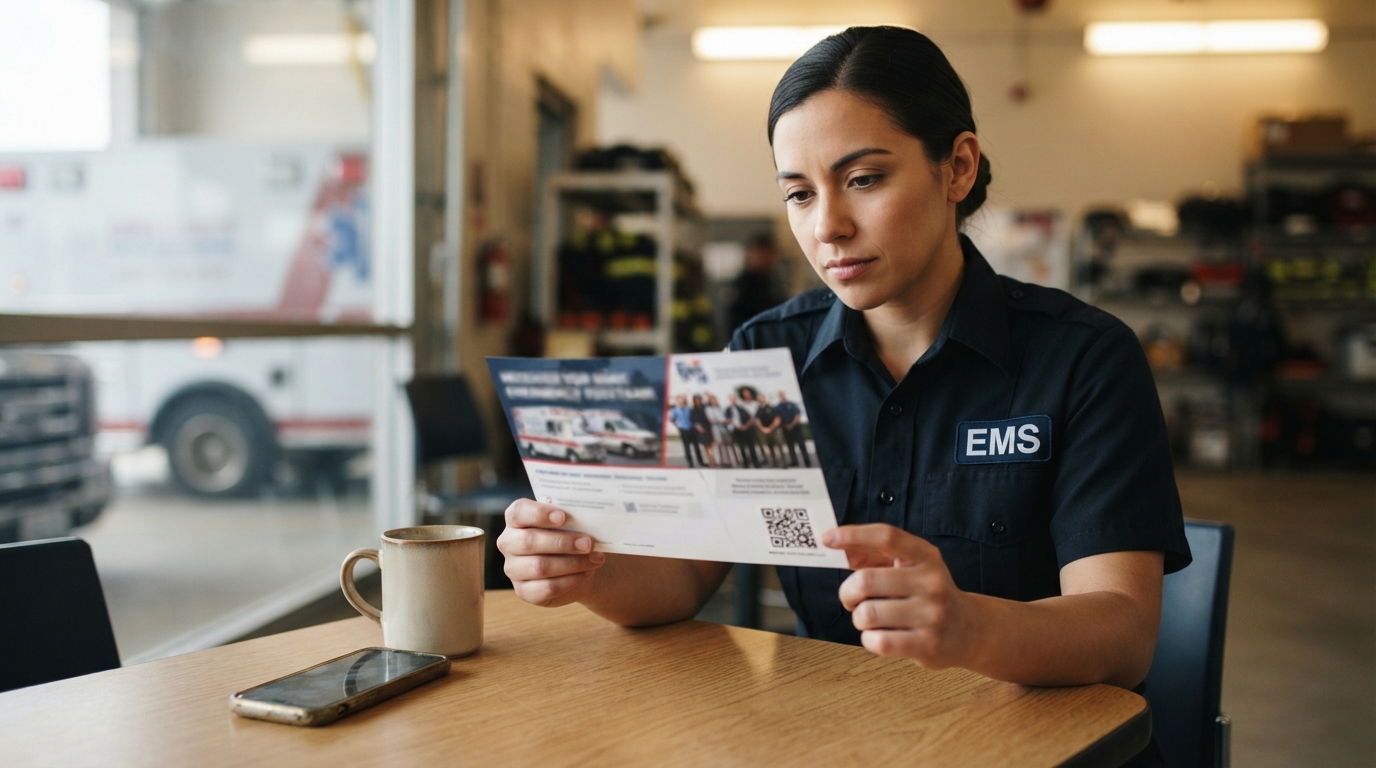
A recruitment card should be easy to understand in a few seconds. RecruitCard builds its cards around four components: a personalized name, a specialty-specific message, credible employer branding, and one clear action.
Personalized recipient name
Using the recipient's actual first name makes the piece more relevant than a generic greeting such as “Dear nurse.” Personalization does not change the role requirements. It helps signal that the message was created for a defined professional audience rather than sent as a general hiring notice.
Specialty-specific message
The copy should identify the telemetry opportunity, not describe an undifferentiated RN opening. A nurse should be able to see the unit or specialty, location, and key reason to explore the role without searching for basic details.
Credible employer branding
Your hospital or health-system brand should be clear on the card. The creative should use approved employer-brand elements and describe the opportunity in a way that supports trust. Final messaging should reflect the actual role requirements and details your organization can substantiate.
One clear action
A QR code and short URL should lead to the same intended next step. Avoid filling the card with competing actions. A recipient should know whether you want them to learn more, register for an event, express interest, or begin an application.
In practical terms, a concise card often includes:
- The telemetry role or broader nursing opportunity.
- The unit or specialty context.
- The facility or location.
- One approved reason to consider the opportunity.
- A QR code and short URL with a clear instruction.
What to Say to Telemetry Nurses Who Are Already Employed
Lead with the specific opportunity. “We are hiring” is rarely enough context for a nurse who was not planning to change jobs today. The message should quickly answer why this role may be worth a closer look.
Depending on what your organization has approved, that may include the unit fit, shift, location, schedule, professional development path, patient population, or broader employment experience. Only state details that your employer can support.
A low-friction invitation is often more appropriate than assuming the recipient is ready to apply immediately. For example, the call to action might invite them to explore a telemetry role, view unit details, or learn about an upcoming nursing event.
Avoid unsupported promises about compensation, flexibility, culture, advancement, or hiring speed. The card has one job: give a relevant telemetry nurse a clear reason to scan or visit the landing page now.
Where the QR Code and Landing Page Fit
The QR code is the bridge between a physical card and a digital response experience. It gives recipients a simple way to act when they are ready. The short URL provides an alternative for someone who prefers not to scan.
Use a landing page built for the campaign
Whenever possible, send recipients to a landing page dedicated to the telemetry opportunity rather than a crowded general careers page. The page should carry the same message and branding as the card, so the recipient can confirm they reached the right destination.
Useful landing-page elements include:
- A concise role summary.
- The telemetry unit, facility, and location.
- Essential requirements.
- Approved employer-brand information.
- A clear contact, interest, event-registration, or application path.
- One clear next step.
Consistency matters. If the card highlights a telemetry night-shift opportunity at a particular facility, the landing page should not force the recipient to navigate through unrelated openings before they can learn more.
How to Measure a Telemetry Nurse Direct-Mail Campaign
Direct-mail recruiting does not have to be unmeasured. RecruitCard uses QR scans and landing-page traffic to show engagement generated by a campaign.
These are engagement measures, not guarantees about hiring outcomes. A scan or landing-page visit shows that a recipient reached the campaign's digital response path. It does not, by itself, establish a response rate, cost per hire, or return on investment.
Set up tracking before the mail is delivered
Define the tracking setup before the campaign is mailed. That lets your team review scans and visits against the appropriate role, market, message, or rollout. If you are promoting more than one location or creative variation, the tracking approach should make those distinctions clear.
After the campaign begins, your team can review practical questions such as:
- Are recipients scanning the QR code?
- Are they reaching the intended landing page?
- Are different locations producing different levels of landing-page interest?
- Does one message generate more engagement than another?
This information can help you assess campaign engagement and compare interest across messages or locations.
When Direct Mail Is a Good Fit for a Telemetry Nurse Role
Targeted direct mail is most useful when there is a defined opportunity and a clear reason to reach beyond active job-search channels.
- A specific telemetry requisition has remained open and normal recruiting channels are not producing enough qualified attention.
- The local qualified pool is limited, and many potential candidates are likely already employed.
- The role has a clear specialty, unit, shift, and geography that can guide audience and message development.
- You are hiring telemetry nurses continuously and want to build longer-term awareness for future openings.
- You are promoting a nursing hiring event, open house, or broader opportunity that includes telemetry roles.
When the campaign needs more preparation
Direct mail is less useful when the role is unclear, the message is vague, or there is no agreed response path after a recipient scans. Before mailing, make sure the role details are accurate, the landing page is ready, and the recruiting team knows how it will handle interest generated by the campaign.
What RecruitCard Handles in an End-to-End Campaign
RecruitCard manages the campaign rather than providing a mailing-list-only handoff. For telemetry nurse recruiting, the work includes:
- Audience targeting by license type, nursing specialty, and geography.
- Card strategy and design using your employer brand, the recipient's first name, specialty-specific copy, and one clear call to action.
- Printing, postage, and delivery.
- QR-code and landing-page response tracking.
- Support for a single-market campaign, multiple locations, or a broader nationwide rollout.
RecruitCard's deepest stated expertise is licensed healthcare hiring. The approach is intended for roles that may not close through standard channels alone, including specialty, night-shift, and location-specific nursing needs.
Questions to Ask Before Launching
Use these questions to align your HR, recruiting, hiring, and marketing stakeholders before campaign development begins:
- Which telemetry role, unit, shift, and location are we promoting?
- Which license and specialty criteria should define the audience?
- Is this for one requisition, several locations, a hiring event, or an ongoing pipeline?
- Which employer-brand elements and role details should appear on the card?
- What is the one action recipients should take after receiving it?
- Where will the QR code and short URL send candidates?
- How will the team review QR scans and landing-page traffic?
- Which role details and claims have been approved by HR, recruiting, and the hiring team?
Add a Targeted Channel to Your Telemetry Nurse Recruiting Plan
Targeted direct mail can extend telemetry nurse recruiting beyond active job-search channels by combining precise audience matching, personalized creative, and a measurable digital response path. It is strongest when your team has a defined telemetry need, a clear specialty and geography, a relevant message, and one next step for recipients.
If you are evaluating a campaign for a hard-to-fill telemetry role, a multi-location nursing need, or an ongoing pipeline, Schedule a consultation about a telemetry nurse direct-mail campaign.
Enjoyed this? There's more from RecruitCard.
Book a 15-minute call →