What Candidate Bench Strength Means in Healthcare Hiring

Candidate bench strength in healthcare hiring means having a qualified, engaged pool of potential candidates ready for current or future roles, rather than starting from zero when a vacancy opens. It is most useful for hospital and health-system HR and talent-acquisition teams, along with healthcare employers hiring licensed professionals for hard-to-fill or high-turnover roles.
What Candidate Bench Strength Means in Healthcare Hiring
Candidate bench strength is the depth and readiness of your potential candidate pipeline for a defined role, specialty, location, and shift. It is not simply the number of names your organization has collected.
A useful bench includes people who may be qualified for the opportunity, relevant to the role, aware of your employer, and reachable when an opening or program becomes timely. For a healthcare employer, the bench may be organized around an RN specialty, a therapy discipline, a care setting, or a recurring frontline need.
For example, a hospital might build awareness among RNs who could be interested in ICU, ED, or night-shift opportunities in a defined geographic area. The immediate goal may be to support an open role. The longer-term goal is to avoid beginning every future search with no established audience or awareness.
Strong bench strength can support several hiring needs:
- Immediate outreach for a difficult requisition.
- Recurring hiring for roles that reopen often.
- Workforce planning for anticipated growth or new services.
- Awareness for a hiring event, new facility, apprenticeship, or training program.
Why Healthcare Employers Need a Stronger Candidate Bench
Licensed healthcare vacancies can remain open when the qualified local pool is small, the role requires a particular specialty, or many suitable professionals are already employed. That is common with roles such as ICU and OR nursing, rural physical therapy, respiratory therapy, pharmacy, behavioral health, and night-shift coverage.
When your recruiting plan relies only on active applicants, you are working from a narrower pipeline. Job boards and paid search are built primarily to reach people who are already looking or actively responding to recruiting messages. Many of the professionals you would most like to speak with may not be searching at that moment.
This matters for ongoing needs, not only specialty requisitions. Long-term care and home care employers may need a continuing flow of CNA, HHA, or caregiver interest. Hospitals and clinics may repeatedly hire nurses, allied-health professionals, and support staff. A candidate bench gives your team a way to create awareness before the next urgent opening appears.
Bench-building also supports opportunities that candidates may not know to search for, including a new facility, a planned expansion, a hiring event, an open house, an apprenticeship, or a training program.
What Strong Candidate Bench Strength Looks Like
A strong candidate bench is not one undifferentiated audience. It is built around four practical dimensions: role fit, geographic fit, timing, and engagement.
Role fit
Role fit means the audience aligns with the credential and work itself. For licensed healthcare hiring, that can mean matching by license type and specialty rather than relying on broad demographics alone. Depending on the need, the relevant definition might include RN, LPN, physical therapist, dental hygienist, pharmacist, respiratory therapist, counselor, or another licensed or certified profession.
Specificity matters. “RN” is a broad category; an ICU night-shift opening is a more defined hiring need. The clearer the role definition, the more relevant the outreach can be.
Geographic fit
Geographic fit means connecting the opportunity to the target location or market. A local role needs local awareness, while a broader hiring plan may involve multiple locations or a nationwide rollout. Your message can also introduce an opportunity to people who may consider relocation for the right role, location, or employer.
Timing
Not every qualified person will be ready to move today. A potential candidate may be settled in a current role but become open to a conversation when a schedule changes, a new facility opens, or a specialty opportunity becomes available. Bench strength accounts for that timing reality.
Engagement
Engagement means people recognize the employer and have a simple way to take the next step. That step could be viewing a role, registering for an event, learning about an apprenticeship, or joining a talent community. A clear action is more useful than asking a recipient to navigate a broad careers site without context.
How to Build Candidate Bench Strength for Licensed Healthcare Roles
Start with a defined hiring need. The starting point might be ICU nights, OR nurses, rural physical therapists, dental hygienists, pharmacists, or respiratory therapists. A precise need helps you define both the audience and the message.
Define the audience with precision
Build the audience around license type, specialty, and geography. This is different from a generic mailing-list handoff. The intent is to create a relevant audience for a particular hiring need, not to send a broad message to an undefined population.
Choose a reason to consider the opportunity
Decide what may make the opportunity worth a recipient’s attention. The message may focus on a specialty, a shift, a location, a facility, an employer brand, a hiring event, or a future opportunity. For example, the reason to explore an ICU night-shift opening may be different from the reason to learn about a new apprenticeship program.
Reach people beyond active-search channels
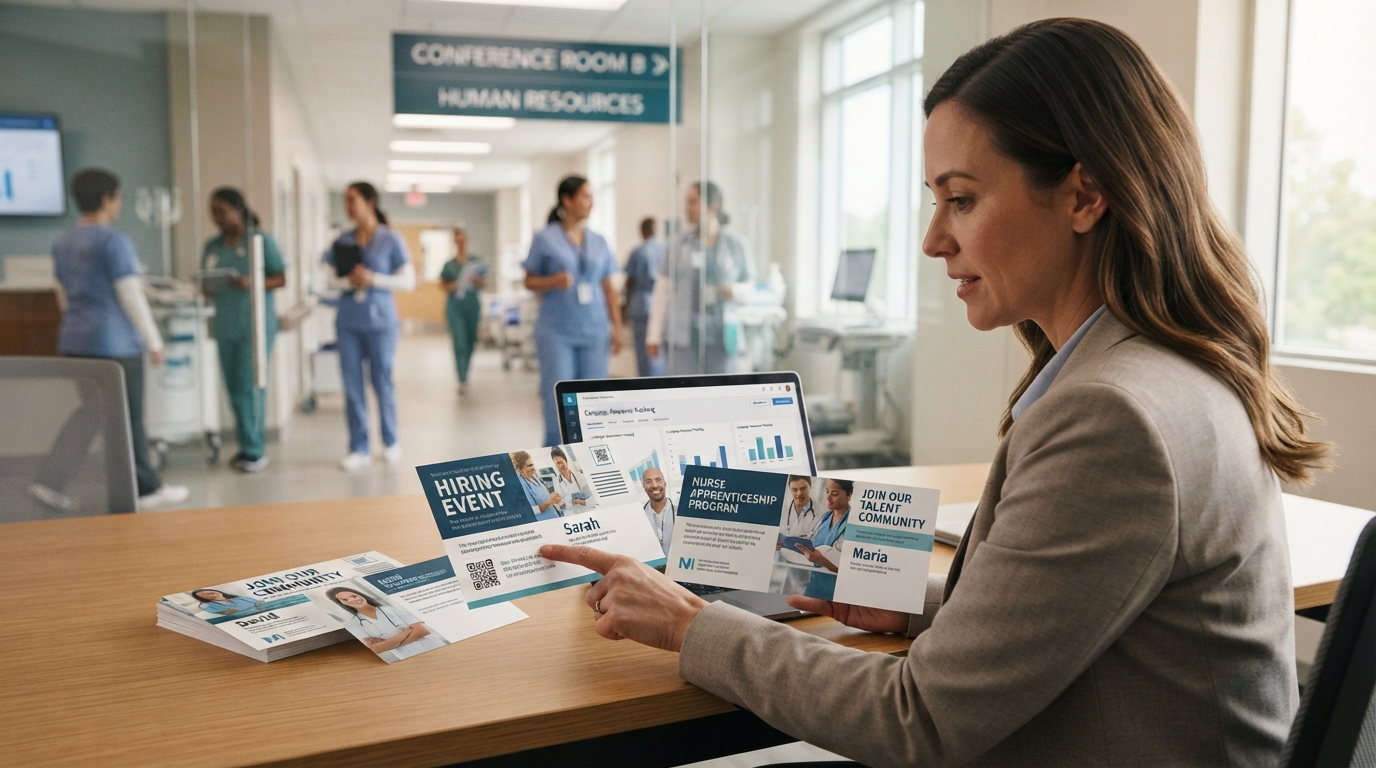
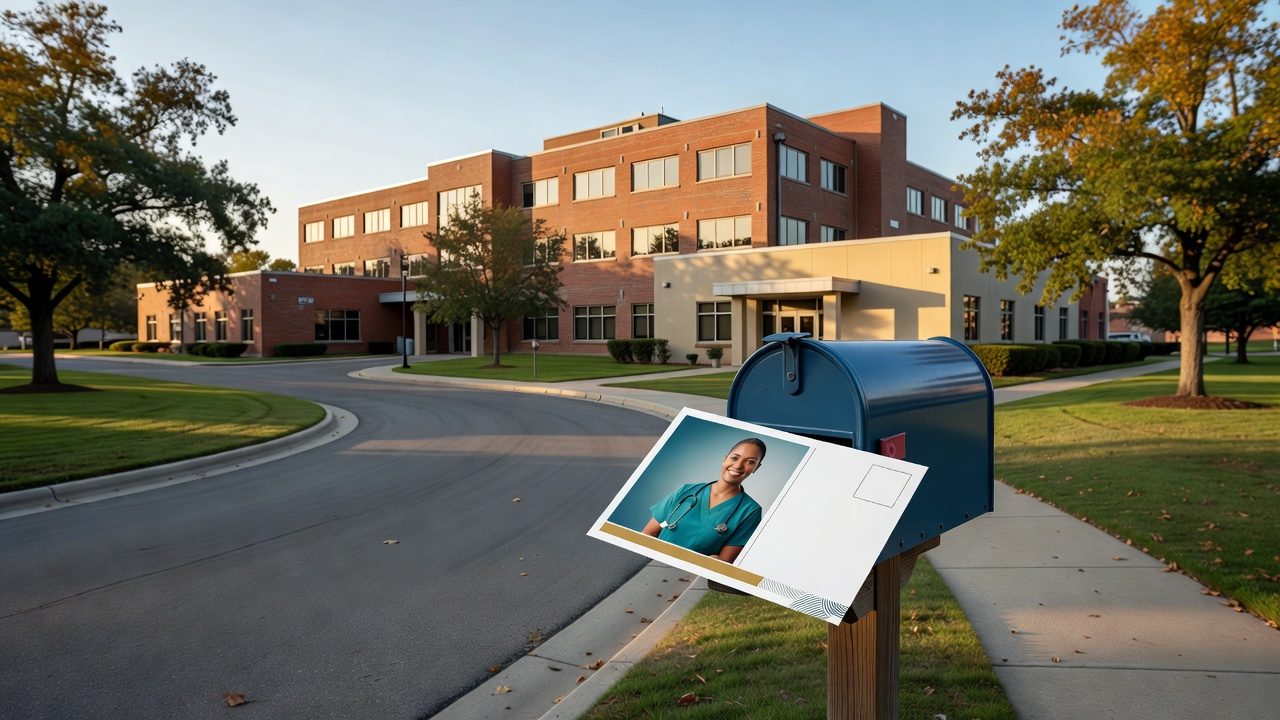
A personalized direct-mail card can introduce the role to passive candidates who may not encounter it through job boards or paid search. Mail does not replace your careers site, job postings, recruiter outreach, or digital recruiting. It adds another path for a qualified audience to become aware of an opportunity.
Keep the card focused
A focused recruiting card has four core elements:
- The recipient’s actual first name.
- A specialty-specific message.
- Credible employer branding.
- One clear action, supported by a QR code and short URL.
The landing page should continue the same message and make the next step easy to understand. It should not force a candidate to guess which role, event, or program the card was promoting.
Using Direct Mail to Reach Passive Healthcare Candidates
Direct mail can complement digital recruiting by reaching professionals at home, including people who are not currently searching job boards or clicking paid search ads. It is another channel for awareness and response, not a replacement for every other recruiting channel.
Direct mail recruiting is also not the same as buying a generic list. RecruitCard campaigns are built around matching by license type, specialty, trade or certification, and geography. That precision helps the employer present a more relevant opportunity and avoid treating candidate outreach as a mass mailing exercise.
A physical card can make sense when a role is difficult to close through normal channels, including a night-shift position, rural site, or niche specialty. It can also promote an event or program that candidates may not be actively searching for.
Examples of focused messages include:
- An ICU-specific message for nurses who may consider a defined unit and shift.
- A rural-site message that introduces the location and the reason to explore it.
- A specialty message for an allied-health or behavioral-health opportunity.
- An invitation to a hiring event or open house.
- An awareness message for an apprenticeship or training program.
Mail creates an additional path to awareness. It does not mean every recipient is ready to apply, and it should be planned with an appropriate next step for people at different stages of interest.
How to Measure Candidate Bench Strength and Campaign Response
Candidate-bench building should be measured differently from a campaign intended only to generate immediate applications. A pipeline effort may be designed to create recognition and future interest before a requisition becomes urgent.
QR scans and landing-page traffic show whether recipients engaged with the mail piece and visited the campaign destination. The landing page can organize the appropriate next action, such as:
- Viewing a current role.
- Registering for a hiring event.
- Learning about an apprenticeship or training program.
- Joining a talent community or requesting more information.
You can pair this campaign response data with your internal recruiting measures, including inquiries, applications, screening activity, interviews, and hires, when those steps can be connected through your process. The appropriate measure depends on the campaign’s purpose. An event-awareness campaign and an urgent single-role campaign should not necessarily be judged by the same immediate outcome.
No channel can promise a specific response rate, cost per hire, return on investment, or hiring result. Measurement provides a clearer view of engagement and helps your team evaluate how the campaign fits into the broader recruiting process.
When to Build a Candidate Bench
The best time to build a bench is often before a vacancy becomes urgent. Starting earlier gives your organization time to establish awareness among a relevant audience rather than relying only on an immediate applicant flow.
- Before a predictable hiring cycle, expansion, or planned growth.
- For high-volume or high-turnover local roles that repeatedly reopen.
- When a specific requisition has remained open and normal channels are not closing it.
- Before a hiring event, open house, apprenticeship launch, or new-facility announcement.
- As an ongoing pipeline effort for specialties with a limited qualified local pool.
- For a single market, multiple locations, or a nationwide hiring plan.
For some organizations, one defined role is the right starting point. For others, the need is a recurring specialty pipeline. In both cases, the audience, message, and candidate action should be clear before outreach begins.
What a Managed Candidate-Bench Campaign Includes
A managed RecruitCard campaign covers the work needed to put a focused recruiting mail piece in front of a defined audience and measure engagement afterward. That includes audience targeting, creative development, personalization, printing, postage, delivery, and response tracking.
RecruitCard provides more than a list handoff. The campaign includes the physical card and the path a recipient follows after delivery. The card can reflect your employer brand, including your logo, tone, role details, and one clear call to action.
Campaigns can support a single market, multiple locations, or a nationwide rollout. The right approach depends on the roles you need to support, the relevant specialty, the target geography, and what you want candidates to do next.
If you are evaluating a candidate-bench effort for a specific healthcare hiring need, Book a 15-minute call.
How Agencies Can Add Candidate Bench-Building Direct Mail
Recruitment marketing agencies can offer direct mail as a white-label service without building an in-house print, postage, delivery, and QR-tracking operation. This gives agencies a way to add a physical outreach channel to a client’s recruitment marketing plan.
The model can be aligned to a specific requisition, recurring hiring program, hiring event, or longer-term pipeline initiative. Audience targeting and creative can be built around the agency client’s employer brand, role or specialty, geography, and candidate action.
For an agency, the practical question is the same as it is for an employer: who should receive the message, why might the opportunity matter to them, and what should they do next?
How to Decide Whether Your Organization Needs More Bench Strength
Your organization may need a stronger bench when normal recruiting activity is not producing enough relevant conversations for an important role. This is especially likely when the qualified audience is small, specialized, already employed, or difficult to reach through active-search channels.
Consider these questions:
- Has the role remained open despite normal recruiting activity?
- Is the qualified local audience limited or highly specialized?
- Do you hire this role repeatedly, or expect future demand?
- Are many of the people you want to reach already employed and not actively searching?
- Are you promoting something candidates may not know to search for, such as a new facility, apprenticeship, or hiring event?
The best starting point is a defined role, specialty, geography, and candidate action. From there, you can decide whether a focused campaign should support an immediate opening, a recurring need, or a longer-term pipeline.
FAQ: Candidate Bench Strength in Healthcare Hiring
Is candidate bench strength the same as having a resume database?
No. A resume database may contain many contacts, while bench strength is about having a relevant, reachable, and potentially engaged pool for defined roles, specialties, and locations.
Can bench strength help with one hard-to-fill requisition?
Yes. It can support a specific role such as an ICU night-shift position, a rural therapy role, or a niche allied-health opening. The same audience-building approach can also support future hiring needs.
How can we reach passive licensed healthcare candidates?
Use outreach that does not depend solely on active job searching. A personalized direct-mail card can present a specialty-specific opportunity to a targeted audience and direct interested recipients to a landing page.
How do we know whether a candidate-bench campaign is working?
QR scans and landing-page traffic show whether recipients engaged with the campaign. You can then connect those actions with inquiries, applications, event registrations, or other steps tracked in your recruiting process.
Can candidate bench strength support hiring events or apprenticeships?
Yes. Bench-building campaigns can promote hiring events, open houses, apprenticeship awareness, training programs, and future opportunities, not only individual job postings.
Enjoyed this? There's more from RecruitCard.
Book a 15-minute call →