Can a Single Mailing Support Both Immediate Vacancies and Future Pipeline Needs

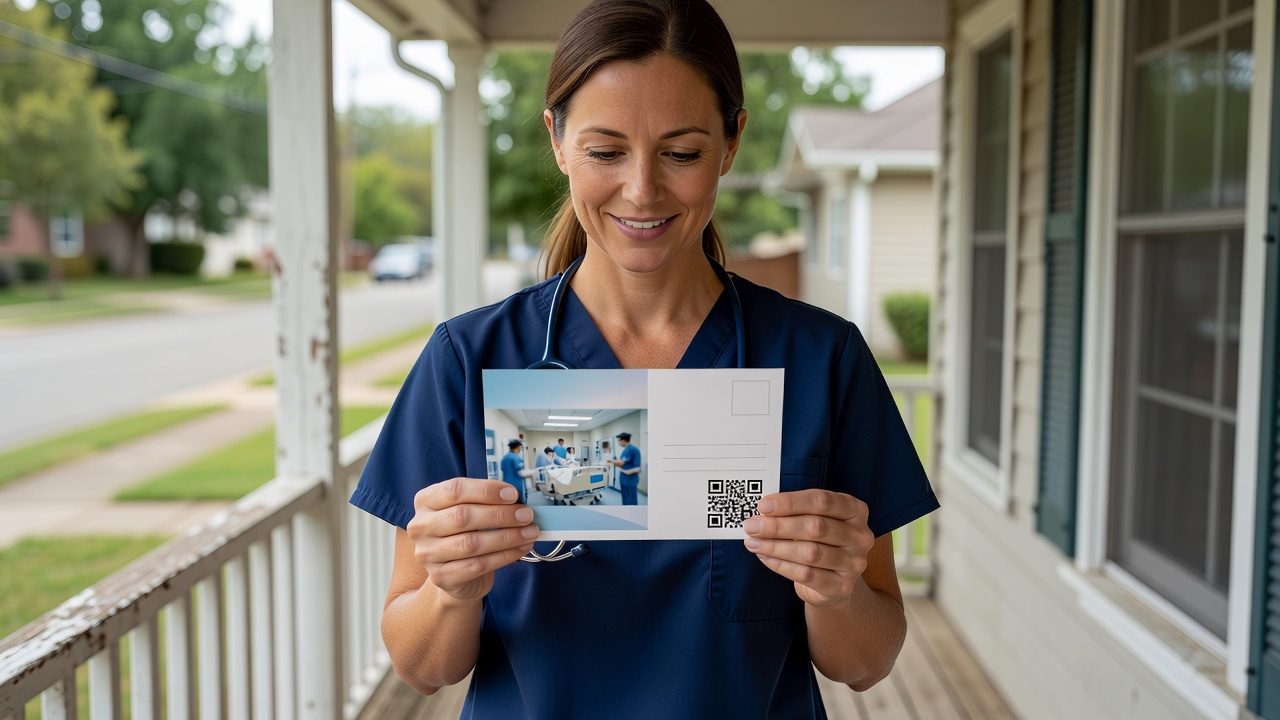
Yes. A single targeted direct mail campaign can support an open requisition today and build awareness among licensed professionals who may be ready to move later. The key is a card and landing page that work for both groups, so you do not split the list or redesign the piece.
This article is for hospital, health system, and other licensed-healthcare hiring teams with a hard-to-fill role open now and a likely need for the same specialty again.
- Short answer: One mailing to one precisely targeted audience can serve both an immediate vacancy and a future pipeline.
- Card: Keep the call to action open enough that ready candidates and not-yet-ready candidates both have a reason to scan.
- Landing page: Give active candidates a clear path to apply and give everyone else a way to learn about you or stay in touch.
- Measurement: Read QR scans and landing-page activity over time, not only in the first stretch after delivery.
Why does one audience work for two time horizons?
It works because the licensed professionals you need today are the same finite pool you will need when the next vacancy opens. If you target by license type, specialty, and geography, the people who are not looking today are still your future applicants.
The pool does not change when the timeline does
In a niche specialty or a smaller market, the qualified local pool is limited and mostly employed. Many of those people are not browsing job boards or clicking paid search ads, because those channels mainly reach people who are actively looking. A card that arrives at home reaches them anyway.
An impression counts even without a response
A personalized postcard with your employer brand creates an impression whether or not the recipient responds right away. It is reasonable to expect that a candidate who has seen your name is better placed to recall it when they are ready for a change. That is a judgment about how recognition works, not a measured result.
Separate campaigns usually cost you more
Running one campaign for "hiring now" and another for "future pipeline" means mailing heavily overlapping people twice, with two creative efforts and a weaker cumulative message. One mailing to a precisely targeted audience serves the urgent need and the longer strategy without that duplication.
How do you design the card for a dual purpose?
Make the call to action outcome-neutral, so it invites both immediate applicants and people who are only curious. The card still follows the same four parts: the recipient's first name, a specialty-specific message, credible employer branding, and one clear action.
Write an invitation, not a deadline
Compare two approaches. "We're hiring now for the ICU" speaks only to someone ready to move this month. "Join our ICU community. Explore careers and growth opportunities with us" speaks to that person and to the nurse who is content today but open to hearing more.
The card does not need to say "immediate" or "now hiring." It needs to present your specialty and your opportunity as credible and appealing.
Keep one action
Dual purpose does not mean multiple asks on the card. Keep a single QR code and short URL. The branching happens on the landing page, after the candidate has chosen to engage.
Keep the brand consistent from card to screen
Use the same employer name, tone, and visual identity on the card and the destination. Consistency reinforces recognition, whether someone applies today or remembers you months from now.
How does your landing page capture both groups?
A well-structured landing page gives active candidates a direct route to the current opening and gives exploratory candidates something useful to do instead of leaving. The page is where one card becomes two paths.
Offer clear entry points
- For active candidates: the current job description and a simple way to apply.
- For exploratory candidates: information on your unit culture, team, benefits, and what growth looks like in the specialty.
- For interested but not ready candidates: an option to hear about future openings in this specialty or to join a talent community.
An email signup turns pipeline interest into contact data without asking for an application. Decide with your team what you can follow up on, since a signup list only helps if someone uses it.
Treat the page as part of your brand
Passive candidates are often more willing to read about life at your facility than to work through a standard job description. The destination should read as an extension of your employer brand, not only as a posting.
What tracking shows
QR code tracking reports scans, and landing-page traffic shows what people did next. Candidates who explore but do not apply today are still visible as engaged, which matters when the goal includes the pipeline.
How should you size the audience for two objectives?
Size it by who qualifies, not by who is ready. Targeting by license type, specialty, and geography identifies the qualified candidates in your market, so you are not choosing between a hiring-now list and a pipeline list. You are reaching everyone who fits.
A broader scope brings in more passive candidates
A larger, well-defined geographic area or specialty scope will include more people who are not actively looking alongside those who are. For pipeline building, that works in your favor. For a role where candidates might relocate, a wider geography also gives you more reach. RecruitCard handles both single-market and nationwide campaigns.
Let the response data guide the next step
Response tracking shows how many people engage right away and how many browse without applying. That information can shape the timing and size of your next campaign.
Plan for a second mailing
One mailing builds awareness. A follow-up to the same audience later reinforces your brand among people who saw the first card, especially if roles are still open or new ones have appeared.
When does a single mailing make sense?
It makes sense when you have an opening now and reasonable expectation of more hiring in the same specialty or unit later. It is a poor fit if you have no continuing need and only want the one role filled quickly.
- You expect repeat hiring. You have one or more openings now and anticipate turnover or new roles in the same specialty in the coming months.
- The pool is small. Your specialty is niche or geographically limited, so reaching the same people once serves several hiring cycles.
- Your brand is your advantage. Your unit culture and employer story are strengths, and passive candidates need to know who you are before they are ready to move.
- You will use the follow-up. You are willing to let the landing page and your follow-up process, not only the card, carry the pipeline work.
How do you measure success across both horizons?
Measure immediate results and pipeline value separately, because they show up on different schedules and in different signals.
Immediate signals
Early results include QR scans, landing-page visits, and applications from candidates who are clearly job hunting. These tell you whether the card reached people who were ready.
Pipeline signals
Pipeline value looks different. Watch engagement on the landing page, email signups, return visits to your careers page, and whether the same people reappear when you mail again or post a future role.
Keep watching after the first weeks
Do not discard QR and landing-page data after the initial burst. Keep monitoring over the following weeks to see delayed response alongside the immediate kind. Your tracking shows who acted right away and who explored, which helps you decide how to nurture the second group.
Plan a campaign that covers both
Plan a campaign with RecruitCard. If you have a hard-to-fill role open and expect to hire in the same specialty again, we can walk through the audience, the card, and the landing page path with you. Book a 15-minute call.
Frequently asked questions
Do I need two different cards for an immediate opening and a pipeline?
No. One card with an open, credible invitation can serve both. The landing page is where active and exploratory candidates take different paths.
Is direct mail recruiting measurable if people do not apply right away?
Yes. QR scans and landing-page traffic show who engaged, including people who looked around but did not apply. That engagement is useful pipeline information.
Is this the same as buying a generic mailing list?
No. The audience is built by license type, specialty, and geography, not by a broad demographic or a purchased general list.
Can one campaign cover several locations?
Yes. RecruitCard supports single-market campaigns and nationwide rollouts, so you can define the geography around where your roles and likely candidates are.
Do you handle the design and printing?
Yes. The campaign is managed end to end: targeting, card design with your employer brand and the recipient's first name, printing, postage, delivery, and QR code and landing-page response tracking.
Sources
Enjoyed this? There's more from RecruitCard.
Book a 15-minute call →