From License Match to Human Attention

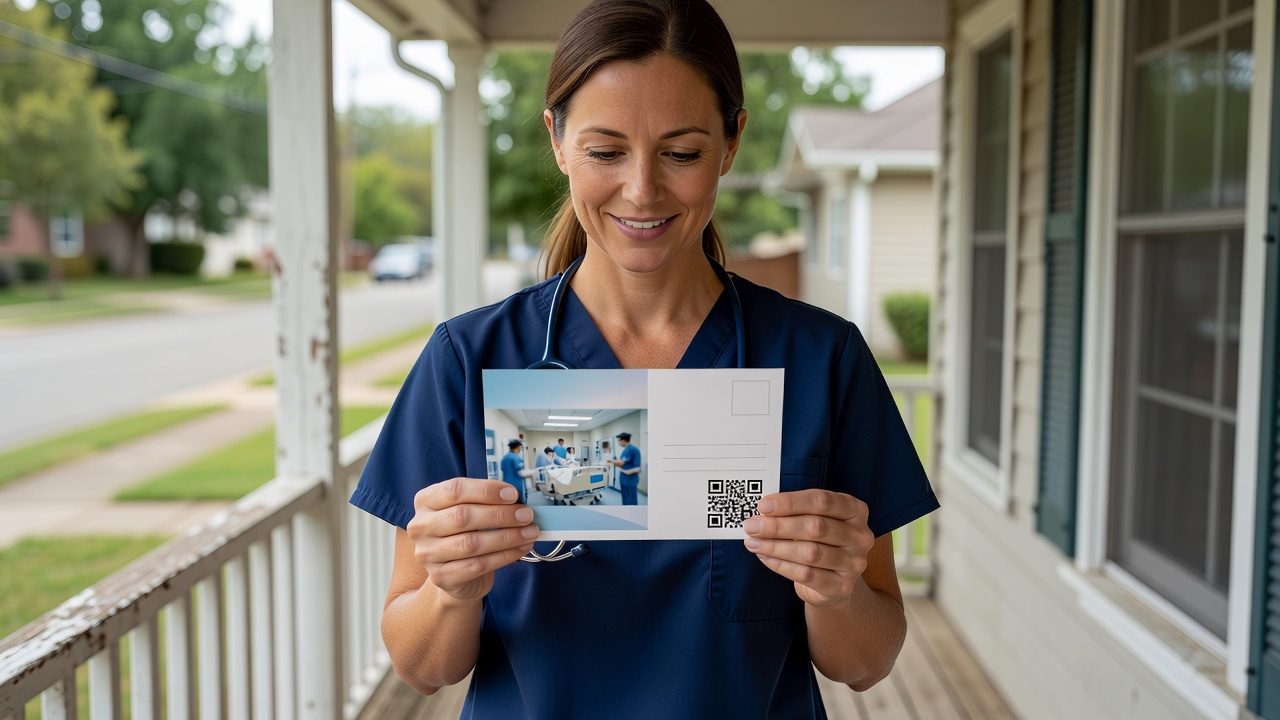
For hospital and health system hiring teams trying to reach licensed professionals for hard-to-fill roles, a license match is only the starting point. RecruitCard connects precise audience targeting with four card components: the recipient’s first name, a specialty-specific message, credible employer branding, and one clear action through a QR code and short URL.
Why a License Match Is Only the First Step
Hiring for ICU, ED, OR, L&D, oncology, case management, and night-shift roles often means trying to reach professionals who are already employed and not actively searching job boards. Matching an audience by license type, specialty, and geography helps identify people who may be relevant to the opportunity. It does not, by itself, give them a reason to stop, read, and respond.
Audience precision is who receives the card. Message relevance is why that recipient should care about what is on it. A nurse may hold the right license and live within the intended geography, yet still overlook a card that simply says, “We are hiring nurses.”
Direct mail recruiting is not the same as sending a broad demographic mailing or handing over a generic purchased list. The audience is built through license, specialty, and geography matching, then connected to creative that speaks to a specific professional opportunity.
Component One: Personalize the Recipient’s First Name
Using the recipient’s actual first name helps the card feel addressed to a professional rather than sent to an anonymous list. It is a simple way to make the first moment of attention more personal.
Personalization is not a substitute for explaining the role. It should support a useful message about the opportunity, shift, specialty, or location.
A practical comparison
A generic headline might read: Experienced nurses wanted.
A more focused card might read: Maria, explore an ICU night-shift nursing opportunity in your area.
The second example does not assume Maria is looking for a job. It gives her immediate context about why the card may be relevant. The rest of the card still needs to explain the employer, the opportunity, and the next step.
Component Two: Lead With the Specialty and Role
A specialty-specific message is more useful than a broad statement such as “hiring nurses” or “hiring healthcare professionals.” The recipient should be able to recognize the role focus quickly.
The most relevant detail depends on the hiring need. It may be a unit, shift, location, career path, or program.
- ICU night shift: Lead with the ICU setting and night-shift need rather than a general RN message.
- OR opening: Make the perioperative or operating-room context clear.
- Rural physical therapy role: Explain the practice setting and location context plainly.
- High-volume caregiver hiring: Focus on the local need and the type of caregiving opportunity.
This approach can support more than an individual requisition. A focused card can also build awareness for a hiring event, open house, apprenticeship, training program, or longer-term candidate pipeline.
Component Three: Make the Employer Brand Credible
The employer brand gives a recipient a reason to consider the message. It also helps distinguish the card from an unexplained solicitation. A licensed professional should be able to see who is reaching out and understand the setting behind the opportunity.
Before creative work begins, plan the essentials:
- The employer name and visual identity.
- The relevant facility, practice, system, or program context.
- A concise, truthful reason the role may be worth exploring.
- Any details that help explain the opportunity, such as the unit, shift, location, or training path.
Credible branding does not require exaggerated claims. A clear employer identity and a plainly stated opportunity are often more useful than vague recruiting language. RecruitCard can incorporate your employer branding as part of its managed creative process.
Component Four: Give the Recipient One Clear Action
A card should lead to one primary action. Asking a recipient to search a careers page, call a general line, and remember a job title creates unnecessary friction.
RecruitCard uses a QR code and short URL as the bridge between the physical card and a campaign landing page. The landing page can present the opportunity, provide relevant details, and offer a direct path to respond or learn more.
QR scans and landing-page traffic provide measurable signals of campaign activity. They show how recipients interact with the campaign. They are not a guarantee of hires or a complete measure of every hiring outcome.
If you are assessing whether this approach fits a difficult healthcare requisition, Book a 15-minute call.
How the Four Components Work Together
The four components follow a practical sequence:
- The audience match establishes potential relevance.
- The recipient’s first name helps earn attention.
- The specialty and role message creates context.
- The employer brand builds credibility.
- One clear action reduces friction.
Removing any component can weaken the card. Precise targeting paired with a generic message may still feel irrelevant. Strong creative sent to the wrong audience wastes the opportunity. A credible message without a clear next step can leave interest unconverted into a measurable action.
RecruitCard manages this as an end-to-end campaign, including targeting, design, printing, postage, delivery, and response tracking. Campaigns can be planned for a single U.S. market or a nationwide rollout.
Where This Approach Fits Best
This model is often a strong fit when your normal channels are not closing a specific hiring need. Common situations include:
- A specialty requisition that has remained open.
- A small local pool of licensed professionals who are likely already employed.
- Continuous hiring for high-turnover local roles, such as CNAs, HHAs, or caregivers.
- A hiring event, open house, apprenticeship, or training program that needs awareness.
- A long-term pipeline effort before the next vacancy opens.
Passive candidates may not see or act on job boards or paid search because they are not actively looking. A job posting may never enter their consideration set. A targeted physical card can introduce a relevant opportunity at home, outside the crowded environment of active job searching.
This is particularly relevant for night shifts, rural locations, niche specialties, and roles that will not close through normal channels. RecruitCard’s deepest expertise is licensed healthcare hiring. The same model can also support engineering and skilled-trade employers seeking licensed or certified candidates.
What RecruitCard Manages Beyond the Card
RecruitCard is not a mailing-list handoff. The managed service connects audience strategy, creative execution, physical delivery, and measurement.
- Define the audience through license, specialty, and geography matching.
- Develop a personalized card with your employer brand and one clear action.
- Coordinate printing, postage, and delivery.
- Track QR scans and landing-page traffic after delivery.
Recruitment marketing agencies can also ask about a white-label model for offering direct mail without building an in-house print, postage, and tracking operation.
How to Plan the Brief Before Creative Work Begins
A clear brief helps turn a difficult requisition or awareness goal into a focused campaign. Start by defining:
- The target license, certification, or trade.
- The specialty, unit, or role focus.
- The intended geography.
- The specific role, hiring event, apprenticeship, training program, or pipeline objective.
- Your employer brand requirements.
- One desired recipient action.
Next, identify what makes the opportunity relevant to the intended audience. This could be the shift, unit, location, practice setting, career path, or event details. Those facts provide the substance for the specialty-specific message.
The landing page should match the card’s message. If the card speaks to an OR opening, the landing page should continue that conversation rather than send the recipient into a general career-site search.
Finally, decide who will review QR scans and landing-page traffic after delivery. Measurement works best when your team has a plan to review campaign activity and follow up on the response path.
FAQ
Is this just a generic mailing list with a healthcare label?
No. The audience is matched by license type, specialty, and geography, then connected to a personalized card and focused message. The goal is precision rather than a broad demographic mailing.
Can the card target an ICU or OR audience instead of all RNs?
Yes. A campaign can be planned around a specific specialty, trade, or role focus, along with the relevant geography and employer message.
How is campaign activity measured?
The card can use a QR code and short URL that lead to a campaign landing page. QR scans and landing-page traffic show how recipients interact with the campaign.
Can this support a hiring event or apprenticeship program?
Yes. The same four components can promote a hiring event, open house, apprenticeship, training opportunity, or longer-term candidate pipeline. The model is not limited to one open requisition.
Does RecruitCard handle design and mailing?
Yes. The managed service includes audience targeting, card design, printing, postage, delivery, and response tracking. Agencies can also ask about a white-label model.
Enjoyed this? There's more from RecruitCard.
Book a 15-minute call →