How First-Name Personalization Changes a Recruiting Postcard Experience

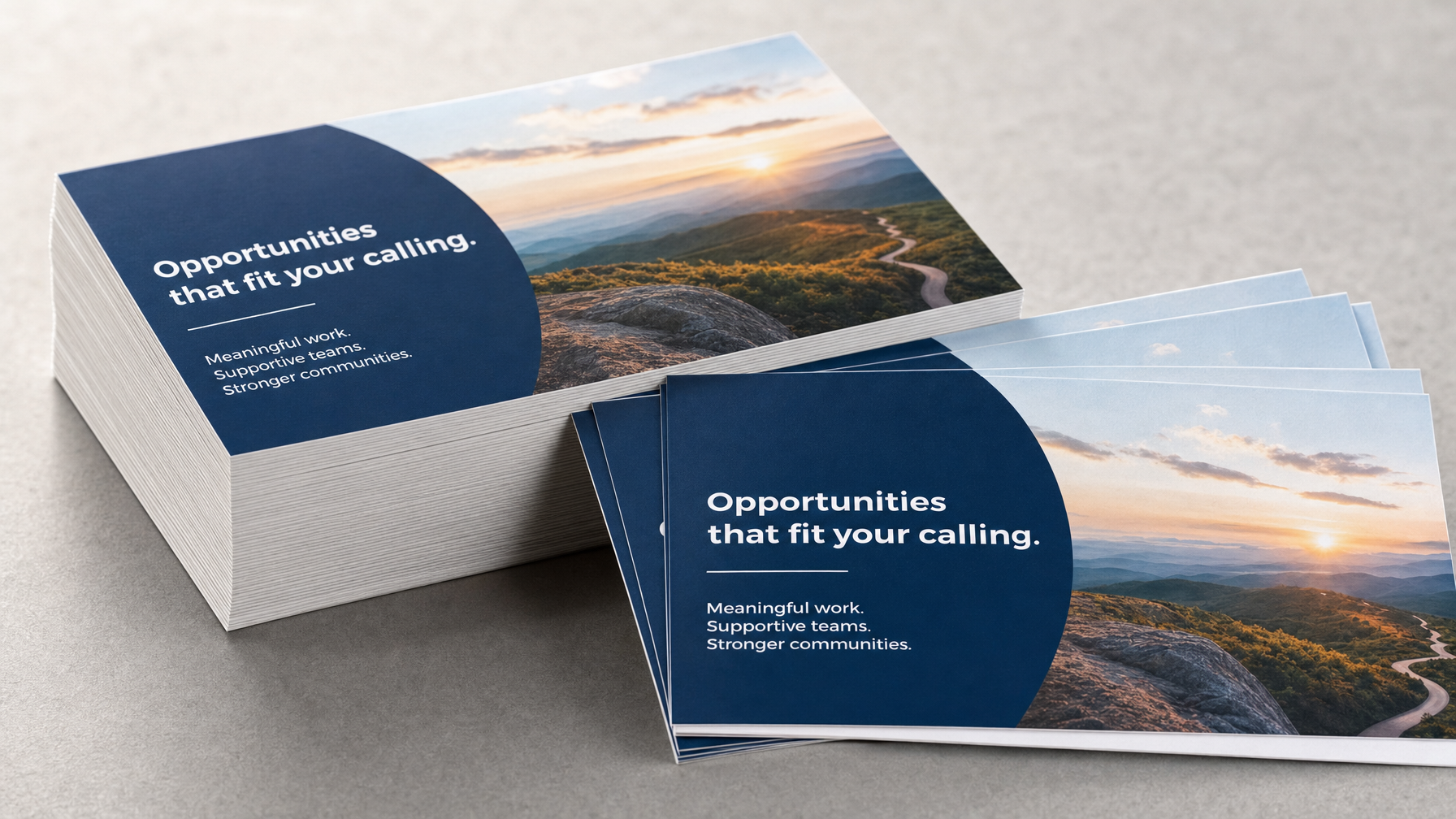
First-name personalization makes a recruiting postcard feel like a direct invitation rather than a generic advertisement. For healthcare employers and recruitment marketing agencies, it can help a targeted message stand out when the recipient is a licensed professional who may not be actively job hunting.
Who This Article Is For
This article is for hospital and health-system HR and talent-acquisition teams hiring licensed healthcare professionals, particularly for difficult roles such as ICU, ED, OR, L&D, oncology, case management, and night-shift nursing.
It also applies to long-term care, home care, outpatient, allied-health, dental, pharmacy, and behavioral-health employers, as well as recruitment marketing agencies that want to add direct mail to their client services.
The focus here is the role of a recipient’s first name in a targeted recruiting postcard. It is not a promise of a scan, application, interview, or hire. A first name changes the opening experience; the relevance of the opportunity still depends on the audience, message, location, and next step.
What First-Name Personalization Changes
Putting a recipient’s actual first name on a recruiting postcard signals that the card is intended for a specific person, not a broad anonymous audience. It creates a more direct opening for a message about a particular specialty, role, unit, shift, or location.
For example, a card addressed to a recipient by first name can immediately introduce an ICU night-shift opportunity in a defined market. The recipient does not have to work through a broad “healthcare professionals wanted” message to decide whether the card might apply to them.
Personalization can also make the call to action easier to understand. A direct greeting, a focused opportunity, and one next step give the card a clearer path:
- This message is for me.
- This is the type of opportunity being presented.
- This is what I can do next.
First-name personalization works best as part of precise audience selection. It is not a substitute for matching the campaign audience by license type, specialty, and geography.
Why a Generic Recruiting Postcard Can Be Easy to Ignore
A generic recruiting card can resemble a mass advertisement. If it does not make clear who the role is for, where it is located, or why the recipient should consider it, the recipient has to do that sorting work themselves.
Licensed professionals often encounter recruiting messages that do not match their specialty, care setting, shift preferences, or geography. A broad message to “nurses,” for instance, may not speak to an OR nurse, an ICU nurse considering nights, or a case manager in a particular area.
First-name personalization improves the opening experience by making the outreach feel direct. Specialty and geographic relevance improve the substance of the message. Both matter. A postcard with a first name but an unrelated role can still feel irrelevant.
How the Recipient Experience Changes
Opening impression
The recipient sees their actual first name rather than a generic greeting. That simple change makes the first line read more like an invitation than a general promotion.
Relevance
The name can be paired with a focused message about a specific license type, specialty, unit, role, shift, setting, or location. A healthcare employer might lead with a message for ICU night-shift nurses. A rehab department might speak to physical therapists for a rural site.
Clarity
A strong card has one prominent action. That may be scanning a QR code or visiting a short URL to view role details, register for an event, or learn about a program.
Continuity
The landing page should continue the same conversation. Its employer branding, role message, and call to action should match what the recipient saw on the card. A mismatch can create uncertainty about where the QR code leads and why the recipient was contacted.
Personalization can make the message more direct, but it does not guarantee that someone will scan, apply, interview, or accept an offer.
The Four Parts of a Strong Personalized Recruiting Card
RecruitCard’s card approach brings four elements together. Each has a different job to do.
1. Personalized name
Place the recipient’s first name where it is easy to notice and where it supports the main message. The name should feel conversational, not like an isolated data field added to the design.
2. Specialty-specific message
Speak to the relevant license type, specialty, trade, shift, setting, or opportunity. Specificity gives the recipient a reason to keep reading.
- An ICU night-shift opening can speak directly to ICU nursing experience and the shift.
- A rural physical-therapy role can make the location and setting clear.
- A hiring-event card can identify the profession and make event details prominent.
- An apprenticeship-awareness card can introduce a program that may not be easy for candidates to discover through a job search.
3. Credible employer branding
The card should clearly identify the employer. Use recognizable employer branding and a concise reason to explore the opportunity. The recipient should not need to guess who is reaching out.
4. One clear action
Give the recipient one primary next step. A QR code and short URL can lead to a focused landing page. Avoid asking the recipient to choose among several unrelated actions on one card.
Personalization Is Not the Same as Buying a Generic Mailing List
A generic mailing list is broad audience distribution. It may define recipients using wide categories that do not reflect the actual requirements of a role.
RecruitCard’s model builds the audience through license type, specialty, and geography matching. The first name is one part of a larger targeting and creative process. It does not turn a broad, mismatched audience into a relevant one.
Before a card is designed, the campaign needs to answer basic fit questions:
- Which license type or credential is relevant?
- Which specialty, role, unit, trade, or setting matters?
- Which geography should the campaign cover?
- What is the specific opportunity or reason to engage?
A personalized card can still miss the mark if the specialty, location, or opportunity is not a fit for the recipient.
Where First-Name Personalization Fits in Passive-Candidate Recruiting
Job boards and paid search are useful channels, but they generally depend on people encountering an active digital opportunity and choosing to engage with it. That creates a limitation when the people you most want to reach are already employed and not actively searching.
A mailed recruiting card gives you another way to present a relevant opportunity to licensed professionals at home. It is best used as a complementary channel, not as a replacement for every digital, referral, internal mobility, or recruiter-led activity.
The card needs a specific reason for the recipient to consider it. That might be:
- A hard-to-fill specialty or unit.
- A night-shift role.
- A rural or otherwise difficult-to-staff location.
- A hiring event or open house.
- A newly available apprenticeship or training program.
- An early pipeline conversation before the next vacancy opens.
Examples of Personalization by Recruiting Use Case
Hard-to-fill requisition
For a role that has remained open through normal channels, use the recipient’s first name alongside the exact specialty and location. A focused message can explain that the outreach concerns a particular unit or shift, rather than a general healthcare opening.
High-volume local hiring
For CNAs, HHAs, and caregivers, a personal greeting can make a straightforward local role message feel more direct. The card should still be clear about the role and the area being served.
Hiring event
A personalized invitation can make the event the center of the card. Keep the relevant profession, event details, employer identity, and registration action easy to find.
Apprenticeship or training awareness
Some opportunities are not well served by search behavior because candidates may not know the program exists. A postcard can introduce the opportunity directly and provide one place to learn more.
Long-term pipeline building
Personalized outreach can also support an ongoing pipeline effort. The message does not have to be limited to one immediate requisition if the goal is to build awareness with a defined professional audience before a future need arises.
Design Choices That Make Personalization Feel Natural
- Use the first name in a prominent, conversational position.
- Keep the card focused on one audience and one primary message.
- Pair the greeting with a specific reason to explore the role, event, or program.
- Do not crowd the design with multiple jobs, competing QR codes, or unrelated calls to action.
- Make the employer identity clear from the start.
- Review name formatting and legibility before print.
- Check that the printed card and landing page use consistent employer branding, role details, and language.
Good personalization should support the message, not distract from it. The recipient should quickly understand both the opportunity and the action being requested.
How RecruitCard Manages the Campaign
RecruitCard manages direct mail recruiting campaigns from audience targeting through response tracking. The campaign can include:
- Audience targeting by license type, specialty, and geography.
- Creative development using employer branding, the recipient’s first name, a specialty-specific message, and one clear action.
- Printing, postage, and delivery.
- QR-code and landing-page response tracking.
Campaigns can support a single market, multiple locations, or a nationwide rollout. RecruitCard’s deepest expertise is in licensed healthcare hiring. The same direct-mail model can also support employers seeking licensed or certified engineering and skilled-trade candidates.
For recruitment marketing agencies, RecruitCard also offers a white-label option for adding this channel without building an in-house print, postage, and response-tracking operation.
How to Measure the Experience Without Overclaiming
Direct mail recruiting activity can be measured through QR scans and landing-page traffic associated with the campaign. These signals show whether recipients are taking the initial digital step after receiving the card.
You can review that activity alongside the actions that matter to your organization, such as recruiter follow-up, applications, event registrations, or other employer-defined next steps. You can also assess whether the landing-page audience and message align with the intended campaign audience.
Tracking is useful, but it has limits. QR scans and page visits do not by themselves establish that every application or hire came from a postcard. They are measurable campaign inputs that should be considered with your broader recruiting process.
Questions to Ask Before Personalizing a Recruiting Postcard
- Is the audience defined by the relevant license type, specialty, and geography?
- Does the message address a specific role, unit, shift, location, event, or program?
- Is the recipient’s first name displayed accurately and legibly?
- Is there one primary call to action?
- Does the QR code lead to a focused landing page?
- Does the landing page carry through the same employer brand and message?
- Will the campaign support one market, multiple locations, or a nationwide rollout?
- Who will manage creative, printing, postage, delivery, and response tracking?
Personalization Works Best as Part of a Complete Recruiting Message
A first name makes a recruiting postcard more direct. It tells the recipient that the message was intended for an individual rather than an undefined audience. But relevance comes from the full combination: the right audience, a specialty-specific message, clear employer branding, and one understandable action.
RecruitCard applies that approach most deeply to licensed healthcare hiring, including difficult specialty, unit, shift, and location needs. The same model can support other licensed or certified hiring needs, hiring events, apprenticeship awareness, and long-term candidate pipelines.
If you are considering direct mail for a specific hard-to-fill role, event, program, or pipeline need, Book a 15-minute call.
Enjoyed this? There's more from RecruitCard.
Book a 15-minute call →