How to Use Direct Mail Before a Healthcare Hiring Event, Not Just During It

For a healthcare hiring event, use direct mail before the event to build awareness among targeted licensed professionals, create a reason to attend, and give recipients a simple way to respond. This workflow is for hospital and health-system HR and talent-acquisition teams, along with healthcare recruitment marketing agencies supporting them. It is especially useful when an event supports roles that are difficult to fill through job postings alone, such as ICU, OR, ED, night-shift, rural, or other specialty positions.
1. Define the event objective and audience
Start by deciding what the event must accomplish. A hiring event can serve several purposes, but the campaign should have one primary objective.
- Increase attendance for a defined hiring event.
- Promote a hard-to-fill role, unit, shift, or specialty.
- Introduce candidates to a new facility, service line, or location.
- Build a longer-term candidate pipeline for future openings.
Then define the professionals the event is meant to reach. Be specific about license type, specialty, and geography. For example, an event may focus on RNs for ICU or OR roles, PTs for a rural outpatient site, or CNAs and HHAs for ongoing local hiring.
Decide whether the invitation supports one location, several locations, or a nationwide rollout. Separate the primary audience from any broader awareness audience. An ICU nurse invitation should remain focused on ICU nursing rather than trying to speak to every healthcare professional in the market.
2. Select recipients by license, specialty, and geography
Build the mailing audience around the event's actual hiring needs and location. This is different from sending a general demographic mailing list to a broad area.
Match recipients to the roles the event is intended to support. Depending on the event, that could mean licensed professionals associated with night-shift nursing, allied health, caregiving, behavioral health, rehabilitation, or another defined specialty.
This approach gives you a way to reach qualified professionals who are already employed and may not be actively searching job boards or responding to paid search ads. Those candidates can be structurally difficult to reach through active-jobseeker channels alone.
Confirm the intended audience and market before creative production begins. The audience should be built through matching by license type, specialty, and geography, with the invitation shaped around that match.
3. Create an event-specific reason to respond
Give recipients one clear reason to attend. “Healthcare hiring event” is usually too broad on its own. Explain what the person will be able to explore or discuss.
- Meet the hiring team for a defined unit or specialty.
- Learn about a role that fits the recipient's experience.
- Explore opportunities at a new facility or local site.
- Discuss a schedule, shift, or location that has been difficult to fill through normal channels.
Use language that reflects the actual opportunity. An invitation for ICU night-shift RNs should say so. It should not read like a generic career fair message.
Make the essential details easy to find: the date, location or attendance method, intended attendees, featured roles, and next action. If the event introduces an apprenticeship, training program, or another opportunity candidates may not know exists, explain it in plain language.
4. Build the card around four essential elements
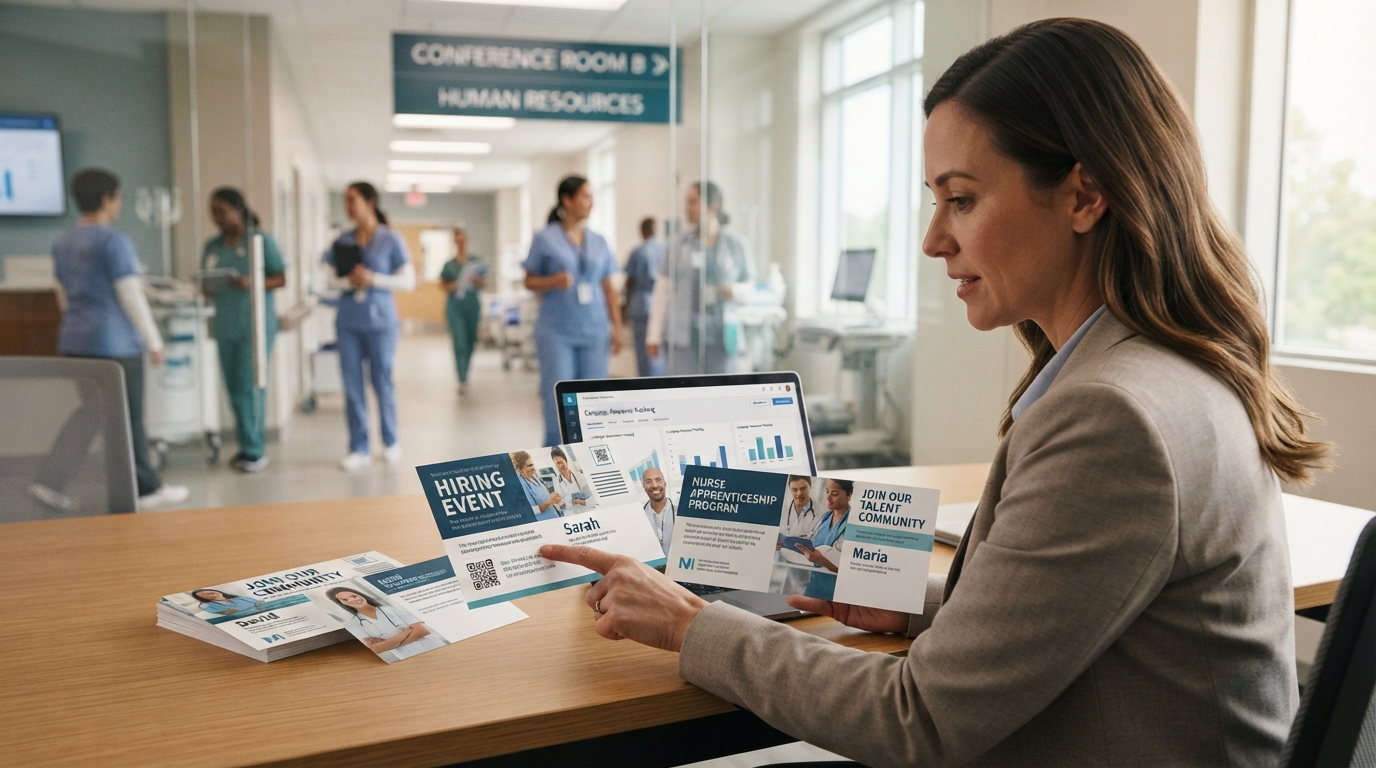
A direct mail event invitation needs to be quickly understood. RecruitCard campaigns use four core card elements to keep the message focused.
Use the recipient's actual first name
Personalization helps the invitation feel addressed to an individual rather than sent as an untargeted mass piece. Use the recipient's actual first name where appropriate.
Connect the message to the specialty
Make the event relevant to the recipient's license, trade, or specialty. Name the unit, type of role, location, or shift when those details are central to the invitation.
Show credible employer branding
Clearly identify the employer hosting the event. Use the employer's brand so recipients understand who is inviting them and can assess the opportunity in context.
Include one clear action
Use a QR code and short URL leading to the event information, registration process, or designated landing page. Avoid filling the card with competing actions. If the primary action is registration, make registration the action.
5. Send the mail before the event, not as an afterthought
Treat mail as the awareness stage of the event, not as a last-minute reminder. Plan the campaign early enough for recipients to notice the invitation, consider it, and decide whether to attend.
Coordinate the mailing with event registration, recruiter availability, and any digital reminders you plan to use. The card and landing page should use the same role names, employer branding, date and location details, and call to action.
If registration is required or capacity is limited, state that plainly. Clear logistics are more useful than vague urgency.
6. Make the landing page useful after the scan
A QR code should not lead to a general careers homepage when the card promoted a specific event. Send recipients to a page that continues the exact message of the invitation.
Include the event purpose, featured roles, location, date, attendance format, and registration instructions in plain language. Keep the main action prominent.
Some qualified people will be interested but unable to attend. When those options are available, give them a practical alternative, such as learning more about the featured roles or joining a candidate pipeline for future contact.
Design the landing page for mobile use. A person scanning a QR code from a mailed card will commonly arrive on a phone.
7. Prepare the hiring team to follow up
Direct mail creates an opening for conversation. Your recruiting and hiring teams need to be ready to continue it.
- Share the same audience definition and event message used in the mailing.
- Prepare recruiters and hiring managers to discuss the role, specialty, shift, location, event format, and next steps.
- Set a process for people who register, scan without registering, attend, or contact the team after the event.
- Decide who owns follow-up and how candidate interest will be recorded.
Use the campaign as an extension of your recruiting operation, not as a substitute for event staffing, candidate conversations, or follow-up.
8. Measure pre-event engagement
Direct mail event promotion can be measured. Track QR-code scans and landing-page traffic associated with the campaign, then compare that activity with your event registration or contact process.
This helps you understand the movement from awareness to action. It can also show which specialty, geography, or event message generated interest. Use those observations to improve future invitations rather than relying on assumptions about what candidates noticed.
For recurring event programs, review what the tracking shows alongside your team's recruiting process. The goal is to refine the audience, message, landing page, and follow-up path for the next campaign.
9. Extend the campaign beyond one event
Continue conversations with attendees and interested recipients through your normal recruiting process after the event. The audience and creative lessons can inform future hiring events, open houses, hard-to-fill requisition campaigns, and apprenticeship-awareness efforts.
An ongoing approach may make sense when hiring needs are continuous, such as recurring nursing, CNA, HHA, or caregiver recruitment. A single event can introduce the audience; later campaigns can maintain awareness as openings change.
Healthcare recruitment marketing agencies can also offer this model as a white-label service. RecruitCard can manage targeting, creative, printing, postage, delivery, and response tracking without requiring an agency to build a separate print-and-mail operation in-house.
10. Decide whether direct mail fits your event
Use this approach when your event targets a defined license type or specialty, the qualified local pool is limited, or the people you want are likely already employed. It can also support multi-location or nationwide event promotion when each audience and message can be clearly targeted.
Clarify the plan before mailing if the event has no defined audience, no specific action for recipients to take, or no workable follow-up path. A focused audience, relevant invitation, useful landing page, and prepared recruiting team give the event a stronger foundation.
When you are ready to review the audience, message, and tracking plan, Book a 15-minute call.
Enjoyed this? There's more from RecruitCard.
Book a 15-minute call →