Is the Campaign for Applicants or Awareness?

For hospital and health system recruiting teams, decide first whether your campaign should drive immediate applications or build awareness for a future hiring need. That choice determines the card's message, its single call to action, and the response data you should track.
1. Define the campaign's primary job
Choose one primary objective before discussing card design. Your campaign should either generate applicants for a specific role or build awareness for an opportunity people may not be actively searching for.
Choose an applicant campaign for an open role
An applicant campaign is suited to a defined requisition that is not closing through normal channels. This may include an ICU night shift, a rural physical therapy role, or a specialty nursing position. The recipient should quickly understand that there is a current opportunity and what step to take next.
Choose an awareness campaign for a future need or less searchable opportunity
An awareness campaign is suited to a hiring event, apprenticeship, new facility, training program, or long-term candidate pipeline. Its purpose is to introduce an opportunity that a qualified person may not find through a routine job search.
A campaign can support both applications and awareness, but one goal should lead. When a card asks a recipient to do several different things, the next step can become unclear.
2. Match the objective to the audience
Build the audience around the hiring objective, not around a broad demographic category.
For applicant campaigns, start with the requisition
Define the license type, specialty, trade, and geography connected to the open role. An ICU nursing need, for example, calls for a different audience and message than a general RN opening. The same applies to a physical therapy role, surgical specialty, or licensed trade position.
For awareness campaigns, start with future relevance
Define the qualifications and locations most relevant to the event, program, facility, or future role. If you are introducing an apprenticeship or opening a new facility, focus on people whose background makes the opportunity relevant, even if they are not ready to apply today.
Direct mail recruiting is not the same as sending a generic mailing to a broad demographic group. RecruitCard campaigns are targeted by license type, specialty or trade, and geography. Campaigns can support a single market or a nationwide audience, depending on your hiring objective.
3. Write one clear action
Give the recipient one clear next step that matches the campaign's stage and purpose.
Actions for applicant campaigns
- View the role
- Learn about the position
- Start an application
Actions for awareness campaigns
- Register for a hiring event
- Join a talent community
- Learn about an apprenticeship or training program
- Explore a new facility or future opportunity
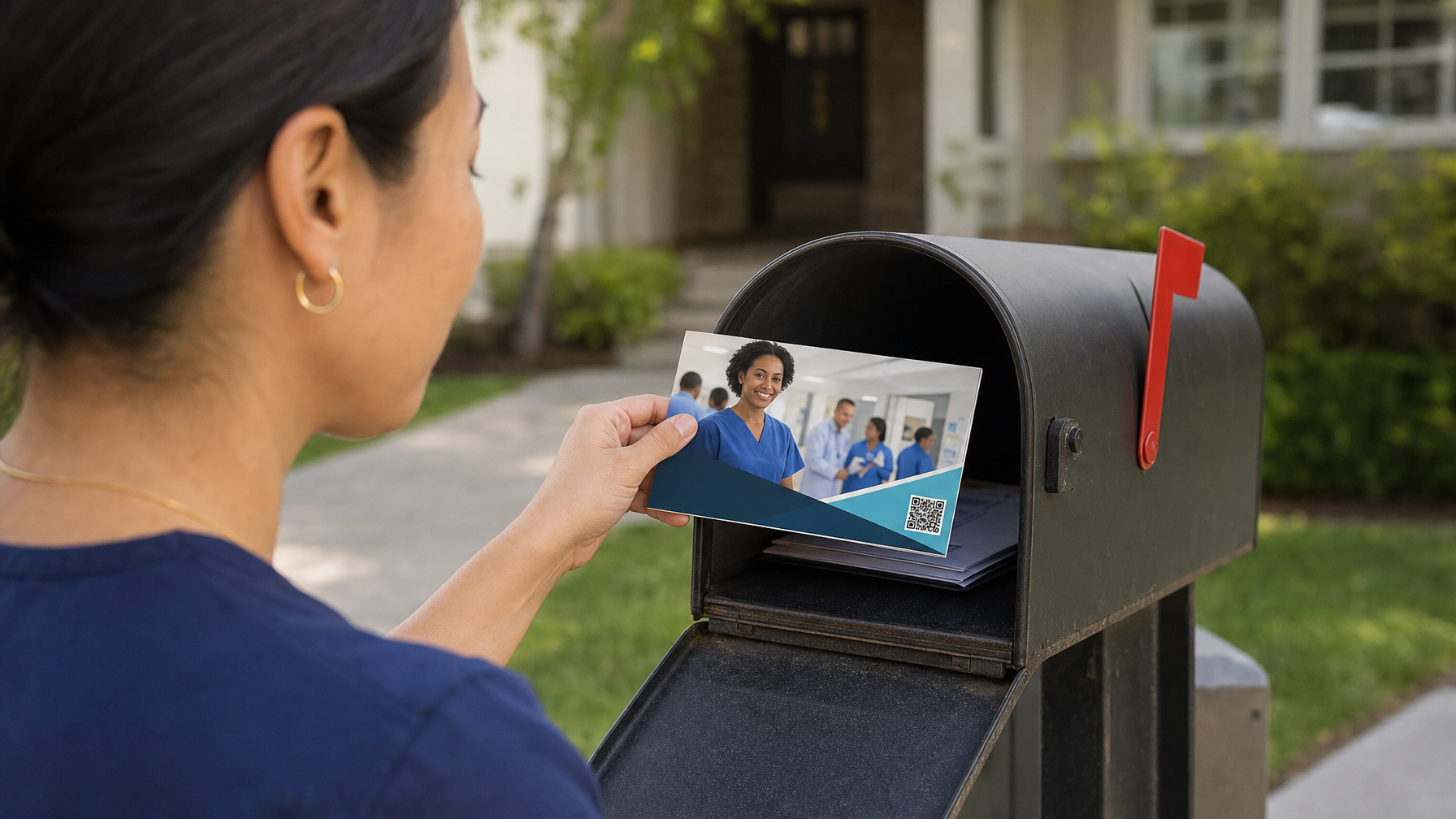
Do not place several competing actions on the card. The recipient should know what to do immediately after reading the message. A QR code and short URL provide a direct path from the card to the intended landing page.
4. Build the card around the objective
Every element of the card should reinforce the campaign's primary job. A practical card has four components: a personalized name, a specialty-specific message, credible employer branding, and one clear action.
Personalize the recipient experience
Use the recipient's actual first name. This helps make the message feel directed to a person with a relevant professional background rather than to a general audience.
Make the message professionally specific
Match the message to the license type, specialty, trade, role, event, or program. For an applicant campaign, emphasize the open role and why it is relevant to the recipient's background. For an awareness campaign, explain what the recipient may not discover through a job search, such as a new program, hiring event, or future opportunity.
Make the organization recognizable
Use credible employer branding so the recipient can identify the organization behind the opportunity. The card should clearly connect the employer, the message, and the action.
Keep the design focused on one response
The card should lead naturally to a single action. A role-focused card should not split attention between an application, an event registration, and a general talent network. Likewise, an awareness card should not make a future program look like an immediate role application unless that is the campaign's actual goal.
5. Choose the right landing page
The landing page should continue the same promise and message introduced on the card.
Landing pages for applicant campaigns
Send recipients to a page where they can review the role and take the appropriate recruiting step. The page should make it easy to understand the position that prompted the scan or visit.
Landing pages for awareness campaigns
Send recipients to a page that explains the event, program, facility, or pipeline opportunity. Decide in advance what expression of interest you need to collect, such as an event registration or interest in future opportunities.
A mismatch between the mail piece and landing page creates unnecessary friction. If the card promotes an apprenticeship, the destination should explain that apprenticeship. If the card promotes an ICU night opening, the destination should continue with that role.
6. Set up response tracking before mailing
Plan measurement before the campaign is mailed. RecruitCard tracks QR code scans and landing-page traffic so you can review campaign activity.
Review activity in the context of the objective
- For an applicant campaign, review scans and traffic tied to the specific requisition or role message.
- For an awareness campaign, review engagement with the event, apprenticeship, facility, or pipeline page.
Tracking helps you understand campaign activity. It does not replace reviewing completed applications, registrations, and follow-up actions within your recruiting process.
Before launch, document the campaign objective, audience, card version, landing page, and desired response. This gives the resulting activity useful context.
7. Decide how the campaign fits your hiring plan
Use the campaign type that supports the work your team needs to accomplish now.
Use an applicant campaign when the requisition is immediate
Choose this approach when you need attention on a defined role that is not closing through your usual channels. It can be useful when the qualified local pool is small, specialized, and already employed.
Use an awareness campaign when timing matters less than familiarity
Choose this approach when you need to create familiarity before a vacancy, event, apprenticeship, or new facility needs attention. It gives qualified people a reason to learn about an opportunity before they begin an active search.
Consider an ongoing pipeline for recurring needs
If you repeatedly need the same license type or specialty, an ongoing pipeline approach may fit your plan. This can apply to high-volume local roles such as CNA, HHA, and caregiver positions, as well as recurring specialty needs.
Recruitment marketing agencies can use the same workflow as a white-label service without building their own targeting, creative, print, postage, delivery, and response-tracking operation.
8. Confirm the campaign brief and next step
Before moving forward, write down the campaign's objective, audience, message, one clear action, landing page, and tracking plan.
- Confirm whether the card promotes an immediate applicant opportunity or awareness for a future response.
- Review the brief with the people responsible for recruiting follow-up, event coordination, or pipeline management.
- Make sure the landing page and response process support the action requested on the card.
When you are ready to discuss the audience and campaign structure, book a 15-minute call.
Enjoyed this? There's more from RecruitCard.
Book a 15-minute call →