Recruiting Behavioral Health Professionals for Community-Based Care
For community-based behavioral health employers, recruiting works best when you reach the specific licensed and credentialed professionals your programs need, in the geographies where they can serve patients. This workflow is for talent-acquisition teams and program leaders hiring counselors, social workers, psychiatric nurses, case managers, and related professionals, including people who may already be employed and are not searching job boards.
1. Define the behavioral health role and care setting
Start with the actual position you need to support. “Behavioral health” is too broad to guide a useful campaign on its own. Define the role, the work environment, and the requirements a qualified candidate will need to understand.
- Name the exact role: licensed counselor, clinical social worker, psychiatric nurse, case manager, or behavioral health specialist.
- Describe the care setting: outpatient care, mobile services, residential programs, crisis response, school-based care, or home and community visits.
- Document the details that can affect candidate interest, including service area, schedule, patient population, travel expectations, supervision structure, and required license or certification.
If the goal is to close an open role that has not responded to normal recruiting channels, begin with one specific requisition. If the goal is different—such as building a candidate pipeline, promoting a hiring event, or introducing a new program—use a broader objective and message from the start.
2. Identify the licensed or credentialed audience
Build the audience around the professional requirements of the role and the geography where the person can work. This is different from sending a generic employment message to a broad professional demographic.
- Define the needed license type, behavioral health discipline, specialty, and geographic location.
- Separate audiences when credentials or work experience are meaningfully different. A psychiatric nurse campaign should not use the same message as a campaign for clinical social workers or counselors.
- Set a practical service geography, including nearby communities and, when appropriate, areas relevant to candidates considering a move.
The audience should match the role’s professional requirements and service area. A direct mail recruiting campaign is not simply a generic mailing-list purchase. RecruitCard plans audiences by license type, specialty, and geography for this reason.
3. Decide whether passive candidates are part of the strategy
Include passive candidates when the qualified local pool is small, specialized, already employed, or difficult to reach through active-job-seeker channels. A passive candidate is someone who may be open to the right conversation but is not actively searching or responding to job postings.
Job boards and paid search primarily put an opening in front of people who are currently looking. A personalized mail piece gives you another way to introduce a relevant opportunity to qualified professionals at home, outside the competition for attention around a job posting.
Make the reason to consider the role concrete
Frame the opportunity around details that may matter to the intended audience, such as the organization’s mission, the patient population, clinical support, flexibility, advancement, or a new community-based program. Do not rely on a generic “we are hiring” announcement.
For example, a message to counselors supporting a mobile crisis program should identify that program and location. A message to psychiatric nurses should explain the relevant care setting rather than treating every behavioral health professional as the same audience.
4. Build the card around four essential elements
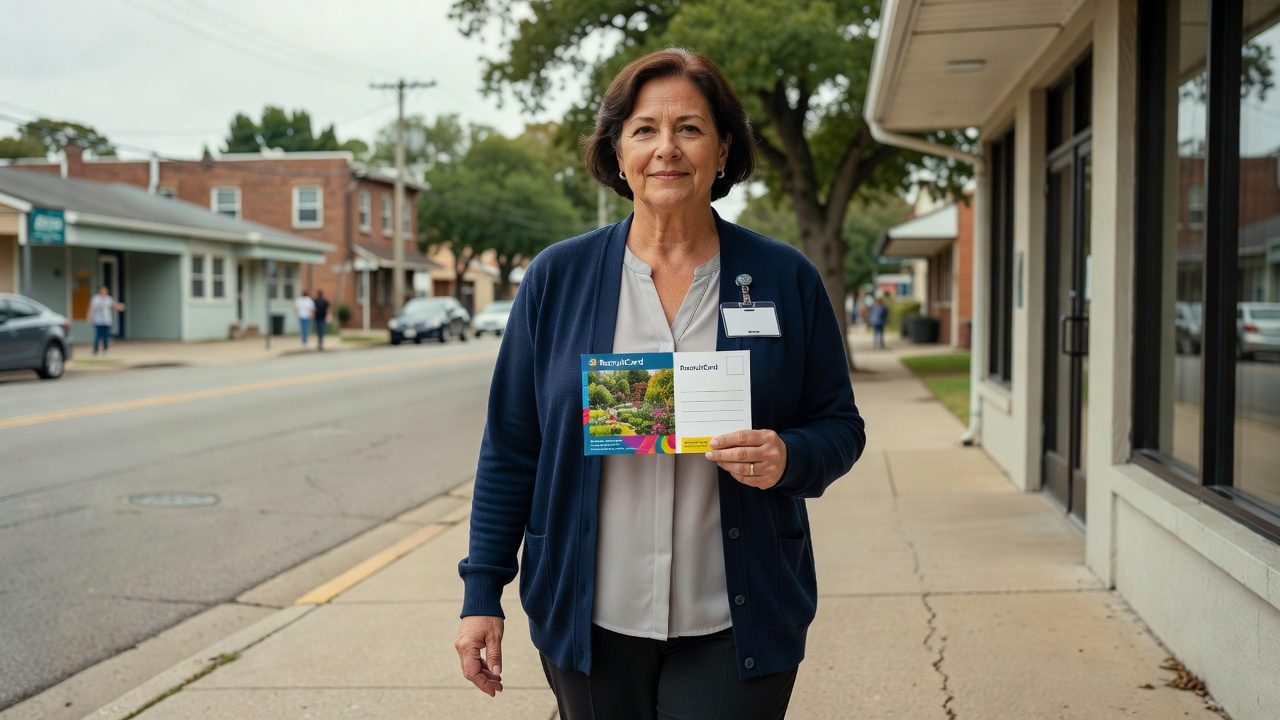
A recruitment card should give the recipient enough context to decide whether to take the next step, without trying to fit an entire job description into a small format. Build it around these four elements.
Personalized name
Address the recipient by their actual first name when it is available for the campaign. Personalization helps make the outreach feel intended for a person rather than for a broad, anonymous audience.
Specialty-specific message
Explain why the role is relevant to the recipient’s behavioral health discipline and the community served. Refer to the role, program, or care setting directly.
Credible employer branding
Present the organization clearly. Include the employer’s branding, care model, mission, and role context as appropriate. Keep claims grounded in details the employer can support.
One clear action
Ask the recipient to take one primary next step. A QR code and short URL can lead to a campaign landing page where the candidate can review the opportunity or express interest.
5. Match the message to the community-based care proposition
Community-based behavioral health work can differ substantially from hospital-based or purely office-based practice. Explain what the work involves rather than assuming the program’s value is self-evident.
- Describe the connection to local communities, integrated services, or care delivered outside traditional settings when relevant.
- Address practical questions about caseload, supervision, travel, scheduling, safety, team structure, and professional development when those details are available.
- Use concrete descriptions of the program and position instead of broad claims about impact or outcomes.
Create separate creative when programs have different candidate motivations. A residential program, a school-based service, and a crisis-response team may need distinct messages, even when they recruit from related behavioral health disciplines.
6. Create the response destination before mailing
Decide where a candidate will go after scanning the QR code or entering the short URL before the card is produced. The landing page should be built for the role, specialty, or program being promoted.
- Repeat the key facts from the card: position, location, requirements, program context, and next step.
- Make it easy for a candidate to express interest or review the opportunity without first navigating a general careers site.
- Use a clear response path that aligns with your existing recruiting workflow.
QR-code scans and landing-page traffic let you distinguish direct mail engagement from other recruitment sources. They also give your team a defined place to evaluate whether recipients are taking the intended next step.
7. Manage production and delivery as one campaign
Coordinate the operational pieces as one workflow: audience targeting, creative, printing, postage, delivery, and response tracking. Treating these as disconnected tasks can create mismatches between the recipient, the card, and the landing page.
Review the campaign before production
Confirm the recipient name treatment, specialty message, employer branding, QR code, short URL, landing-page content, and any required disclaimers. Also confirm whether the campaign is a focused local-market effort or a broader rollout across multiple communities or locations.
RecruitCard manages these campaign components end to end, from targeting through delivery and QR-code and landing-page tracking. Campaigns can support a single market or a nationwide rollout. Recruitment marketing agencies can also use a white-label structure when offering the campaign under the agency’s brand.
8. Measure engagement and improve the next outreach
Track QR scans and landing-page traffic as direct indicators of campaign engagement. These measures show whether recipients are responding to the card and visiting the dedicated destination.
- Compare engagement by role, specialty, geography, message, or rollout when your campaign includes distinct audience segments.
- Connect campaign traffic to your normal application or recruiting workflow so your team can understand what happens after a scan or visit.
- Use the findings to refine the audience, offer, card creative, landing page, or follow-up process.
Do not judge every campaign only by immediate applications. A campaign supporting awareness, a future program, a hiring event, or a longer-term candidate pipeline may have a different purpose from a campaign focused on one open requisition.
9. Extend the campaign beyond one open requisition
The same targeted approach can support more than an individual vacancy. Consider using it to promote hiring events, open houses, new community programs, apprenticeship or training opportunities, and future hiring needs.
If your organization regularly hires counselors, social workers, psychiatric nurses, or related behavioral health professionals, an ongoing pipeline can keep the organization visible to a relevant audience before the next vacancy opens. Refresh the message when the role, location, program, or hiring objective changes. A long-term campaign still needs a relevant reason for candidates to respond.
For a first campaign, choose one clear business objective: close a specific role, build awareness, support a hiring event, or develop a future candidate pool.
10. Choose the next planning step
Use this workflow when you have a defined behavioral health role, a qualified audience that may be difficult to reach through active-job-seeker channels, and a clear response destination. Prepare the role details, target license or specialty, service geography, employer brand assets, and desired call to action before campaign planning begins.
RecruitCard can manage targeting by license type, specialty, and geography, along with card creative, printing, postage, delivery, and QR-code and landing-page tracking. Its deepest expertise is licensed healthcare hiring, including roles where a specific specialty, schedule, or service area makes ordinary posting-based recruiting less effective.
For a campaign discussion, book a 15-minute call.
Enjoyed this? There's more from RecruitCard.
Book a 15-minute call →