Rural Hiring Starts With a Geography Conversation

For hospital and health system HR and talent acquisition teams hiring in rural areas, geography is more than a mailing radius. Start with a geography conversation that defines the real candidate audience, explains why the role is worth considering, and connects the mail piece to a landing page that supports local or relocation decisions.
1. Define the rural hiring problem before choosing a geography
Begin with the requisition, not the map. Identify the role, unit, specialty, shift, and work location. This could be an ICU opening at a rural hospital, an outpatient physical therapy role, or a night shift nursing position.
Then clarify the problem you are trying to solve:
- Is the qualified local candidate pool small?
- Is awareness of the employer or facility limited?
- Is relocation a consideration for some candidates?
- Are qualified professionals already employed and not actively searching job boards?
- Are you competing for the same limited specialty audience as other employers?
Also define the hiring use case. The campaign may support one open requisition, several related roles, a hiring event, or a longer term candidate pipeline. This is a planning conversation. It is not an automatic decision to mail farther from the facility.
2. Describe the location in terms candidates can evaluate
Give candidates enough practical context to decide whether the opportunity merits a closer look. Confirm the facts your organization can publish, including the facility location, nearby communities, work setting, schedule details, and role requirements.
Separate confirmed information from assumptions. You may know that a role is based at a particular facility and serves a particular care setting. You should not assume why a candidate would relocate, how far they are willing to commute, or which aspects of a community matter most to them.
Next, identify what makes the opportunity relevant beyond the immediate area. That may be a specialty specific role, a distinctive work setting, or a career opportunity that candidates can explore in more detail. Use only employer approved details. This information should guide both the audience brief and the card message.
3. Set the audience around license type, specialty, and geography
Choose the required license or certification first. Then define the specialty, trade, or role focus and the geographic area to consider. For a rural ICU opening, the audience discussion should be more precise than a broad request to reach nurses.
Consider whether the campaign needs more than one geographic segment. For example:
- A nearby segment may include qualified professionals who could reasonably evaluate a local work opportunity.
- A broader segment may focus on professionals who could consider learning more about a specialized role and its location.
Document the geography in concrete terms. Name the facility area, relevant nearby communities, or a broader United States audience when appropriate. RecruitCard supports single market and nationwide rollouts.
This is not a generic mailing list purchase. A RecruitCard campaign audience is planned through license type, specialty, and geographic matching.
4. Decide what each audience segment needs to know
Write a motivation hypothesis for each segment before writing the card. A nearby candidate may want to understand the schedule, work setting, and local location. A candidate farther away may need clearer context about the specialty, facility, and location before deciding to respond.
Keep the message specific to the role. A rural ICU opening should not read like a general nursing message. The same principle applies to outpatient rehabilitation, operating room, labor and delivery, oncology, and other specialized hiring needs.
Choose one primary action for the card. Depending on the campaign, that action might be to:
- Review the opportunity
- Start a conversation with the recruiting team
- Register for a hiring event
- Visit a hiring page
Plan for personalization with the recipient's actual first name. Personalization should support a relevant, direct message rather than add clutter.
5. Build the card around four essential elements
A focused recruiting card gives the recipient a reason to take one next step. Build it around these four elements:
- Personalized name: Address the recipient by their actual first name.
- Specialty specific message: Speak to the license, specialty, role, or unit being recruited.
- Credible employer branding: Clearly show who is hiring and where the opportunity is located.
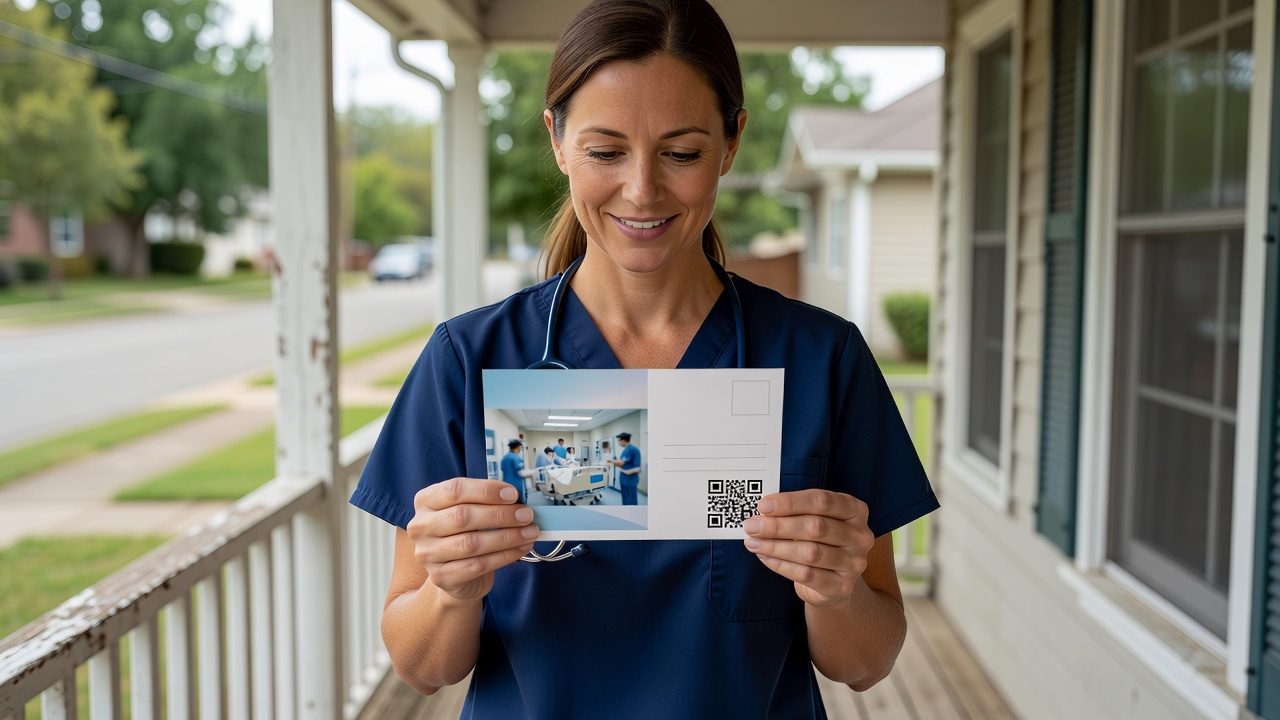
- One clear action: Use a QR code and short URL that lead to the next step.
Avoid competing actions that ask the recipient to do several things at once. The card is an invitation to learn more. It does not need to answer every employment or relocation question in the mailbox.
6. Create a landing page that answers the geography question
Match the landing page to the card audience and its call to action. A rural role should lead to a page that makes the location understandable and gives candidates a clear reason to continue.
Include the approved information that helps a candidate evaluate the opportunity:
- The role and specialty
- The work setting
- Published schedule information
- The facility location and useful surrounding area context
- A clear next step for an inquiry or application
If relocation is relevant, include only information the employer has approved. Do not presume a candidate's moving needs or promise relocation assistance unless the employer has confirmed it.
Keep the page simple. A candidate who scans the QR code should be able to understand the opportunity and find the intended inquiry or application path without searching through unrelated content.
7. Connect the campaign to the hiring use case
The response path should match the purpose of the campaign.
- Hard to fill requisition: Lead with role details and a direct path to contact the recruiting team or apply.
- Hiring event or open house: Make the event information and registration action central to the page.
- Apprenticeship or training awareness: Explain what the program is and who should learn more.
- Ongoing pipeline: Give qualified professionals a clear way to express interest, even when one immediate opening is not the only hiring need.
This approach helps the campaign serve a defined hiring purpose instead of sending every audience to a generic careers page.
8. Plan measurement before the mail is sent
Confirm the response path before production begins. RecruitCard campaigns can track QR scans and landing page traffic. These measures can show engagement with the card and visits to the campaign page.
They should not be treated as proof of a hire by themselves. Use a campaign specific landing page or response path so your team can evaluate traffic in the context of the intended audience and message.
Agree in advance on who will handle inquiries, event registrations, or applications generated through the campaign. A clear internal response process matters, particularly when the outreach supports a difficult specialty or shift.
9. Choose the campaign scope and operating model
Decide whether the effort should focus on one rural market, several facilities, or a nationwide audience for a specialized role. For multiple locations, determine whether one shared message is appropriate or whether each location needs its own page and creative.
RecruitCard manages audience targeting, card design, printing, postage, delivery, and response tracking as one campaign. Recruitment marketing agencies can use the same managed model through a white label offering.
The operating model should follow the hiring need. A single facility campaign and a broader specialty rollout may require different audience segments, messages, and landing pages.
10. Review the geography brief and start the conversation
Bring the essentials to the planning discussion:
- Requisition details, including role, unit, specialty, and shift
- Required license or certification
- Facility location and relevant candidate geography
- Employer brand assets
- The intended landing page action
- Approved role and location information for candidates
Use the review to identify gaps. The most important missing detail may be candidate motivation, not the size of the mailing area. A rural hiring campaign is stronger when its geography, message, and response page all help the right candidate evaluate one clear opportunity.
Book a 15 minute call to discuss the role, audience, and campaign approach.
Enjoyed this? There's more from RecruitCard.
Book a 15-minute call →