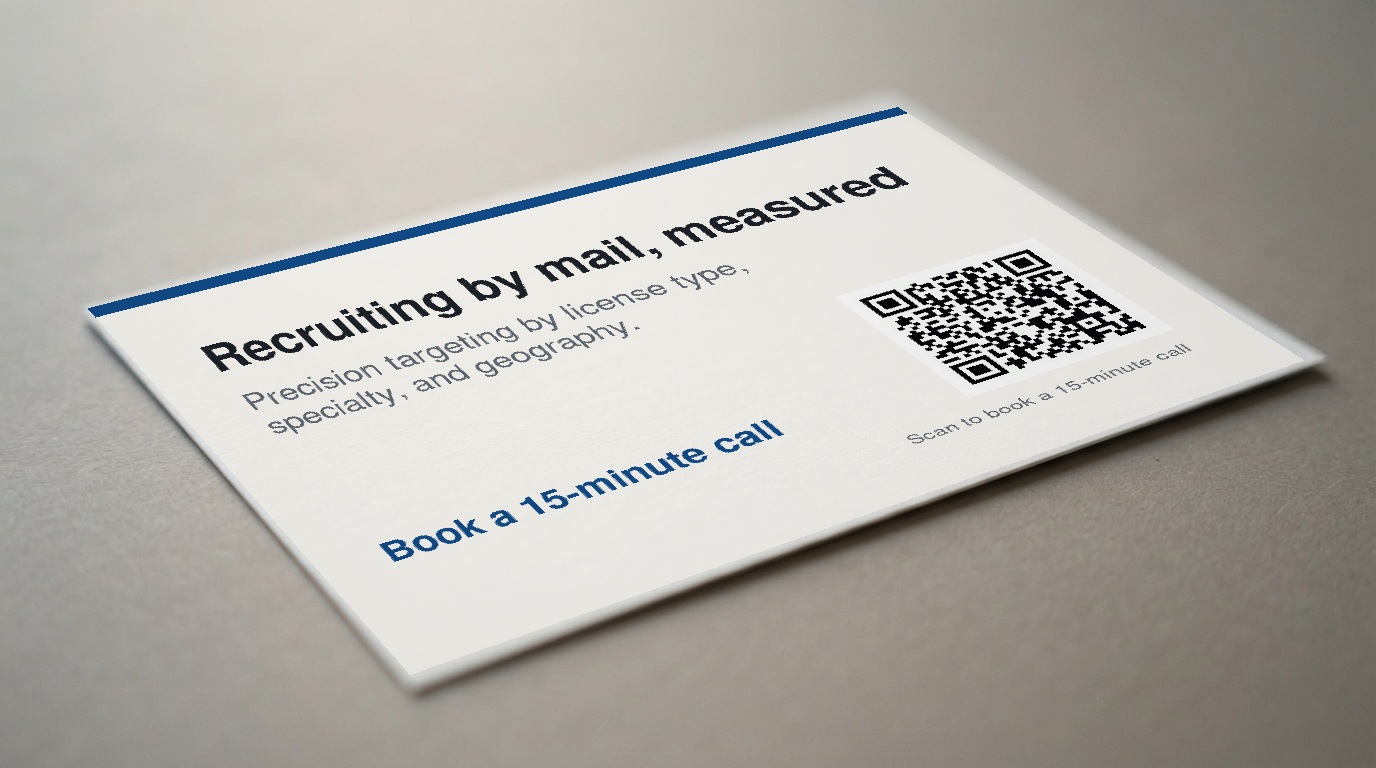
The Anatomy of a Caregiver Recruitment Postcard That Gets One Action Right

For home care, long-term care, and other employers hiring CNAs, HHAs, and caregivers, a strong recruitment postcard makes one next step obvious: scan a QR code or visit a short URL to learn more and apply. Its effectiveness depends less on adding more information and more on combining precise audience targeting, a personalized name, a caregiver-relevant message, credible employer branding, and one clear call to action.
Why a Caregiver Recruitment Postcard Needs One Clear Action
A postcard can have one primary objective without trying to make the recipient do everything at once. The objective may be to start an application, learn about local caregiver openings, register for a hiring event, or explore an ongoing opportunity. The card should direct the recipient to the single next step that supports that objective.
Friction grows when one piece asks a recipient to call, text, visit several web pages, attend an event, and apply through different methods. A caregiver looking at mail between shifts should not have to decide which instruction matters most.
The recommended action is simple: scan the QR code or enter the short URL to reach a campaign landing page. These are two ways to complete the same action, not two competing calls to action.
The postcard is not the place for a full job description, every benefit detail, or every role an organization is hiring for. Its job is to create relevant interest and make the next step easy. The landing page can provide the details needed to continue.
The Four Parts of a Caregiver Recruitment Postcard
A focused caregiver recruitment postcard has four connected parts:
- A personalized recipient name
- A specialty-specific message
- Credible employer branding
- One clear action
Each part should reinforce the same recruitment goal. For example, a card for caregivers in a defined local market might greet the recipient by first name, identify a home care or long-term care opportunity, clearly show the employer's established brand, and invite the recipient to scan to learn more. It does not need extra instructions that pull attention in different directions.
1. Personalized Recipient Name
Using a recipient's actual first name can make a card feel more relevant than a generic household mailer. It signals that the message is intended for an individual caregiver rather than every household in a broad demographic audience.
The name can appear in a headline or opening line. For example:
Maria, explore caregiver opportunities in your area.
Personalization works best when it supports a direct, useful message. It should not be repeated so often that it feels gimmicky. One natural use is usually enough to establish relevance.
This is also different from a generic demographic mailing. A targeted direct mail campaign is planned around the relevant license type, specialty or trade, and geography, then paired with a message designed for the hiring need.
2. A Message Written for Caregivers
The message should tell recipients why the opportunity may be worth their attention. For caregiver hiring, that often means identifying the type of role, work setting, location, or schedule when those details matter.
For example, a campaign might focus on local caregiver openings, a long-term care setting, a particular shift need, or an ongoing need for CNAs or HHAs. The language should be plain and specific enough to answer the recipient's immediate question: Why should I consider this?
Keep the message aligned with the audience
A card intended for caregiver hiring should not try to speak to every healthcare profession. A message for CNAs, HHAs, or caregivers should stay centered on the opportunity those recipients may recognize.
This focus is especially useful when you are hiring continuously, staffing high-volume local roles, or trying to bring attention to harder-to-fill shifts. The card can introduce the opportunity; the landing page can explain the role in more detail.
Use direct language
Clear language is more useful than broad recruiting slogans. A concise message can state the work setting or hiring purpose, identify the employer, and invite the recipient to learn more. Avoid claims that cannot be supported or copy that tries to answer every possible question in a small format.
3. Credible Employer Branding
Recipients should be able to identify the employer quickly. A card can include the employer's logo, established workplace identity, and a concise reason to consider the organization. The visual and written style should match the employer's existing brand rather than rely on generic healthcare imagery or interchangeable language.
Credibility comes from clarity and consistency. The organization named on the card should match the organization presented on the landing page. The caregiver message should match the actual hiring purpose. The call to action should lead where the card says it will lead.
Strong branding does not require exaggerated promises. It requires a recognizable employer identity and a clear explanation of what the recipient can explore after scanning.
4. One Clear Call to Action
For most caregiver recruitment postcards, the primary call to action is to scan the QR code or use the short URL to visit the campaign landing page. Both options should lead to the same destination.
Action-oriented wording should reflect the campaign goal. Examples include:
- Learn about caregiver openings
- Explore local CNA opportunities
- See current home care roles
- Start your application
- Learn about the upcoming hiring event
Place the QR code, short URL, and action wording where they are easy to find. Repeating the instruction can be helpful when it improves clarity, but the card should not add unrelated links, separate destinations, or competing instructions.
What the Landing Page Should Do After the Scan
The landing page should continue the postcard's message and employer branding. If the card promotes caregiver openings in a particular area, the page should immediately confirm that context rather than send visitors to a general careers homepage with no clear path forward.
A useful campaign landing page includes:
- The role or hiring opportunity
- Essential details relevant to the campaign
- Clear employer identification
- A next step, such as beginning an application or learning more about the event
Because many recipients will scan from a phone, the page should be easy to use on a mobile device. The action should be visible without forcing visitors to search through unrelated content.
QR scans and landing-page traffic provide measurable signals of engagement with the campaign. That tracking does not replace your hiring workflow, applicant tracking system, screening process, or follow-up process. It helps show whether recipients are reaching the intended digital destination.
How to Target the Right Caregiver Audience
Caregiver recruitment should begin with the hiring need, not a generic household mailing. RecruitCard plans audiences around license type, specialty or trade, and geography so the audience aligns with the role and market you need to reach.
For caregiver recruitment, that may mean structuring the campaign around CNA, HHA, or caregiver audiences where appropriate, then defining the geographic area around a home care service area, long-term care community, or facility-based need. Geography matters because many caregiver roles are local and because commute considerations can influence interest.
A targeted campaign can support several objectives:
- A specific caregiver requisition that is not closing through normal channels
- Continuous local hiring for high-volume or high-turnover needs
- A hiring event or open house
- Awareness for a new care opportunity
- Longer-term candidate pipeline building before the next vacancy opens
The appropriate audience and message depend on the role, the market, and the campaign objective.
When a Caregiver Postcard Campaign Is a Good Fit
A caregiver postcard campaign can be a practical fit when normal recruiting channels are not producing enough attention from the local qualified audience. Common situations include:
- A specific caregiver role has remained open despite job postings and other routine efforts.
- You need to reach already-employed or passive local professionals who may not be actively searching.
- You hire caregivers continuously and need a repeatable awareness channel.
- You are promoting a hiring event, open house, or new care opportunity.
- You want to build awareness before the next vacancy opens.
The model is particularly relevant when the people you want to reach are unlikely to encounter your posting because they are not currently looking for one.
How Direct Mail Fits With Job Boards and Digital Recruiting
Job boards and paid search generally depend on people actively searching for work or engaging with recruiting content. That makes them useful channels for active candidates, but they may not reliably put an opportunity in front of people who are already employed and not looking.
Targeted direct mail is a complementary channel. It brings a caregiver-specific message to the recipient's home and directs that person to a measurable digital destination. It is not a universal replacement for job postings, referrals, applications, career sites, or other recruiting methods.
The strongest connection between print and digital is simple: the postcard earns attention, and the QR code or short URL carries interested recipients to a page where they can take the next step.
RecruitCard's End-to-End Campaign Support
RecruitCard manages the parts of a direct mail recruitment campaign that need to work together: audience targeting, card design, personalization, printing, postage, delivery, and QR-code or landing-page response tracking.
The card can carry your employer brand, use the recipient's first name, and present a caregiver-specific message with one defined action. Campaigns can support a single market or broader planning, including nationwide rollouts where appropriate.
For recruitment marketing agencies, RecruitCard also offers a white-label option for adding this mail channel without building an in-house print, postage, and response-tracking operation.
A Practical Review Checklist Before Mailing
- Is the audience defined by the relevant caregiver role, specialty or trade, and geography?
- Is the recipient's first name displayed accurately and naturally?
- Does the headline speak directly to the caregiver opportunity?
- Can the recipient identify the employer quickly?
- Is there one primary action, with the QR code and short URL pointing to the same destination?
- Does the landing page work well on mobile?
- Are QR scans and landing-page visits set up for response tracking?
- Does the card avoid unsupported claims, crowded copy, and multiple competing instructions?
Next Step for Employers Hiring Caregivers
The central principle is straightforward: define a precise audience, write a relevant message, present a recognizable employer, and ask for one measurable action. This structure can support an open caregiver role, continuous local hiring, a hiring event, or a longer-term pipeline goal.
If you are evaluating a targeted direct mail campaign for caregiver hiring, Book a 15-minute call.
Frequently Asked Questions
Is a caregiver recruitment postcard the same as buying a generic mailing list?
No. The campaign is planned around license type, specialty or trade, and geography so the audience is aligned with the hiring need rather than a broad demographic profile.
Can the postcard target CNAs, HHAs, or caregivers specifically?
Yes. The audience and message can be structured around the relevant caregiver role and geographic market, subject to campaign planning.
How do we measure whether people responded?
Use a QR code and short URL that lead to a campaign landing page, then review QR scans and landing-page traffic as response signals.
Do you handle the design, printing, and mailing?
RecruitCard's managed service includes targeting, creative, printing, postage, delivery, and response tracking rather than handing over a list alone.
Can the same approach support a hiring event or ongoing caregiver pipeline?
Yes. The postcard can promote a hiring event, create awareness for an ongoing hiring need, or support longer-term pipeline building instead of only advertising one open requisition.
Enjoyed this? There's more from RecruitCard.
Book a 15-minute call →