The Rural PT Recruiting Message Needs More Than a Location Pin

A rural physical therapy role needs to show candidates why relocation makes sense, not just where the job is. The best rural PT recruiting message leads with what makes your practice or facility worth joining, then answers the practical questions a relocating candidate will ask. This article is for hospital, clinic, and rehab hiring teams who are recruiting PTs for rural or small-town roles and want to plan a card and landing page that do that job.
- The problem: A location alone does not give a PT a reason to move. They are weighing community, scope, schedule, pay, and family fit.
- The card: Use a personalized name, a specific scope message, real employer and community context, and one clear action.
- The audience: Target by license type, specialty, and geography, and do not assume the candidate lives nearby.
- The landing page: Finish the story after the QR scan, including relocation answers and an obvious next step.
Why Location Alone Doesn't Close Rural PT Roles
A location pin tells a physical therapist where the job is, but it does not tell them why they should move there. A PT considering relocation is evaluating quality of life, professional growth, compensation, schedule, and how their family fits into a new community.
Job boards and digital ads show the location and a list of duties. They rarely carry the full picture of what daily work and daily life look like in your community. They also only reach people who are already searching, and the PT you most want to hire may be employed and not looking.
Why direct mail fits the relocation question
Direct mail to licensed PTs outside your immediate market reaches passive candidates who are not actively searching but might relocate for the right opportunity. The card arrives at home, where a candidate can read it without a competing feed or a list of similar postings.
A physical card also signals effort. It says you went looking for this person, rather than posting an opening and hoping the right candidate finds it.
The Four Elements of a Rural PT Recruiting Card
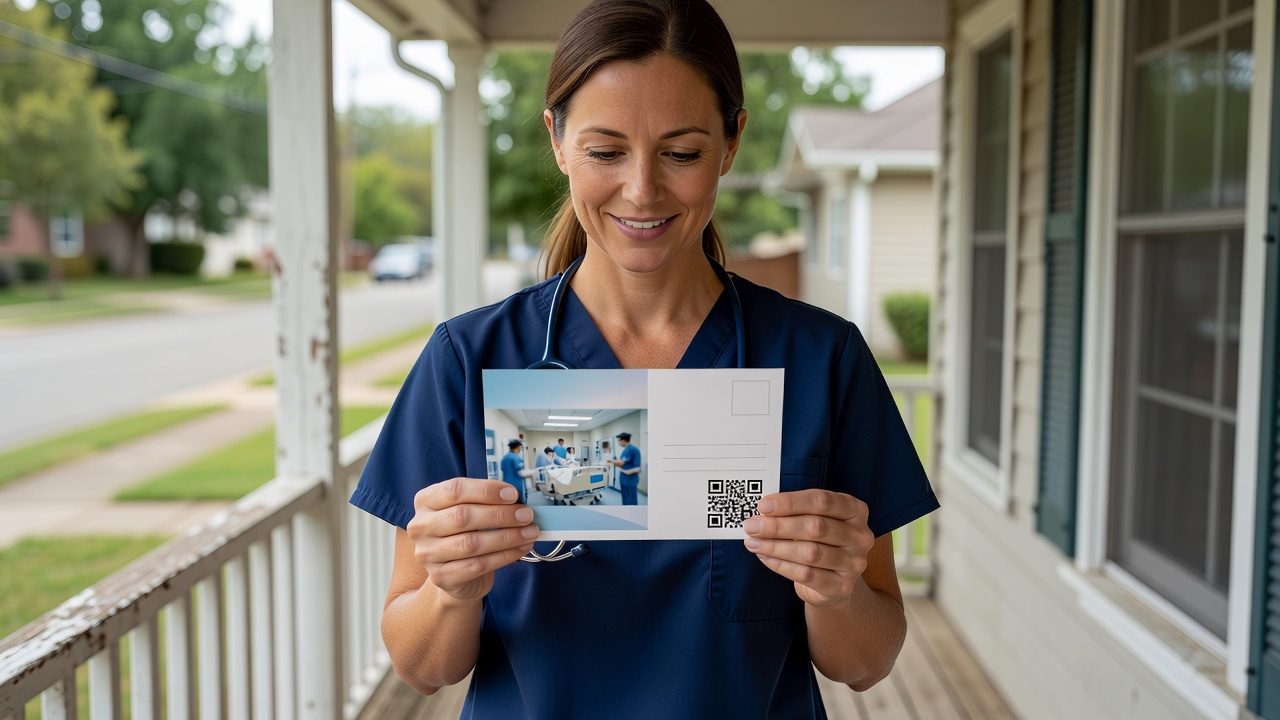
An effective rural PT card has four parts: a personalized name, a specialty and scope message, employer and community context, and one clear call to action. Each part has a specific job on a small piece of mail.
1. Personalized name
The card arrives addressed to a specific PT by their actual first name, not to "Physical Therapist" or a generic title. That small detail separates it from a mass mailing and tells the reader the message was meant for them.
2. Specialty and scope message
Show what kind of PT work the candidate will do, and be specific. Rural roles often involve broader scope, a different pace, or distinct patient populations. If that is true for your role, say it plainly. "Orthopedic and post-surgical caseload with some geriatric care" tells a candidate more than "exciting opportunity."
3. Employer brand and community context
Include details that make your practice or facility real: team size, patient mix, equipment, specialty services, or professional development paths. A rural clinic might highlight a close-knit team or access to outdoor recreation. A hospital might emphasize specialty services or growth paths. Only use details that are true and that you can back up on the landing page.
4. One clear call to action
Use a QR code and a short URL that lead to a landing page where the candidate can learn more, apply, or request a call. Avoid competing messages. One card, one action.
What to Clarify Before You Brief Your Campaign
Before a campaign is briefed, you should be able to answer the questions a relocating PT will ask, because the card and landing page can only share what you have decided. Work through the points below with your hiring manager and leadership.
Scope of practice
Decide whether this PT will work independently, supervise aides, handle triage, or manage a specific caseload. Rural roles often differ from hospital-based or urban outpatient settings, and candidates want to know how.
Schedule and flexibility
State whether the role is part-time, full-time, shift-based, or includes on-call coverage. Rural employers sometimes have more scheduling flexibility than candidates assume, so say so if it applies.
Relocation support
List any sign-on bonus, relocation assistance, loan repayment, housing help, or flexible start date. If you offer it, state it clearly. If you are not sure yet, settle it before the campaign is built rather than after.
Professional isolation and community
Some PTs worry that a rural setting means professional isolation. If you have continuing education support, peer collaboration, or access to specialists, put that in the message.
Housing and cost of living
Rural areas may cost less to live in, but housing availability varies widely. If you can offer insight into local housing or point to resources, include it.
What patients actually need
Rural caseloads often have a distinct character. Agricultural workers, aging retirees, or outdoor-recreation injuries may drive demand. Show the real picture so candidates can picture the work.
Building an Audience for Candidates Who Might Relocate
You build the audience by targeting licensed PTs across the geography you are willing to recruit from, not just the town or county where the job sits. That lets you reach PTs in urban or regional markets who may be open to a move if the role and community fit their goals.
- Geography goes beyond your town. The audience can include candidates in other cities, regions, or states, depending on how far you are willing to recruit.
- Do not assume proximity. The card must answer why relocation is worth considering from the first glance.
- License type and specialty keep the audience precise. You reach PTs, not a generic group of healthcare workers. You can narrow by clinical focus such as orthopedics, neuro, pediatrics, or geriatrics when the role calls for it.
- One audience can span several markets. A single campaign can cover multiple states or regions, and a nationwide rollout is possible.
This is different from buying a generic mailing list. The targeting is built around license type, specialty, and geography, and it is shaped by the role you need to fill.
Your Landing Page After the QR Scan
The landing page is where you finish the story the postcard started. If the card mentions professional growth, the page should show the specifics, such as continuing education access, mentorship, career pathways, or specialization tracks.
Answer relocation questions on the page
Address relocation concerns directly. Include links to local housing resources, school information, community recreation, and cost-of-living context. Candidates considering a move are looking for reasons to feel confident, and a page that answers their questions does that work for you.
Make the next step obvious
A candidate should be able to apply, request more information, or ask for a brief call from the same page. Do not make them hunt for it.
Watch how the page performs
Track QR scans and landing page traffic, and look at which sections people engage with. That tells you whether your relocation message is landing or needs adjustment before the next campaign.
Messaging Angles for Different Rural PT Scenarios
The right lead message depends on what your setting actually offers. Pick the angle that is true for you rather than listing every possible benefit.
Rural hospital with a growing PT department
Lead with professional growth, equipment, collaborative team culture, and exposure to several patient populations in one setting.
Solo or small-group clinic
Emphasize autonomy, patient relationships, a voice in practice decisions, and a close-knit team.
Underserved community with high patient demand
Show the direct impact of the work. PTs in rural areas often build long relationships with their patients and see the effect of their care close up.
Facility with outdoor recreation or lifestyle appeal
If you are near mountains, lakes, or an outdoor activity hub, name it. For some candidates that is a genuine reason to move.
Area with a labor shortage and strong support
If you offer relocation funds, flexible schedules, or loan repayment, lead with that. Candidates relocating for a rural role often care about practical support first.
What Not to Assume About Your Candidate
The biggest mistake in a rural PT message is assuming the candidate already knows or wants what you are offering. Four assumptions are worth avoiding.
- Do not assume they know your town or region. Even if your community is well known nearby, a PT in another market may never have considered it.
- Do not assume they are tied to their current location. Some PTs are ready to move. Others need certainty about schools, housing, or work for a partner.
- Do not assume they will search for you online. Passive candidates are not researching employers unprompted. The card and landing page are your chance to tell the story.
- Do not assume lower pay is acceptable because the area is rural. Many rural employers compete through compensation, schedule, or lifestyle fit, not by undercutting wages elsewhere.
Measuring What Works in Your Rural PT Campaign
You measure a rural PT campaign through QR scans and landing page activity, which show how candidates responded to your message. These are signals you can act on, not guesses.
- QR scans show how many PTs engaged with the card. If scans are low, the headline or visual on the card may need work.
- Landing page traffic and section engagement show which topics matter most. Are candidates reading relocation resources more than the job description? That tells you what to emphasize next time.
- Applications and inquiries show whether interest turned into action.
- Geographic origin of responders, where you can see it, helps you learn which regions yield the most qualified candidates and refine future targeting.
Getting Started with Your Rural PT Brief
Start by writing down five things before anyone designs a card. Doing this up front keeps the message honest and specific.
| Brief item | What to decide |
|---|---|
| The role and its scope | Be honest about what a rural PT does day to day. |
| Real advantages | List what would make you want to relocate if you were a PT. |
| Relocation support | Name relocation help, flexible start dates, and housing resources you can offer. |
| Geographic reach | Decide how far you are willing to recruit and which markets may have PTs open to a move. |
| Landing page plan | Decide what story to tell after the scan and which questions to answer. |
Plan your rural PT campaign. If you have a PT role that is not closing and want to talk through the card, audience, and landing page, Book a 15-minute call.
Frequently Asked Questions
Can a postcard really persuade a PT to relocate?
A postcard alone will not, but it can start the conversation. Its job is to get a passive candidate to take one step, scanning the code, where the landing page can tell the fuller story.
Should the card mention pay or relocation support?
If you have a clear offer, such as relocation assistance or loan repayment, it can be a strong lead because candidates relocating often weigh practical support. Confirm what you can state before the card is designed.
Can we target PTs by specialty, not just license type?
Yes. Targeting is by license type, specialty, and geography, so you can aim at a clinical focus such as orthopedics, neuro, pediatrics, or geriatrics when it fits the role.
Can one campaign reach candidates in several states?
Yes. A single audience can span multiple states or regions, and nationwide rollouts are supported, depending on how far you want to recruit.
How do we know whether the campaign worked?
Response is tracked through QR scans and landing page traffic, along with applications and inquiries. Those signals show what candidates did with your message.
Sources
Enjoyed this? There's more from RecruitCard.
Book a 15-minute call →