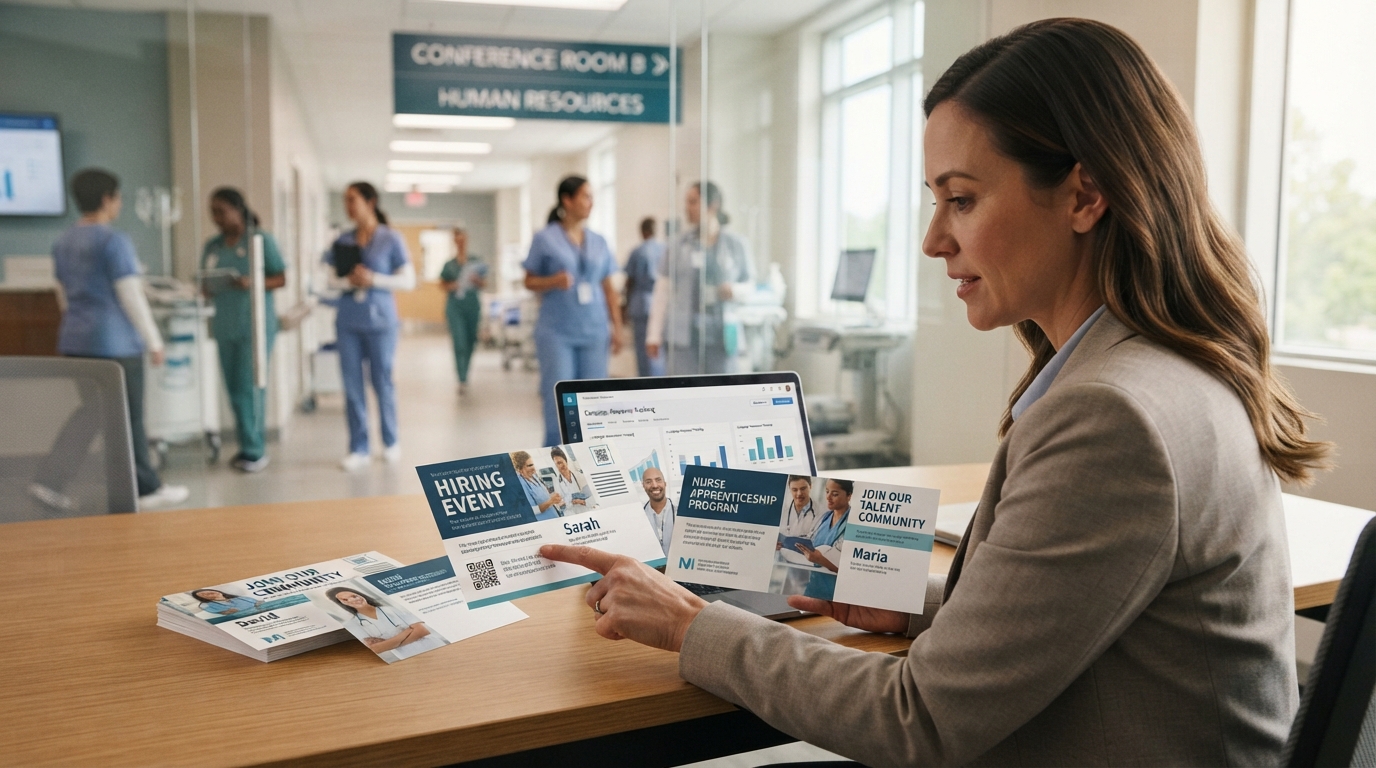
When a Hiring Event Has No Search Demand Yet

For hospital and health system talent teams promoting a hiring event before candidates are actively searching, personalized direct mail can make the event itself the awareness message. A campaign can reach a defined license or specialty audience in a chosen geography and guide each recipient to one clear next step, such as registering, viewing open roles, or attending the event.
Why a Hiring Event Can Have No Search Demand Yet
A candidate cannot search for an event they do not know exists. This is the central challenge for a hiring event, open house, facility launch, apprenticeship program, or future-focused recruiting initiative.
Search intent and awareness are different. Job boards and paid search are most useful when someone is already looking for a role, an employer, or an event. They are less suited to introducing an opportunity to a qualified professional who is employed, not searching, and unaware that your event is happening.
This matters when you are planning an event for a specific workforce audience, such as registered nurses for a hard-to-fill unit, licensed practical nurses for long term care, or physical therapists for a rehabilitation team. The purpose is not only to capture existing demand. It is to create awareness among people who may have a reason to attend once they see a relevant invitation.
This approach is for hospital and health system HR and talent acquisition professionals who need to put a specific event in front of a defined clinical audience.
Make the Event the Awareness Object
The mailer should make the event the central message, not simply repeat a broad statement that your organization is hiring. Give the recipient a clear reason to pay attention now: an opportunity to meet a team, learn about a unit, explore relevant openings, or find out about a new program.
Define the intended action before creative work begins. Depending on the event, that action might be:
- Register for the event.
- Scan to view event details.
- View relevant openings before attending.
- Join a talent pipeline for future communication.
One clear action is easier to understand than several competing recruiting messages. A card that asks a recipient to apply, register, follow social channels, call a recruiter, and visit a general careers page creates unnecessary choices. An event invitation works best when the recipient can quickly see what the event is and what to do next.
The event can be relevant even if the recipient is not currently searching for your employer or for a new role. The invitation creates the first point of awareness.
Start With a Defined Specialty Audience
A hiring event invitation does not need to be a broad message to a general demographic. The audience can be planned around license type, specialty, and geography.
For example, an organization might plan an event campaign for:
- Registered nurses for an intensive care unit hiring event.
- Licensed practical nurses for a long term care event.
- Physical therapists for a rehabilitation recruiting event.
- Professionals relevant to emergency, operating room, labor and delivery, oncology, case management, or night shift needs.
A specialty-specific invitation gives the recipient a clearer reason to consider the event. “Meet the intensive care team” is more relevant to an ICU nurse than a general invitation addressed to all job seekers. The same principle applies when the event concerns a particular shift, facility, service line, or career path.
RecruitCard plans audiences through matching by license type, specialty, and geography. That focus is different from sending a broad, generic mailing.
The Four Parts of an Event Mailer
A useful event mailer should answer four questions quickly: who is inviting the recipient, why the event may matter to them, when and where it occurs, and what they should do next.
Personalized name
Using the recipient's actual first name makes the invitation feel intended for a specific professional. Personalization should support a relevant message, not stand in for one.
Specialty-specific message
The message can connect the event to the recipient's license, specialty, shift, unit, trade, or career interest when appropriate. For example, a nursing event may focus on a particular clinical team, while a rehabilitation event may speak directly to the work and setting relevant to therapists.
Credible employer branding
The card should clearly identify the organization, facility, team, and event context. Employer branding helps the recipient understand who is inviting them and why the invitation is worth considering.
One clear action
A QR code and short URL can direct recipients to event details, registration, or another approved next step. The call to action should match the goal established for the campaign.
What the Landing Page Should Do After the Scan
The landing page should continue the promise made on the card. It should be focused on the event rather than routing visitors immediately to a general careers homepage.
Depending on the event, the page may include:
- The event date and time.
- The location or instructions for accessing a virtual event.
- Participating teams or departments.
- Relevant roles or career areas.
- Registration details.
- A simple contact or sign-up path, when applicable.
Specificity matters. A recipient who scans a card about an operating room hiring event should find information that confirms the event is relevant to operating room professionals.
QR scans and landing page traffic provide measurable signals of campaign activity. They show interaction with the event destination. They should not be treated as hires or guaranteed attendance. Review those signals alongside registrations, attendance, and recruiter follow-up.
Use Direct Mail Alongside Existing Recruiting Channels
Direct mail can serve as an awareness channel alongside job postings, recruiter outreach, social promotion, email, and event reminders. It does not need to replace those channels.
The distinction is practical. Search and job boards reach people who are actively looking. A targeted mail campaign can introduce an event to defined passive candidates who may not encounter it through search because they are not seeking a new role or do not know the event exists.
Before launch, align the mail date with the landing page, registration process, recruiter follow-up plan, and event reminders. The experience after a scan should be ready before the invitation arrives.
A campaign can support a single market or a nationwide rollout, depending on the recruiting objective and the audience you need to reach.
When This Approach Fits Best
Personalized direct mail may be a useful fit when:
- You are creating a hiring event for a specific license or specialty audience.
- You need awareness for a new facility, team, shift, apprenticeship, or training opportunity that candidates cannot search for yet.
- Your qualified local audience is limited and many potential candidates are already employed.
- You want to build a longer-term talent pipeline before the next vacancy opens.
- You are a recruitment marketing agency seeking to offer a direct mail channel under your own brand through a white-label option.
It can be particularly relevant for roles that do not close through normal channels, including niche specialties, rural sites, and hard-to-fill shifts.
What RecruitCard Manages
RecruitCard manages an end-to-end direct mail recruiting campaign. The process includes audience targeting, card design, personalized names, employer branding, printing, postage, delivery, QR code setup, landing page coordination, and response tracking.
This is more than a mailing list handoff. The campaign is built around the event audience and the single action you want recipients to take.
RecruitCard has its deepest expertise in licensed healthcare hiring. The same campaign model is also available to engineering and skilled-trade employers seeking licensed or certified candidates.
If you are planning an event and want to discuss the audience and desired action, Book a 15 minute call.
Frequently Asked Questions
Can direct mail promote an event before people are searching for it?
Yes. A campaign can introduce the event to a defined license or specialty audience and direct recipients to event details, registration, or another single next step.
Can you target a specific unit or specialty instead of all healthcare workers?
The audience can be planned around license type, specialty, and geography. Examples include intensive care, emergency, operating room, labor and delivery, oncology, case management, and night shift recruiting needs.
How do we measure whether the event campaign generated interest?
QR scans and landing page traffic show campaign activity and help you evaluate engagement with the event destination. Review these signals alongside registrations, attendance, and recruiting follow-up.
Does this work only for one open requisition?
No. The same model can support hiring events, open houses, apprenticeship awareness, facility launches, and ongoing pipeline building.
Can RecruitCard handle design and mailing?
Yes. RecruitCard manages targeting, creative, printing, postage, delivery, and response tracking as part of an end-to-end direct mail recruiting campaign.
Enjoyed this? There's more from RecruitCard.
Book a 15-minute call →