When One RN Posting Covers Too Many Jobs: Segmenting ICU, ED, and Oncology Outreach

If one RN posting is trying to attract ICU, ED, and oncology candidates at once, it may be too broad to earn attention from any of them. Segmenting outreach by specialty lets you speak to each audience’s work, priorities, and next step while keeping the campaign tied to your actual hiring needs. This approach is for hospital and health-system HR and talent-acquisition teams hiring for hard-to-fill nursing roles.
Why One General RN Posting Can Miss the Right Candidates
An “RN needed” message may be accurate, but it can make very different nursing roles feel interchangeable. ICU, ED, and oncology nurses share an RN license. They do not necessarily evaluate an opportunity through the same professional context.
A nurse already working in critical care may want to know which unit is hiring and what kind of environment the role supports. An ED nurse may look first for clarity about the emergency-department setting and shift. An oncology nurse may need to see an oncology-specific opportunity, rather than a general statement that a hospital is hiring nurses.
This matters especially with passive candidates: licensed professionals who are already employed and are not actively searching job boards. A broad message can be easy to pass over, even when a specific role might merit consideration. Specialty segmentation is a way to make outreach more relevant. It is not a guarantee of applications or hires.
Start With the Hiring Problem, Not Just the RN License
License-level targeting identifies the broad professional qualification: RN. Specialty-level outreach adds the role context that makes the message meaningful: ICU, ED, oncology, or another defined nursing area.
Before developing a card or landing page, define the hiring problem in practical terms:
- The exact unit or specialty
- The shift, when it is relevant to the role
- The location or locations
- The specific requisition, hiring event, or pipeline objective
- The action you want an interested nurse to take
An ICU opening, an ED night-shift role, and an oncology position can belong to the same health system hiring initiative. They should still be treated as three related but distinct messages. Geography belongs in each audience definition, particularly when the qualified local pool is limited or when you want to make a role visible beyond one immediate market.
What ICU, ED, and Oncology Messages Should Emphasize
The purpose of specialty-specific creative is not to add more copy. It is to make the recipient quickly recognize that the opportunity is meant for their work.
ICU outreach
ICU outreach should identify the critical-care context clearly. The message can name the unit, location, shift, or hiring purpose when those details are approved for use. It should make the role expectations and unit identity more visible than a generic hospital-wide RN hiring message.
For example, a card might lead with an approved ICU role description and direct the recipient to an ICU-specific career page or hiring-event page. Avoid adding clinical details, staffing statements, benefits, or candidate outcomes unless the employer has approved them.
ED outreach
For ED outreach, make the emergency-department setting clear. A nurse should not need to scan several lines of general employer copy to determine whether the opportunity relates to emergency nursing. If the campaign concerns a night shift, a particular site, or an event for ED candidates, put that approved information in the message.
The goal is a recognizable opportunity with one next step, not a general statement that the hospital has open nursing roles.
Oncology outreach
Oncology outreach should state the oncology context and give a qualified nurse a concrete reason to explore the opportunity. Broad phrases such as “make a difference” may be part of an employer’s approved brand voice, but they should not carry the whole message on their own.
Useful approved details may include the unit or program name, location, shift, a hiring event, or the destination for learning more. Keep claims limited to information the employer has provided and approved.
The Anatomy of a Segmented RN Direct-Mail Card
A segmented card works best when it has a clear audience and a clear purpose. RecruitCard’s approach centers on four components.
Personalized recipient name
Using the recipient’s actual first name makes the piece feel addressed to a professional rather than sent to a broad demographic. Personalization should support relevance, not replace it.
Specialty-specific message
The headline and supporting copy should match ICU, ED, or oncology. Reusing one general RN message across every audience can undo the value of specialty segmentation.
Credible employer branding
Use the hospital or health system’s approved logo, voice, and role information. Employer branding should help the recipient understand who is hiring and what opportunity is being presented.
One clear action
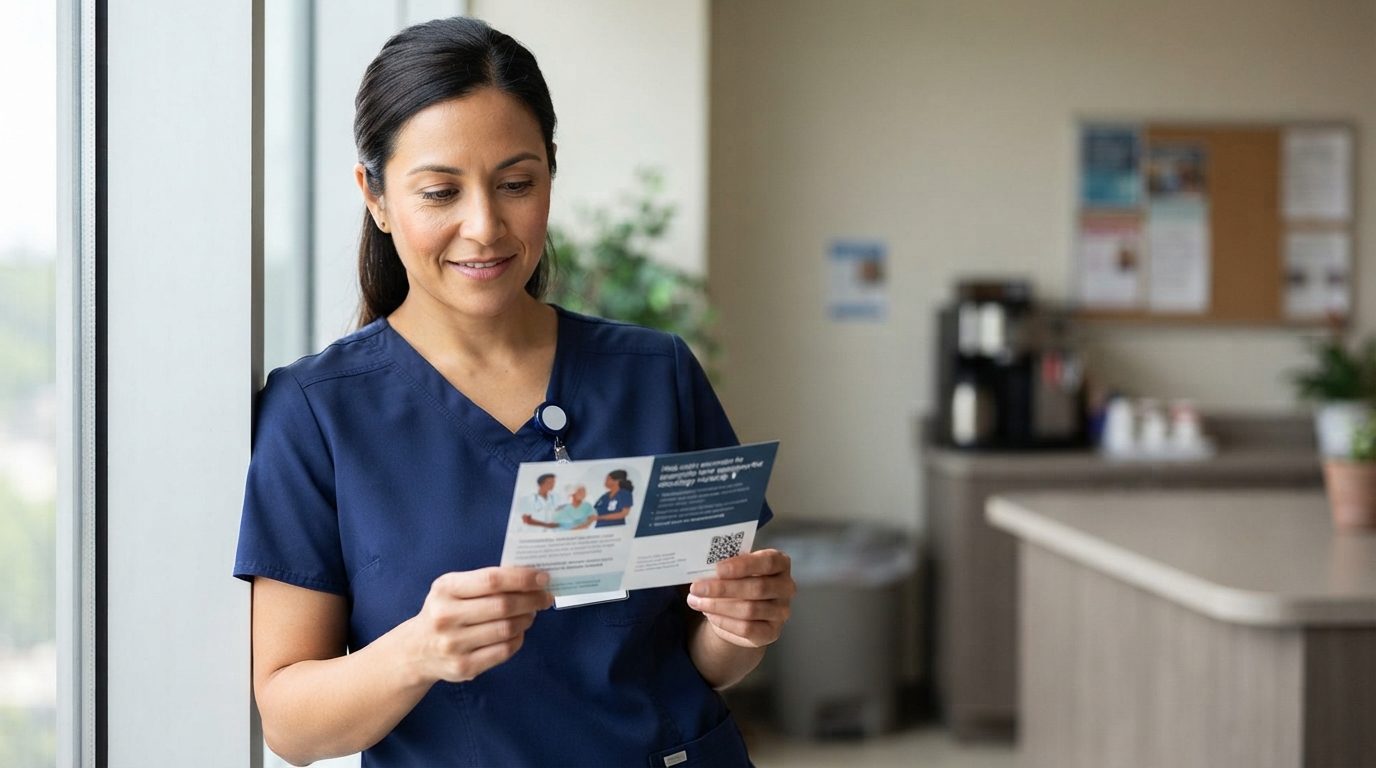
Give the recipient one primary next step: scan a QR code or use a short URL to reach the appropriate landing page or application path. A focused card generally has one specialty audience, one main opportunity, and one next step.
How to Build Separate Audiences for ICU, ED, and Oncology
RecruitCard campaigns are built around matching by license type, specialty, and geography. This is different from handing over a generic mailing list. The campaign also includes creative, printing, postage, delivery, and response tracking.
A practical segmentation structure includes:
- RN license type
- Nursing specialty or trade
- Target geography
- Specific requisition or campaign purpose
One health system might run separate ICU, ED, and oncology creative under one broader nursing initiative. Each segment can have its own message and response path while remaining coordinated around the same hiring priorities.
The model can support a single-market effort or a nationwide rollout, depending on your recruiting need. The appropriate scope starts with the role, the location, and the audience you need to reach.
When Segmentation Matters Most
Hard-to-fill units
Specificity matters when a role is unlikely to close through normal channels. Niche specialties, difficult shifts, and smaller qualified pools benefit from a message that shows the recipient why the outreach is relevant to their work.
Night-shift hiring
A dedicated message can make the shift and unit visible before a nurse reaches the landing page. That helps avoid a mismatch between a broad recruiting message and the actual opening.
Rural or smaller-market roles
For rural or smaller-market roles, focused geography and specialty messaging can be more useful than a hospital-wide RN appeal. The goal is to define the audience around the actual recruiting challenge rather than mailing broadly without a clear role connection.
High-volume hiring and pipeline building
Segmentation is not limited to one requisition. It can support ongoing outreach for high-volume local roles and longer-term candidate pipelines, with messaging organized around the specialties and locations that matter to your workforce plan.
Hiring events and awareness campaigns
The same approach can promote open houses, hiring events, and programs that candidates may not discover through job search. A specialty-specific invitation can be more recognizable than a general hospital recruiting announcement.
How Segmented Direct Mail Complements Job Boards and Paid Search
Job boards and paid search are useful channels, but they primarily reach people who are actively looking or responding to search behavior. The nurses you most want to reach may be employed, busy, and not searching for a new role.
Personalized direct mail gives your specialty and employer message another route to passive, already-employed licensed professionals at home. It does not replace every other recruiting channel. It adds a channel for a defined audience that may not encounter your posting through normal job-search activity.
The distinction is also operational. A generic mailing-list purchase is a list handoff. RecruitCard’s stated approach is audience matching by license type, specialty, and geography, followed by managed creative, print, postage, delivery, and response tracking.
RecruitCard’s Managed Campaign Process
Audience planning
Start by defining the RN specialty, geography, and hiring objective. This could be a specific ICU vacancy, ED night-shift hiring, oncology outreach, an event, or a broader pipeline need.
Creative development
The card is developed around the recipient’s first name, a specialty-specific message, approved employer branding, and one clear action.
Production and delivery
RecruitCard manages printing, postage, and delivery as part of the campaign. You are not left with a list and a separate production process to manage.
Response tracking
QR codes and landing-page traffic provide a way to see how recipients engage with the campaign. Separate codes or destinations can help distinguish specialty segments.
Follow-up planning
Before the campaign is delivered, align the landing page and recruiting workflow with the role being promoted. An ICU recipient should reach an ICU-relevant destination, not a general nursing page that forces them to start over.
How to Measure ICU, ED, and Oncology Outreach
Track QR scans and landing-page traffic for each specialty segment and creative version. When ICU, ED, and oncology have separate landing pages or campaign paths, you can distinguish engagement by audience rather than relying on one blended RN total.
Your team can then connect tracked engagement with its own follow-up process, including inquiries, applications, or recruiting conversations. No one metric tells the whole story, but measurement becomes more useful when the audience, message, and destination are clearly separated.
Review activity by specialty, geography, and campaign purpose. An ICU hiring message and an oncology-event invitation have different objectives and should not be judged as though they were the same campaign.
A Practical Decision Guide: One Campaign or Three Segments?
Use one broader campaign when the roles, audience, geography, and employer message are genuinely similar. Use separate segments when units have different specialties, shifts, locations, candidate motivations, or landing pages.
A coordinated multi-segment rollout can make sense when you need ICU, ED, and oncology hiring at the same time. The key question is simple: would each audience recognize the message as intended for their work? If not, that audience likely needs its own creative.
Do not create segments merely to create more campaign pieces. Tie each segment to a real hiring objective and a clear follow-up path.
What to Prepare Before a Campaign Planning Call
Bring the information that will make the audience and message specific:
- Priority requisitions, identified by ICU, ED, oncology, or another specialty
- Target geography for each role, including whether the effort is local, multi-location, or nationwide
- Approved employer branding, unit details, shift information, and desired call to action
- The campaign goal: a specific hire, hiring event, program awareness, or a longer-term RN pipeline
If you are deciding whether broad RN outreach should become specialty-specific, book a 15-minute call to discuss a segmented campaign.
Frequently Asked Questions
Can you target ICU, ED, and oncology nurses separately?
Yes. The campaign model supports audience matching by license type, specialty, and geography, with specialty-specific creative and response tracking for each segment.
Is this just a generic RN mailing list?
No. RecruitCard’s stated approach combines precision targeting by license type, specialty, and geography with personalized creative and managed production, postage, delivery, and tracking.
Can one health system run outreach for several units at once?
Yes. A campaign can be structured as coordinated segments for multiple units or locations, including single-market and nationwide rollouts.
How do we measure whether each specialty message worked?
Use QR scans and landing-page traffic. Separate destinations or campaign paths for ICU, ED, and oncology make it easier to distinguish engagement by specialty.
Does this work only for one open RN requisition?
No. The same model can support hard-to-fill roles, hiring events, program awareness, and ongoing candidate-pipeline building.
Enjoyed this? There's more from RecruitCard.
Book a 15-minute call →