Why Many Qualified RN Candidates Never See Your Job Posting

Job boards and digital ads are built mainly for people who are already searching, clicking, or responding to recruitment messages. That creates a structural gap when you need to reach already-employed licensed professionals, particularly for hard-to-fill healthcare roles such as ICU, OR, night shift, rural, and niche specialty positions.
This article is for hospital and health-system HR and talent-acquisition teams hiring licensed healthcare professionals, employers with a requisition that remains open despite normal channels, and recruitment marketing agencies evaluating direct mail as an additional channel for licensed-hiring campaigns.
The short answer: passive candidates are outside the normal digital funnel
Job boards depend on a candidate visiting a job-search platform and considering available postings. Digital ads depend on a candidate being reachable through online activity, noticing the message, and deciding to act.
An already-employed RN, physical therapist, dental hygienist, or other licensed professional may be well qualified for your opening but have no reason to search for a new job today. They may not visit a job board, search for a role, or engage with recruitment content often enough to encounter your ad.
That does not make job boards and digital advertising unhelpful. Both can be useful channels for active applicants. The limitation is structural: they do not naturally put your opportunity in front of every qualified professional who is not actively looking.
What “passive, already-employed licensed candidate” means
A passive candidate is someone who is not actively applying for jobs but may consider the right opportunity. An already-employed licensed candidate is working in a role, specialty, setting, or trade related to the position you need to fill.
For example, this could be:
- An experienced RN working a different shift or unit.
- A physical therapist working in another market who may consider a relocation opportunity.
- A dental hygienist who is not browsing job postings but would consider a nearby practice with a relevant schedule or work environment.
- A licensed professional in a niche specialty who is employed and not responding to broad recruiting messages.
These professionals may respond to a credible, relevant opportunity. But a generic job advertisement may not give them enough reason to interrupt their routine and explore it.
Why job boards miss part of this audience
To find your job-board posting, a candidate generally needs to visit the platform or encounter the listing through a related search. Then they need to notice it among other listings and decide that it is worth exploring.
That sequence works best for people who are already looking. It is less dependable for an employed professional who is not planning a move.
A broad title such as RN may also leave out the details that determine whether a role is relevant. For a licensed healthcare professional, those details can include:
- ICU, ED, OR, L&D, oncology, or case-management work.
- Night-shift expectations.
- A particular facility, practice setting, or geographic area.
- A role that may be attractive to a professional considering a move from another market.
A posting can be visible without being personally relevant to the person who would be a strong fit. Job boards are useful for active applicants, but they are not designed as a direct channel to every qualified professional in a defined specialty and geography.
Why digital ads miss part of this audience
Digital advertising competes for attention in environments where users may not be thinking about changing jobs. Seeing an ad does not establish that the person is qualified, notices the message, or takes the next step.
Broad digital targeting can create reach without the specialty-level relevance required for a hard-to-fill role. A candidate may also never see the ad because of platform behavior, browsing patterns, timing, or limited engagement with recruitment-related content.
Paid digital channels can support recruiting. But when the qualified local pool is small, specialized, and already employed, more digital activity may not solve the underlying access problem.
The structural problem is access, not just message quality
A stronger job description can improve the experience for people who find it. It does not change whether passive candidates encounter it in the first place.
Likewise, increasing ad activity does not necessarily create access to professionals who are not engaging with job-search content. For a role that will not close through normal channels, you may need a channel that reaches people outside the active-search funnel.
The practical question is simple: How do you put a relevant opportunity in front of qualified professionals who are not currently looking?
Why licensed healthcare hiring makes the gap more visible
Healthcare hiring often requires a precise combination of license, specialty, setting, schedule, and location. The qualified audience for an ICU night-shift RN, an OR nurse, a rural physical therapist, or an oncology role is smaller than a general demographic audience.
A broad message can consume attention from people who do not have the right license, specialty, location, or interest in the position. Precision matters because the hiring need is not simply “more applicants.” It is access to the right professionals.
This is why hard-to-fill licensed healthcare hiring can benefit from targeting by license type, specialty, and geography rather than reaching a larger undifferentiated audience.
Direct mail as a way to reach outside the active-search funnel
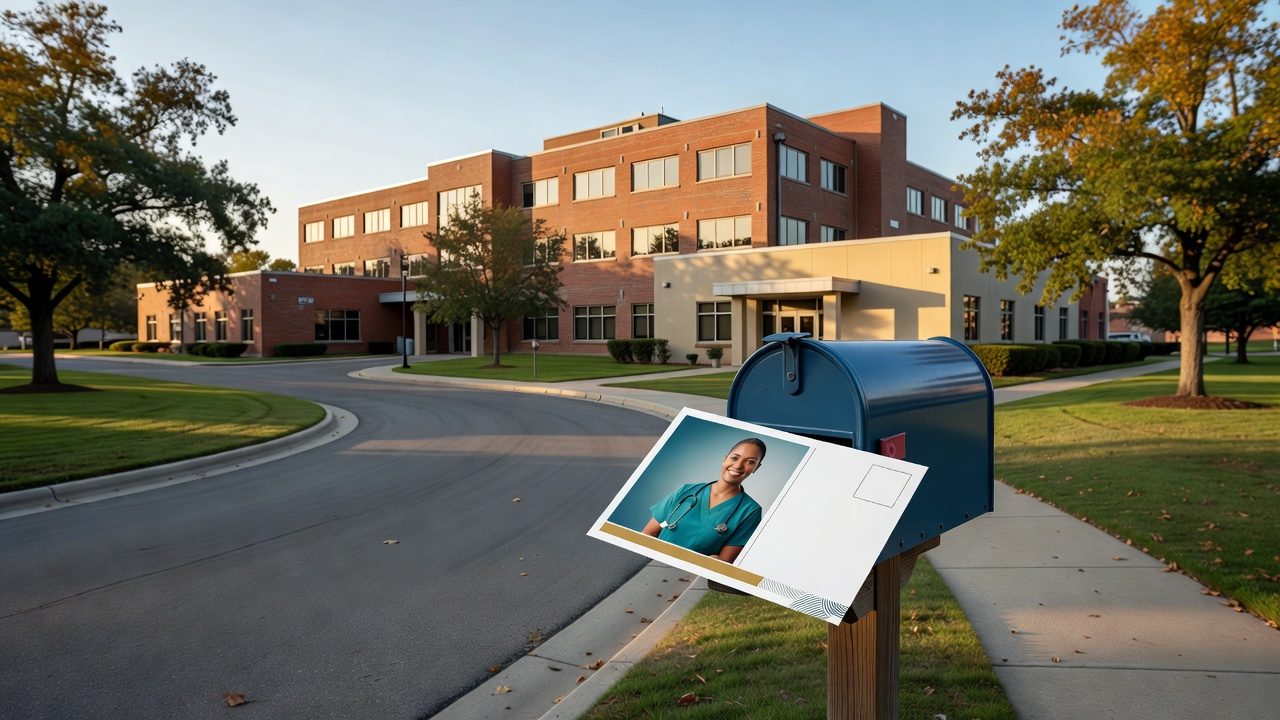
A personalized mail piece reaches a candidate at home rather than waiting for that person to search online for a job. The campaign audience can be matched by license type, specialty, and geography, rather than treated as a generic mailing list.
Direct mail also gives your employer brand and message their own physical space. The recipient is not comparing it with a page of job listings or a stream of search ads at that moment.
This approach can be relevant for:
- A specific hard-to-fill requisition.
- A high-volume local hiring need.
- A hiring event or open house.
- Awareness for an apprenticeship or training program.
- A long-term candidate pipeline effort.
Direct mail is not a universal replacement for digital recruiting. It is a complementary channel for reaching qualified professionals who may sit outside the active-search funnel.
What makes a targeted recruiting mailer different from a generic list mailing
A generic list mailing starts with a broad audience. A targeted recruiting mailer starts with the hiring need: the relevant license type, trade or specialty, and geographic location.
The message can then be built around why the opportunity may matter to that professional group. For example, it can speak to ICU work, OR experience, rural practice, night shift, or a defined allied-health discipline.
Recruiting mail can also make the employer clear and give the recipient a straightforward next step. The goal is relevance, not simply volume.
The anatomy of an effective RecruitCard
A focused RecruitCard has four core components:
- Personalized name: Use the recipient’s actual first name where appropriate.
- Specialty-specific message: Connect the opportunity to the recipient’s license, trade, specialty, or likely professional context.
- Credible employer branding: Identify your organization clearly and present the opportunity professionally.
- One clear action: Use a QR code and short URL that lead to a focused landing page.
Personalization is a relevance tool. It does not promise that every recipient will respond. It does help make the message feel more specific than a generic greeting and a broad job title.
One clear action also reduces friction. Rather than asking the recipient to choose among several next steps, a card can invite them to scan, review the role, register for an event, join a pipeline, or begin an application.
How to measure whether passive candidates engage
Direct-mail recruiting does not need to be an unmeasured activity. A QR code on the mail piece can record scans, and a focused landing page can show campaign-generated traffic.
The landing page should make the next step clear. Depending on the campaign, that may mean reviewing a role, joining a candidate pipeline, registering for an event, or starting an application.
Your recruiting team can connect campaign activity to its existing response and follow-up process. QR scans and landing-page traffic show response-level engagement from the campaign without assuming a guaranteed response rate, cost per hire, or return on investment.
Use cases beyond one open requisition
Hard-to-fill units and specialties
Use a targeted campaign to promote a defined need such as ICU, ED, OR, L&D, oncology, case management, or night-shift work. The message can be aligned to the specific professional context instead of relying on a broad title alone.
High-volume local hiring
For recurring needs such as CNA, HHA, caregiver, or similar roles, a campaign can maintain awareness in a defined geographic area rather than beginning from zero with each opening.
Hiring events and open houses
A mailer can invite qualified professionals to a recruitment session, open house, or hiring event. This is useful when the action is event registration rather than an immediate application.
Apprenticeships and training programs
Some opportunities cannot be discovered through an ordinary job search because candidates do not yet know they exist. A focused mail piece can explain an apprenticeship or training program and direct recipients to learn more.
Long-term pipeline building
Pipeline campaigns build awareness before the next vacancy opens. This can be useful when a specialty, location, or schedule creates recurring hiring pressure.
Multi-location and nationwide campaigns
The same model can support one market, multiple locations, or a broader nationwide rollout. The audience and message should still be defined around the actual hiring need.
When this approach is a good fit
Targeted direct mail may be a practical addition to your recruiting mix when:
- A requisition has remained open and is not closing through normal channels.
- The qualified pool is limited, specialized, geographically defined, and likely to include already-employed professionals.
- You need ongoing awareness for recurring or high-turnover roles.
- You want to reach candidates who may consider relocating for the right opportunity.
- You are promoting a hiring event, apprenticeship, training program, or long-term candidate pipeline.
- You are a recruitment marketing agency that wants to offer direct mail without building an in-house targeting, creative, print, postage, delivery, and tracking operation.
Questions to ask before choosing a channel
Before launching any recruiting campaign, clarify the access problem and the action you want recipients to take:
- Are you trying to reach active applicants, passive professionals, or both?
- What license type, specialty, trade, and geography define a qualified audience?
- Does the message explain why the opportunity is relevant to that professional group?
- What one action should a recipient take after receiving the message?
- How will you track QR scans, landing-page traffic, inquiries, event registrations, or pipeline activity?
- Do you need a one-time campaign, hiring-event promotion, or an ongoing pipeline program?
These questions help determine whether your challenge is application volume, audience quality, awareness, or access to professionals who are not currently looking.
Where RecruitCard fits
RecruitCard manages direct-mail recruitment campaigns end to end. This includes audience targeting by license type, specialty, and geography; card design; personalized recipient names; printing; postage; delivery; and QR-code and landing-page response tracking.
RecruitCard’s deepest stated expertise is licensed healthcare hiring. The same direct-mail model is also available to engineering and skilled-trade employers seeking licensed or certified candidates.
Campaigns can support a single market or a nationwide rollout. Recruitment marketing agencies can also explore a white-label option.
Reach beyond who is already searching
Job boards and digital ads remain useful for active job seekers. But they do not naturally reach every qualified professional who is already employed and not searching.
For a hard-to-fill licensed role, the missing step may be access to a precise audience, not simply more digital exposure. A targeted, personalized direct-mail campaign can put a relevant opportunity in front of licensed professionals and measure engagement through QR scans and landing-page traffic.
Book a 15-minute call to discuss a specific role, hiring event, or pipeline need. You can also Call 516-642-9162.
Enjoyed this? There's more from RecruitCard.
Book a 15-minute call →