Why the Same Technical Recruiting Message Should Not Go to Every Credential Group
If you send the same recruiting message to every credential group, qualified candidates may not see a clear reason to respond. This article is for employers and recruitment marketing agencies hiring licensed or certified professionals, including healthcare, engineering, and skilled-trade candidates. It explains how to adapt your message by credential, specialty, and geography without creating a separate campaign for every individual.
Why One Recruiting Message Falls Short
A credential is more than a label. It often reflects a candidate's training, daily responsibilities, work environment, and career priorities. An ICU nurse, dental hygienist, physical therapist, and certified trade professional may all be qualified professionals, but they do not necessarily evaluate opportunities through the same lens.
A broad statement such as Now hiring skilled professionals may be technically true, but it gives a specialized candidate little information to act on. It does not indicate whether the opening relates to their license or certification, the work they perform, or the setting where they would work.
The goal is not to make a wholly different campaign for every person. The goal is to help each credential group recognize a relevant reason to consider the opportunity. That starts with identifying the group clearly and describing the work in terms that fit that group.
What Changes Between Credential Groups
A credential group is a segment of candidates who share a license, certification, trade, or specialty relevant to the role. One group may include ICU nurses in a defined market. Another may include dental hygienists near a set of practice locations. A third may include certified trade professionals whose qualifications align with a particular type of work.
The core campaign structure can remain consistent, while the message changes where it needs to. Common variables include:
- Job function: What work will the candidate actually do?
- Required credential: Which license, certification, trade, or specialty matters for the opportunity?
- Work setting: Is the role based in a hospital unit, outpatient clinic, dental practice, field setting, facility, or another environment?
- Shift or schedule: Is a particular shift or schedule central to the role?
- Location: Is the opportunity local, rural, spread across multiple locations, or part of a broader search?
- Advancement path: Is there an approved career or training opportunity worth explaining?
- Action: What should an interested recipient do next?
For example, an ICU nurse message can lead with a critical-care unit opportunity. An outpatient nursing message can lead with the clinical setting and type of care. A dental hygienist and a dental assistant should not automatically receive identical copy simply because both work in dental care. Their credentials and daily work differ.
The right level of detail depends on the audience and the role. Not every credential group has the same motivations, and a message should not assume that they do.
Match the Message to the Actual Work
For specialized healthcare hiring, lead with the unit, specialty, or clinical environment. A message for an operating room nurse should make the operating room context apparent quickly. A generic healthcare hiring message can obscure the connection between the recipient's expertise and the role.
The same principle applies to engineering and skilled-trade recruiting. Identify the relevant discipline, certification, trade, or type of work rather than addressing all technical workers as one audience. A qualified recipient should be able to recognize the role's fit from the message without having to guess.
Use plain language. Describe the position accurately, including only duties, requirements, settings, and benefits that your organization has approved. Specificity should clarify the opportunity, not overstate it.
Use Credential, Specialty, and Geography Together
RecruitCard builds audiences through license type, specialty or trade, and geographic location matching. This is different from sending a general demographic mailing or handing over a generic list.
Geography changes what candidates need to know. A local role may need to name the market or work location. A rural opening may need to give enough context for candidates to understand where the opportunity is. A multi-location campaign may need to explain which locations are included. A nationwide search may call for a different framing than a single-market role.
Pairing geography with specialty makes the message more useful. Examples include:
- An ICU opportunity in a specific market.
- A physical therapy opening in a smaller or harder-to-reach area.
- A certified trade role available across multiple locations.
The audience is built through license, specialty, and geography matching. The message can then reflect the particular opportunity that group is being asked to consider.
The Four Parts of a More Relevant Direct Mail Card
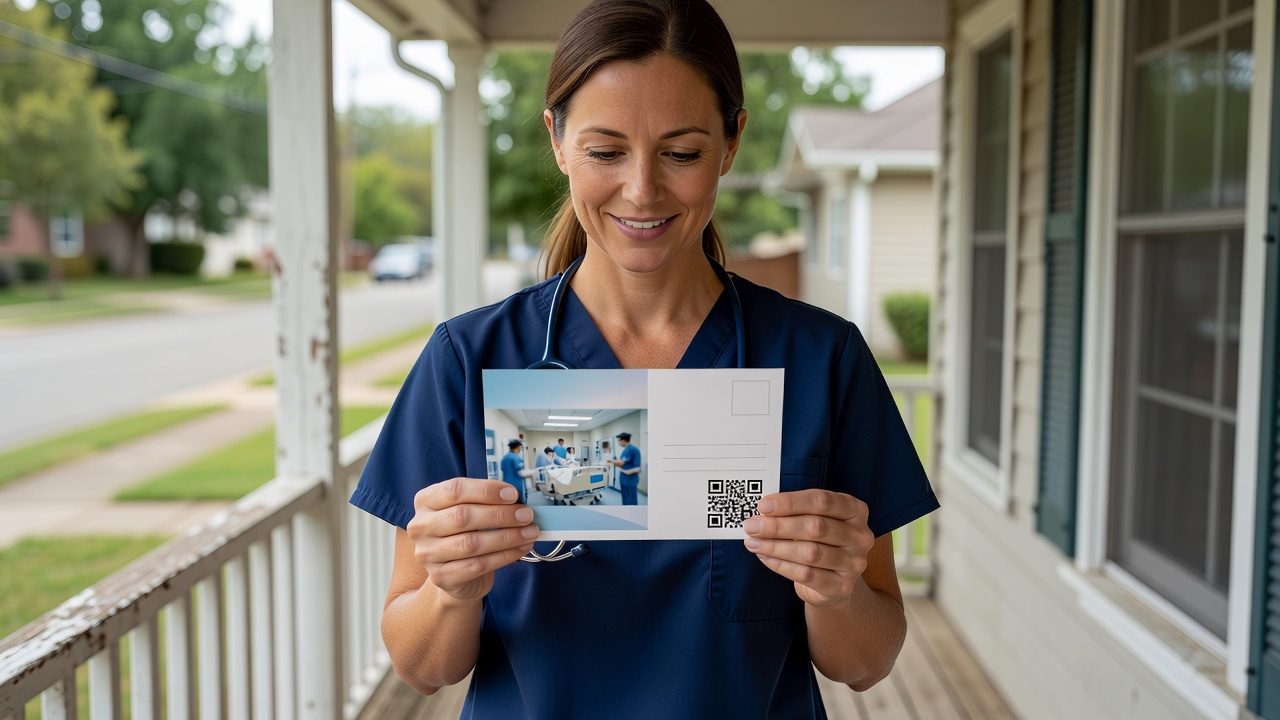
A direct mail card does not need to carry every detail of the job. It needs to make the right recipient recognize the opportunity and understand the next step. RecruitCard's card structure centers on four parts.
Personalized recipient name
Using the recipient's actual first name makes the card feel directed to a person rather than a general audience. Personalization does not replace relevant content, but it helps establish that the message was intended for a specific recipient.
Specialty-specific message
The copy should connect to the credential group, role, unit, trade, or work setting. For example, a card aimed at critical-care professionals should not read like a general RN recruitment notice.
Credible employer branding
Your logo and approved employer brand help the recipient understand who is hiring. Clear branding is especially important when the card invites a candidate to take the next step online.
One clear action
A QR code and short URL can direct the candidate to a landing page without competing calls to action. The card should make the next step easy to identify, whether that means learning about a role, reviewing an event, or exploring a training path.
RecruitCard manages campaign components including targeting, creative, printing, postage, delivery, and response tracking.
Examples of Message Adaptation by Credential Group
ICU nurses
Lead with the critical-care environment, the unit opportunity, and a clear action for interested candidates. The copy should help an ICU nurse recognize the relevance of the role quickly. It should not repeat the same general language used for every RN opening.
Dental hygienists
Focus on the practice or group setting, the patient-care context, location, and the role-specific opportunity. A dental hygienist should be able to see that the message is relevant to their work rather than a broad dental hiring notice.
Physical therapists and PTAs
Address the care setting and geography. This is particularly important when the opportunity is in a smaller market or an area that may not appear in a candidate's routine job search.
Licensed or certified skilled-trade candidates
Identify the trade or certification and describe the type of work clearly. The same targeted direct mail model can apply to these roles. RecruitCard's deepest expertise, however, is licensed healthcare hiring.
Hiring events and apprenticeships
Credential-specific messaging can also promote an event, training path, open house, apprenticeship, or awareness opportunity. The campaign does not have to focus only on a single open requisition.
Why This Matters for Passive Candidates
Job boards and paid search primarily depend on people who are actively looking or engaging with job-related content. Many already-employed licensed or certified professionals are not doing either at a given moment.
Targeted direct mail provides another way to reach those professionals at home. A personalized card with a relevant specialty message can face less immediate competition for attention than a crowded job board listing or search ad.
Relevance does not guarantee a response. Its value is attention and clarity. A specific message gives the recipient a clearer basis for deciding whether to learn more.
How to Measure a Credential-Specific Campaign
Each campaign can use a QR code and landing page to measure scans and landing-page traffic. These measures show engagement with the mail piece and visits to the campaign destination.
Keep the landing-page experience aligned with the card. If the card speaks to ICU nurses, the landing page should continue that ICU-specific message rather than sending the candidate to a broad page that requires them to search for the relevant information.
QR scans and landing-page traffic do not by themselves prove a hire or guarantee campaign performance. Your hiring team should separately decide how it will record inquiries, applications, interviews, and hires in its normal recruiting process.
When Credential-Specific Messaging Is Most Useful
- A specific requisition has remained open and is not closing through normal channels.
- The qualified local pool is small, specialized, or likely to include already-employed professionals.
- You need to recruit continuously for high-volume roles such as CNA, HHA, or caregiver positions.
- You are promoting a hiring event, open house, apprenticeship, training program, or new facility that candidates may not be searching for.
- You are a recruitment marketing agency that wants to offer targeted direct mail under your own brand through a white-label model.
- You need to support a single-market campaign or a nationwide rollout.
A Practical Brief for Each Credential Group
Before developing a card, prepare a short brief for each group you want to reach. This helps ensure that the audience, message, landing page, and tracking plan support the same objective.
- Credential or license: Identify the exact license, certification, trade, or specialty. Avoid relying only on a broad occupational label.
- Role and setting: State what the person would do and where the work takes place.
- Geography: Define the target market, locations, or nationwide scope.
- Reason to consider: Identify the opportunity that deserves attention without making unsupported promises.
- Call to action: Choose one next step, such as visiting a landing page, scanning a QR code, or learning about an event.
- Brand requirements: Provide the employer logo, visual identity, and approved language needed for the card.
- Measurement plan: Confirm how QR scans and landing-page traffic will be reviewed.
How RecruitCard Supports the Campaign
RecruitCard provides a managed, end-to-end direct mail recruiting campaign. The service includes audience targeting by license type, specialty, trade, and geography; card design with employer branding and recipient personalization; printing; postage; delivery; and QR-code or landing-page response tracking.
This is not a generic mailing-list handoff. The campaign is structured around the role, credential group, geography, message, and next action you want a candidate to take. RecruitCard supports both single-market efforts and nationwide campaigns. Recruitment marketing agencies can also use the service through a white-label model.
If you have a hard-to-fill role, a credential-specific hiring event, or a broader pipeline objective, Book a 15-minute call.
Frequently Asked Questions
Does credential-specific messaging mean we need a separate campaign for every license or certification?
Not necessarily. A campaign can be organized around the credential groups that differ meaningfully in duties, work setting, geography, or candidate concerns. Similar groups may be able to share a structure, while distinct groups receive more tailored messages.
Can the same campaign target more than one specialty?
Yes. The audience and message can be structured around relevant license, specialty, trade, and geography groupings. The right structure depends on how similar the roles and opportunities are.
Is this only for healthcare recruiting?
RecruitCard's deepest expertise is licensed healthcare hiring. The same targeted direct mail model can also be applied to engineering and skilled-trade employers hiring licensed or certified candidates.
How do we know whether candidates engaged with the message?
Campaign response can be measured through QR scans and landing-page traffic. These measures show engagement with the campaign and should be reviewed alongside your normal recruiting records.
Can credential-specific direct mail support a hiring event or apprenticeship?
Yes. The campaign does not have to promote only one open requisition. It can also build awareness for a hiring event, open house, apprenticeship, training program, or longer-term candidate pipeline.
Enjoyed this? There's more from RecruitCard.
Book a 15-minute call →