Behavioral Health Hiring Events Need More Than an Event Announcement

Behavioral health hiring events need more than a public announcement. To reach licensed counselors, social workers, psychiatric nurses, and other qualified professionals—especially those already employed—your campaign should combine precise audience targeting, a clear event message, personalized direct mail, and measurable response tracking.
Who This Article Is For
This guide is for behavioral health employers, hospitals, health systems, clinics, and practices planning a hiring event or open house. It is also relevant to recruitment marketing agencies supporting behavioral health employers through a white-label campaign model.
The goal is not simply to increase event attendance. It is to put a relevant opportunity in front of qualified professionals for difficult behavioral health roles, including people who may not be actively applying for jobs.
Why an Event Announcement Alone Often Falls Short
A public event announcement can reach people already following your organization or actively looking for a role. That can be useful. But it has a structural limit: job-board listings, social posts, and paid search generally depend on candidates seeing or seeking the message online.
Many qualified behavioral health professionals are already employed. They may not be monitoring job boards, searching for a new employer, or noticing a paid recruitment message among competing online content.
Your event therefore needs more than logistics. It needs a reason for the right candidate to notice the opportunity, consider it, and take a next step. Direct mail can complement digital promotion by putting a relevant invitation in front of a defined audience at home.
The Behavioral Health Roles You May Need to Reach
Behavioral health hiring needs are rarely interchangeable. Your event may be intended for one role, a related group of roles, or a broader care team. Relevant audiences can include:
- Counselors and therapists
- Licensed clinical social workers and other social workers
- Psychiatric nurses
- Behavioral health technicians
- Licensed or certified professionals supporting behavioral health programs
Each audience may need a different message. A psychiatric nursing opportunity may call for a different event invitation than an outpatient counseling role. Eligibility expectations, care settings, shifts, programs, and locations may also differ.
Start with the actual hiring need: a particular facility, program, shift, service line, or location. That definition should shape both the audience and the invitation.
Start With a Specific Hiring Event Objective
Before promoting an event, decide what it is meant to accomplish. A hiring event may be designed to:
- Discuss current openings for a defined behavioral health role or team
- Introduce a new behavioral health facility, program, or service line
- Support hiring across multiple locations
- Build a longer-term candidate pipeline before a future vacancy opens
Then clarify the intended audience by license type, specialty or role, and geographic area. If you have several openings, organize the event message around the opportunities candidates can explore instead of listing every position your organization has available.
A focused objective makes it easier for a recipient to answer a basic question: Is this event relevant to my work and career path?
Reach Qualified Candidates With Precision Targeting
A generic local mailing list is not the same as an audience built for a behavioral health hiring event. RecruitCard campaigns use audience matching by license type, specialty, and geography, rather than a broad demographic mailing.
That distinction matters when your event is intended for a particular professional audience. You can focus the invitation on behavioral health professionals most relevant to the roles being discussed rather than distributing the same message across a broad local population.
The audience is built through license, specialty, and geographic matching. Campaigns can be structured for a single market or a nationwide rollout, depending on the employer's hiring need.
Use Direct Mail to Reach Passive Behavioral Health Candidates
Personalized direct mail gives you another way to reach qualified professionals who are not actively searching online. A mail piece arrives at home and can introduce an event to someone who may not see a job posting, paid search ad, or social post.
This does not mean digital channels have no role. A hiring event can use several channels. Direct mail is a complementary channel for reaching people who may otherwise remain outside the active applicant flow.
The aim is not mass distribution. It is to put a relevant opportunity in front of a precisely defined audience and make the next step clear.
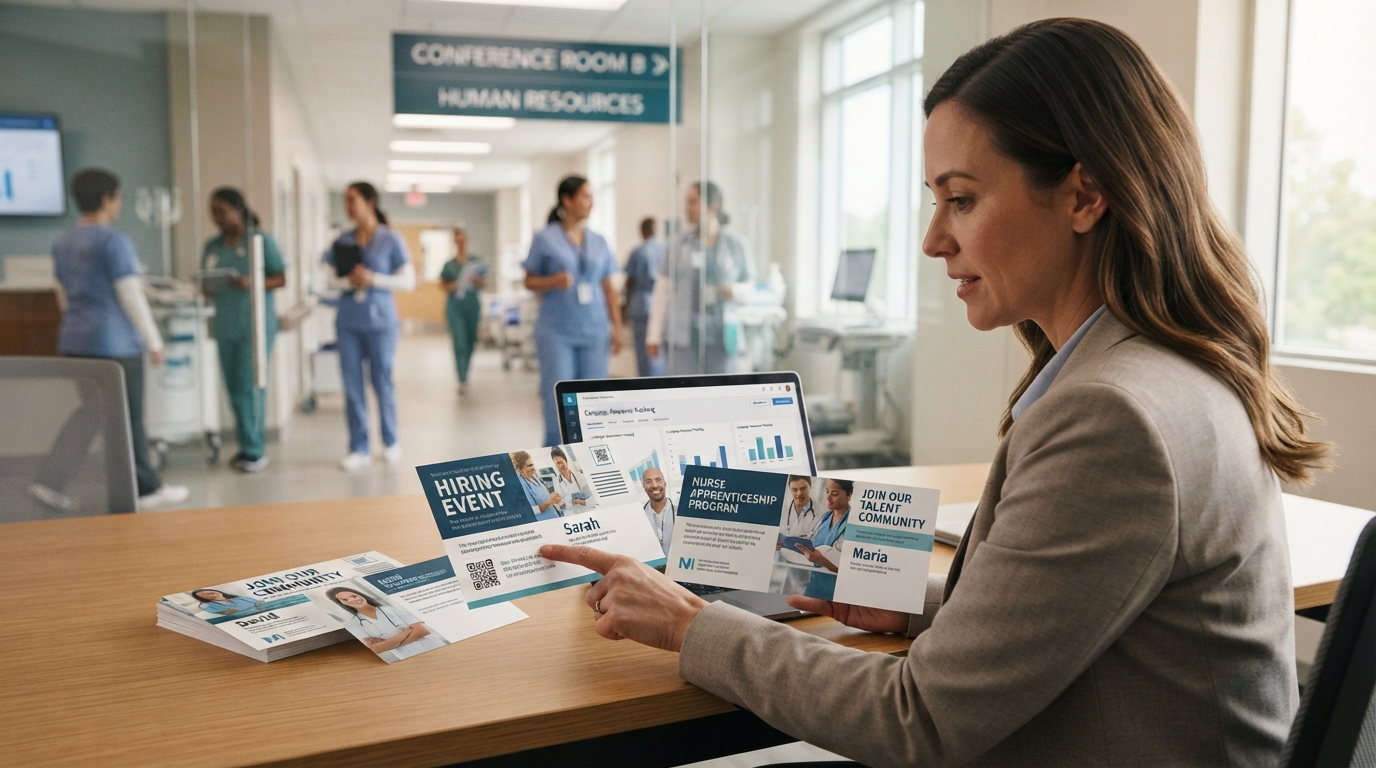
The Anatomy of a Behavioral Health Hiring Event Card
An effective hiring-event card does not need to say everything. It should give the intended recipient a clear, credible reason to learn more.
Personalized name
Address the recipient by their actual first name. Personalization helps distinguish the invitation from a broad community announcement.
Specialty-specific message
Connect the event to the roles, program, care setting, shift, or career path relevant to the audience. For example, an event focused on psychiatric nursing should not use the same lead message as one focused on counseling or social work.
Credible employer branding
Include your organization name, visual identity, and useful facility or program context. The recipient should understand who is inviting them and why the event may be relevant.
One clear action
Use a QR code and short URL that lead to the event information or registration page. Keep the card focused. Avoid competing actions, long lists of openings, or every possible employer benefit.
What the Event Landing Page Should Answer
The card earns attention. The landing page should answer the questions that determine whether a candidate wants to attend or express interest.
- Which roles or specialties will be discussed
- Who should attend, including relevant licenses, certifications, or experience expectations
- When and where the event takes place
- Whether the event is in person, virtual, or both, if applicable
- What candidates can expect, such as meeting recruiters, learning about openings, or discussing a behavioral health program
- How to register or express interest through one straightforward next step
The landing page should continue the employer branding and central message used on the card. Sending recipients to a generic careers page with no event context creates unnecessary friction.
Make the Invitation Relevant to Passive Candidates
Lead with the opportunity, not only the date and location. A passive candidate may not respond to “Hiring Event This Thursday” alone. They need enough context to decide whether the conversation is worth their time.
Use plain language that connects the event to a specific care setting, specialty, shift, program, or location. Do not make unsupported promises about the job. Instead, explain what the candidate can learn about or discuss at the event.
Give recipients a low-friction way to explore the event before they commit. A QR code leading to a concise event page lets a candidate review details privately and decide whether to register.
How to Measure Interest and Response
Direct-mail recruiting does not have to be unmeasured. QR scans show how many recipients interacted with the mail piece, while landing-page traffic shows visits to your event information or registration page.
These measures show campaign engagement. They do not, by themselves, prove attendance or hires. Your internal registration, event, and recruiting process provides the next level of follow-up.
Used together, tracking information can help you evaluate:
- Whether the message prompted recipients to learn more
- How the audience engaged with the event invitation
- Whether the landing page makes the next step clear
- Where recruiting follow-up may be needed
The Full-Service Campaign Workflow
RecruitCard manages the campaign as an end-to-end recruiting channel rather than handing over a mailing list for your team to manage alone.
- Audience targeting: Define the behavioral health role, specialty, and geography.
- Creative development: Build a card around your employer brand, event purpose, personalized recipient name, and one clear action.
- Production: Coordinate printing, postage, and delivery.
- Response tracking: Connect the QR code and landing page to measurable campaign activity.
- Follow-up: Align registration and post-event recruiting steps with your internal process.
Common Mistakes to Avoid
- Relying on one public announcement for a hard-to-reach professional audience
- Mailing a broad local audience without defining the behavioral health role or specialty
- Using the same message for counselors, social workers, psychiatric nurses, and unrelated healthcare roles
- Including multiple competing calls to action on the card
- Sending candidates to a generic careers page without event details
- Measuring attendance alone while overlooking QR scans and landing-page traffic
- Treating the campaign as a one-time event when the same audience strategy could inform future pipeline work
Hiring Events Can Also Build a Longer-Term Pipeline
An event can introduce candidates to an employer, facility, service line, or behavioral health program they were not actively searching for. That matters when you are building awareness ahead of future openings or maintaining a more consistent recruiting presence for recurring needs.
Your team can retain appropriate event and campaign interest signals for follow-up through its own recruiting process. The same targeting model can support future openings, additional open houses, awareness campaigns, and ongoing hiring needs.
Pipeline development still requires employer-managed follow-up. A mail campaign can create a measurable point of engagement; your recruiting process turns that interest into the next conversation.
When a Targeted Direct Mail Campaign May Fit
A targeted direct mail campaign may be a fit when:
- A behavioral health requisition or group of roles is not closing through normal channels
- The qualified local audience is limited or likely to include already-employed professionals
- You are promoting a hiring event, open house, new facility, or program that candidates may not know to search for
- You want to measure campaign activity through QR scans and landing-page traffic
- You are a recruitment marketing agency that wants to offer the channel under your own brand through a white-label model
What RecruitCard Handles
RecruitCard manages audience targeting by license type, specialty, and geography. The service includes card design, employer branding, recipient-name personalization, printing, postage, delivery, and QR-code or landing-page response tracking.
The model supports behavioral health hiring campaigns as part of RecruitCard's broader expertise in licensed healthcare recruiting. It is a managed campaign, not a generic mailing-list handoff.
Promote the Opportunity, Not Just the Event
An event announcement is only one part of a behavioral health hiring campaign. A stronger approach gives the right professionals a relevant reason to attend, makes the next step easy, and tracks engagement after the mail piece arrives.
If you are planning a behavioral health hiring event or open house, Book a 15-minute call to discuss a targeted campaign.
Enjoyed this? There's more from RecruitCard.
Book a 15-minute call →