Can a Case Management Role Be Marketed Like an ICU Role?

No. Case management roles and ICU roles need different audience segments and card messages because their specialties, work settings, and candidate pools are not interchangeable. Treating every RN opening as one mailing list hides the daily work that actually moves a passive candidate to scan a card.
- Match license type, specialty, and geography so case managers and ICU nurses are not mixed into one generic RN list.
- Write the card for the setting the recipient already knows: coordination and discharge planning versus high acuity bedside care.
- Use separate creative when both roles are open so each call to action stays clear.
- Track QR scans and landing page traffic by segment instead of guessing which message worked.
Specialty defines the right recipients
The right recipients are people whose license type and specialty match the role, not every registered nurse in a ZIP code. License and specialty matching lets you reach only case managers or only ICU nurses instead of a broad RN list. Geography adds another filter so the mail goes to professionals already working in the needed local market, or to people you intentionally want to invite from a wider area. One employer brand message sent to every RN misses the specific daily work that attracts each group.
Precision is not a mass mailing
A purchased demographic list is not the same as targeting by license type, specialty, and geography. Case management and ICU hiring both need that precision because the qualified local pool is often small and already employed. Those candidates are structurally hard to reach on job boards and paid search because they are not actively looking.
Work setting and role context change the message
The card copy has to reflect the work setting, not a generic nursing headline. Case management centers on coordination, discharge planning, and patient navigation across the system. ICU work centers on high acuity bedside care, rapid decisions, and shift based intensity. The card must speak directly to the setting a recipient already understands or seeks.
Four parts of a useful card
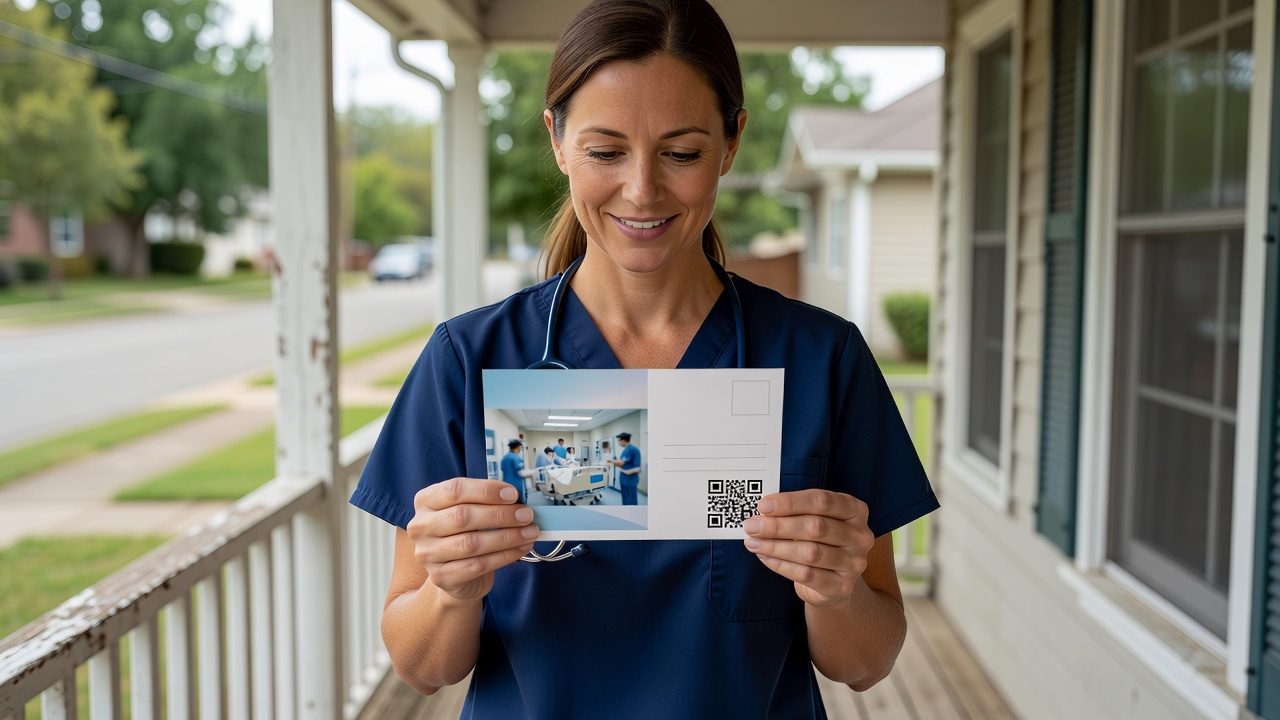
A recruiting card works when it includes a personalized first name, a specialty specific message, credible employer branding, and one clear action such as a QR code plus a short URL. Those four parts stay the same. The specialty message is what cannot be copied from an ICU campaign into a case management campaign without losing meaning.
A personalized, targeted mail piece reaches passive candidates at home, with far less competition for attention than a job posting or paid search ad.
When separate creative beats a single campaign
Separate segments and separate cards produce clearer calls to action for each role type. A shared card dilutes the appeal for both groups and lowers the chance the right person responds. Roles that stay open longest, including night shift, rural sites, and niche specialties, benefit most from this precision because passive candidates see themselves in the message.
When one campaign is enough
If you have a single requisition and a single specialty, one audience and one card is the honest approach. If case management and ICU are both open, two segments keep the employer brand consistent while letting the specialty line and the landing page differ. The same model also applies to hiring events, apprenticeship awareness, and pipeline building before the next vacancy opens.
If you are comparing a case management search with an ICU search and want a managed campaign (targeting, design, print, postage, delivery, and response tracking), book a 15-minute call.
Tracking results by segment
QR codes and landing pages tied to each card show which message and audience produced scans and traffic. You can compare the case management segment with the ICU segment without guesswork. That view guides later decisions on when one message is enough and when separate efforts are required. It does not replace your ATS hiring metrics. It does show whether the mailer itself was opened and acted on.
What happens after the scan
The destination should match the card: one role, one story, one next step. Mixing both openings on one landing page recreates the same dilution you avoided in the mail. Keep the employer brand visible. Keep the action singular.
FAQ
Can one card mention both roles?
A single card can list openings, but each role still needs its own targeted audience and tailored message. Listing both without matching specialty usually reads as a generic RN blast.
How do you decide the audience size for each segment?
Audience size comes from matching license type, specialty, and geography to the specific role requirements. The goal is a precise local (or nationwide) pool, not the largest possible RN count.
Does this approach work for other RN specialties?
Yes. The same logic applies to any unit or setting where the daily work differs from a standard posting, including ED, OR, L&D, oncology, and night shift.
Do you handle design, printing, and tracking?
A full-service campaign covers audience targeting, card design with your employer brand and the recipient's first name, printing, postage, delivery, and QR code plus landing page tracking. Agencies can also run the same model white label.
Can you mail one market or the whole country?
Yes. The same targeting model supports a single market or a nationwide rollout, as long as specialty and geography stay aligned with the requisition.
Sources
- U.S. Bureau of Labor Statistics, Registered Nurses
- Centers for Medicare & Medicaid Services, person-centered care and care coordination
- American Association of Critical-Care Nurses, acute and critical care nursing practice
Enjoyed this? There's more from RecruitCard.
Book a 15-minute call →