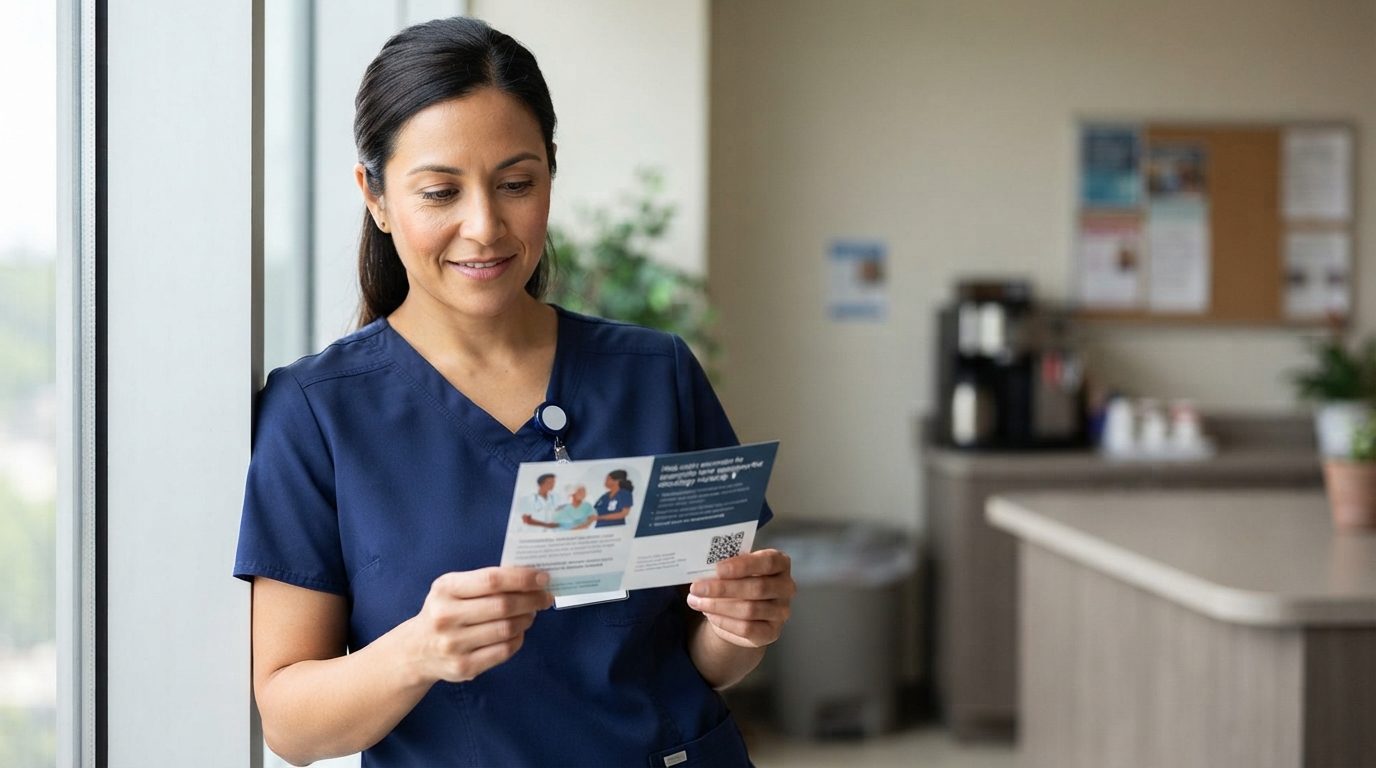
How to Recruit Perioperative Nurses With Personalized Postcards

Hospital and health-system HR and talent-acquisition teams can use personalized postcards to put a specific perioperative opportunity in front of a targeted audience, including nurses who are already employed and may not be actively searching job boards. A RecruitCard campaign combines audience matching by license type, specialty, and geography with personalized card creative, printing, postage, delivery, and QR-code and landing-page tracking.
This is not a generic nursing mailing. The message can focus on the actual need: an OR role, PACU opening, pre-op position, perioperative leadership vacancy, hiring event, or longer-term talent pipeline. The recipient sees a concise, employer-branded invitation with one clear next step.
Why Perioperative Nurse Recruiting Needs a Different Approach
Perioperative hiring is often more specific than a general RN recruitment effort. You may need experience in an operating-room environment, preoperative care, post-anesthesia care, a particular schedule, or leadership within surgical services. When the requisition is specialized, a broad message that simply says “RN wanted” can fail to communicate why the opportunity is relevant.
Qualified perioperative nurses may also be working elsewhere and not spending time on job boards. A personalized postcard gives you another way to introduce the opportunity outside the moment when someone is actively conducting an online job search.
The approach is designed as a complementary recruiting channel. It does not require you to abandon postings, recruiter outreach, or digital advertising. Instead, it creates a direct, specialty-specific touchpoint for the audience you want to reach.
What Makes Perioperative Nurse Recruiting Difficult
“Perioperative nurse” can describe several different hiring needs. Each can call for its own message and audience definition.
- Operating-room nursing: Roles centered on surgical procedures and OR workflows.
- Pre-op nursing: Positions supporting preparation and assessment before procedures.
- PACU nursing: Post-anesthesia care roles that require a clear understanding of the recovery setting.
- Perioperative leadership: Management or leadership opportunities within surgical services.
A broad nursing message can blur these distinctions. A nurse with relevant PACU experience may not respond to a card that appears to be about every nursing opening in a health system. A more useful message identifies the perioperative environment and the role being promoted.
Other practical factors can make the audience narrower: night or weekend coverage, a particular facility location, specialized experience, and competition for a limited local pool. Candidate credentials and professional categories are not presented the same way in every state, so campaign planning should begin with the specific role, specialty, and geography you need to address.
Why Job Boards Alone May Miss Perioperative Nurses
Job boards and paid search are important tools for reaching active job seekers. They generally depend on someone searching for a role, seeing a listing or advertisement, and choosing to click.
That process may not reach every nurse you would consider. A perioperative nurse who is currently employed may not be searching for “OR nurse jobs” or reviewing new postings at the time your requisition is open. They can be structurally outside the audience available through an active-search channel.
Direct mail works differently. A postcard reaches a selected audience at home, outside the online search session. It can introduce an opportunity before the recipient decides to look for a new role. That makes it a complementary channel for hard-to-fill perioperative requisitions, not a replacement for every digital recruiting activity.
How Personalized Postcards Work for Perioperative Recruiting
A targeted postcard campaign is a managed direct-mail process built around license type, specialty, and geography. It is not a generic demographic mailing or a list handoff for your team to manage alone.
For perioperative recruiting, the audience can be shaped around the hiring need, such as perioperative nursing within a defined service area. The right scope depends on the role, the locations you are hiring for, and whether you are promoting one opening or a broader effort.
- A single hospital or service area
- Multiple locations within a health system
- A broader U.S. campaign
RecruitCard’s deepest expertise is licensed healthcare hiring. The same direct-mail model can also be used for other licensed or certified fields, but this approach is especially suited to healthcare teams trying to reach specialized, already-employed professionals.
The Anatomy of a Perioperative Nurse Recruiting Postcard
A useful recruitment postcard should be easy to understand at a glance. RecruitCard campaigns are built around four essential elements.
Personalized recipient name
Using the recipient’s actual first name makes the message more direct. Personalization does not replace a strong offer or clear role description, but it helps the card read as an invitation rather than a broad, untargeted announcement.
Specialty-specific message
The copy should reflect the perioperative need. It might identify the OR, PACU, pre-op setting, surgical-services team, leadership opportunity, location, or schedule detail that matters to the candidate. The goal is relevance, not an attempt to describe every role your organization has open.
Credible employer branding
The card can carry your hospital or health system’s logo, visual identity, and concise employer-brand information. Use claims and details you can support, such as the care setting, team context, or role-specific information you want a candidate to consider.
One clear action
A QR code and short URL direct the recipient to a relevant landing page or application path. Keep the action simple: learn more, view the role, register for an event, or start a conversation.
Avoid crowded cards, several competing calls to action, and generic “all nursing jobs” language. If the objective is to recruit PACU nurses, the card should make that purpose clear.
What the Message Should Say to Perioperative Nurses
Lead with the specific role or clinical environment. The recipient should not have to scan a QR code just to learn whether the card concerns their specialty.
Make the opportunity concrete where details are available. This may include the care setting, location, shift information, and the next step. Add employer-brand content that is meaningful to the candidate, such as the professional environment or team context, without overloading the card or making unsupported promises.
Message directions can vary by hiring need:
- OR recruiting: Lead with the operating-room opportunity and the facility or service-line context.
- PACU recruiting: Identify the post-anesthesia care setting and invite the recipient to review the role.
- Pre-op recruiting: Focus on the preoperative environment, location, and clear next step.
- Perioperative leadership: Present the leadership scope and surgical-services context rather than treating it as a general nursing opening.
These are message approaches, not claims about campaign outcomes. The right language should follow your actual role details and approved employer-brand content.
How Campaign Responses Are Measured
A QR code can connect the postcard to a campaign-specific landing page. This gives your team a way to review QR scans and landing-page traffic associated with the outreach.
These measurement points show activity generated by the campaign and the path recipients were invited to take. They do not guarantee applications, interviews, hires, or any particular response rate. Recruiting outcomes still depend on the role, the candidate experience, your follow-up process, and other factors outside the mail piece itself.
The landing page should match the postcard. A card about a PACU role should lead to a PACU-specific page, a relevant role page, or another aligned next step—not an unrelated generic careers page where the recipient must begin the search again.
What RecruitCard Handles for You
RecruitCard manages the campaign from audience definition through response tracking. The service includes:
- Audience targeting by license type, specialty, and geography
- Postcard design using your employer brand
- Recipient first-name personalization
- Printing and postage
- Delivery coordination
- QR-code and landing-page response tracking
This differs from receiving a mailing list and then coordinating creative, production, postage, and measurement across separate internal or outside resources. The campaign is designed as one managed recruiting channel.
You can use the model for an individual hard-to-fill requisition, a hiring event or open house, or a broader pipeline-building effort. Campaign requirements vary by audience, geography, creative needs, and objective, so those details are best addressed in a consultation.
When a Personalized Postcard Campaign Is a Good Fit
Personalized direct mail may be a useful fit when your team needs an additional way to reach a defined perioperative audience.
- A perioperative requisition has remained open and normal channels are not closing it.
- The target pool is specialized and likely includes nurses who are already employed.
- You need to promote a specific OR, PACU, pre-op, or perioperative leadership opportunity.
- You are inviting candidates to a hiring event or open house.
- You are building an ongoing pipeline for future surgical-services needs.
- Your health system needs to coordinate recruiting across multiple locations or markets.
- You want a measurable mail channel that complements digital recruiting.
Questions to Resolve Before Launch
A clear campaign brief helps keep the card, audience, and landing page aligned. Before launch, decide:
- Which perioperative role, specialty, shift, and location are you targeting?
- Is the goal a single requisition, a hiring event, or a longer-term candidate pipeline?
- What geographic area should the audience cover? Is a broader U.S. rollout appropriate?
- What employer-brand information should appear on the card and landing page?
- What one action should the recipient take after scanning?
- Who will review QR scans and landing-page traffic after delivery?
The audience should be defined through the approved license, specialty, and geography criteria for the campaign. Planning should not assume that professional information is categorized identically in every state.
Postcard Campaigns for Hiring Events and Long-Term Pipelines
The postcard model is not limited to one open perioperative requisition. You can use a specialty-focused card to invite selected candidates to a surgical-services hiring event or open house. In that case, the landing page can provide event details and a straightforward registration or information path.
You can also use targeted outreach to build awareness before the next vacancy opens. For example, a health system may want to introduce its perioperative environment to relevant nurses as part of an ongoing pipeline effort.
These goals are different from an immediate application campaign. Event and pipeline outreach is intended to create awareness and invite engagement; it does not promise a particular hiring outcome.
Add a Direct, Specialty-Specific Channel to Perioperative Recruiting
Personalized postcards give you a way to present a relevant perioperative opportunity to a precisely targeted audience, including passive candidates who may not be searching online. For hard-to-fill OR, PACU, pre-op, and perioperative leadership roles, a focused message can be more useful than a broad nursing announcement.
The essentials are straightforward: the recipient’s first name, a perioperative-specific message, credible employer branding, and one clear action through a QR code and short URL. RecruitCard handles campaign execution and response measurement as well as audience targeting, rather than simply delivering an audience for you to manage.
Schedule a consultation to discuss the role, geography, audience, and campaign objective.
Enjoyed this? There's more from RecruitCard.
Book a 15-minute call →