The Candidate You Cannot Reach by Waiting for an Application

For hospital HR and talent acquisition teams hiring licensed healthcare professionals, the candidate you cannot reach by waiting for an application is the qualified person who is already employed and not actively searching. A targeted direct mail campaign can create the first response by putting a personalized, specialty specific opportunity in front of a named audience at home, then directing interested candidates to a clear next step.
Why waiting for an application misses passive candidates
A passive candidate is a qualified professional who is employed, not reviewing job boards, and not preparing to submit an application. They may be open to a better schedule, a different unit, a shorter commute, or a new clinical setting. But being open is not the same as actively job seeking.
Job boards and paid search rely on active search behavior. Before a candidate sees your posting, they generally need to recognize a reason to look, begin a search, find a relevant role, and decide to apply. If those steps do not happen, even a well written posting may never reach that person.
This matters when you are hiring for roles with a limited qualified pool, including ICU, emergency department, operating room, labor and delivery, oncology, case management, and night shift positions. The issue is not necessarily the quality of your job posting. The right candidate may simply never see it.
The behavioral step that happens before a job board can work
For many candidates, the path to an application follows a sequence:
- Awareness of an opportunity
- Interest in learning more
- A search for details or comparable roles
- An application or other response
- Recruiter follow up
A job board often becomes useful after awareness and search have already started. It is a place where someone who is looking can compare opportunities and take action. It cannot reliably introduce your opening to a professional who is not looking today.
Consider an ICU nurse who is employed and generally satisfied. That nurse may be open to the right opportunity, perhaps one with a different shift, setting, location, or employer. Yet they are not searching for ICU jobs this week. They will not see your job board listing unless something first gives them a reason to look.
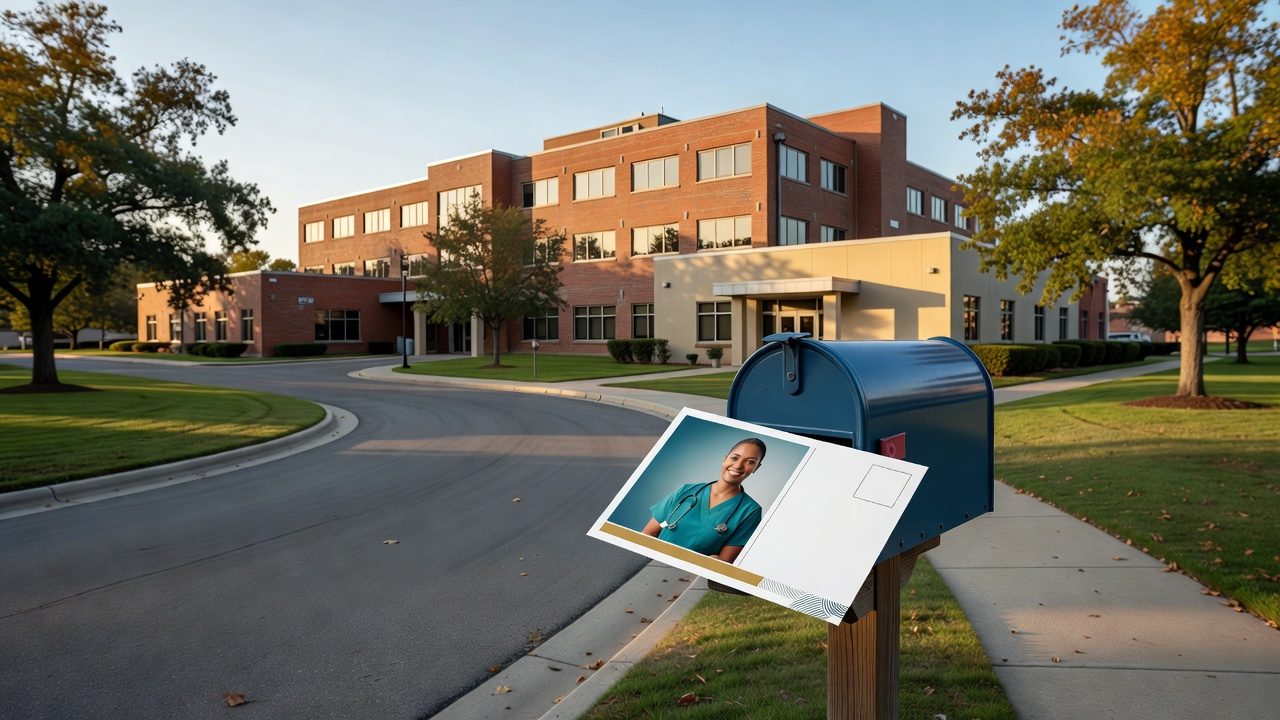
Direct mail can support that earlier step. It introduces a specific opportunity before asking the recipient to search or apply.
How targeted mail creates that first response
Targeted recruiting mail is not a generic demographic mailer. The campaign audience is matched by license type, specialty, and geography. This allows the message to focus on the professionals connected to a particular hiring need.
A named licensed or specialized audience can receive the opportunity at home, even if they are not visiting a job board. The goal is to create a relevant reason to consider the role and make the next action simple.
This approach can support more than one open requisition. You can use it for a specific unit, a hiring event, an open house, apprenticeship awareness, new facility awareness, or long term candidate pipeline building.
What the candidate sees on the card
A useful recruiting card has four core elements:
- The recipient's actual first name: Personalization helps establish that the message is intended for a real person, not a broad anonymous audience.
- A specialty specific message: The role and context should be relevant to the recipient's professional background.
- Credible employer branding: Your brand should make it clear who is presenting the opportunity.
- One clear action: A QR code and short URL direct the recipient to a campaign landing page.
The message should change with the audience. An operating room nurse needs different context than a home health aide, dental hygienist, or rural physical therapist. A broad statement such as healthcare professionals wanted asks the recipient to do too much interpretation. A specialty specific message can quickly identify the role, relevant work setting, location or locations, and the reason to learn more.
The card does not need to explain every benefit or job requirement. Its job is to make the opportunity understandable quickly and provide an easy next step.
Why personalization and specificity matter
Personalization and specificity help a recipient decide whether an opportunity deserves attention. Using the recipient's name can make the piece feel more relevant. Specialty language helps the candidate recognize whether the opening fits their experience.
Geography adds another useful layer. A local campaign can speak directly to a nearby role. A broader rollout can present opportunities across multiple locations when relocation may be relevant. In either case, the message should clearly state where the opportunity is and what kind of work it involves.
These details do not guarantee an application or a hire. They create a clearer reason for a qualified person to consider an opportunity they might otherwise never encounter.
How direct mail works with job boards instead of replacing them
Direct mail and job boards can serve different stages of candidate behavior. Mail can introduce the opening to people who are not actively looking. Your career page, campaign landing page, or job board listing can then provide fuller details and an application path.
Use one clear destination on the card. A candidate should not have to search your career site to find the correct ICU night shift opening or navigate through a long list of locations. The landing page should continue the message from the card and tell the visitor what to do next.
This combination is especially useful when normal channels are producing too few qualified applicants for a specific role. Rather than treating mail and digital recruiting as substitutes, use mail to create awareness and digital channels to support research and conversion.
How you measure whether the campaign created interest
RecruitCard campaigns can track QR scans and landing page traffic. These measures can show whether recipients engaged with the mailed piece, whether a message or audience segment generated visits, and whether interest reached the campaign destination.
Scans and traffic measure engagement. They do not, by themselves, prove an application, hire, or return on investment. To understand the full recruiting path, align the landing page with your recruiting workflow and distinguish campaign traffic from other sources where appropriate.
For example, the landing page can direct candidates to a specific application path or interest form. Your team can then review engagement data alongside the activity that follows in your recruiting process.
When this approach fits your hiring problem
Targeted direct mail is a practical fit when your hiring challenge involves a qualified audience that is small, already employed, difficult to reach through normal channels, or not yet aware of the opportunity.
- A specific requisition has remained open and is not closing through normal channels.
- The local pool of qualified licensed professionals is limited.
- The specialty includes many professionals who are employed and not actively searching.
- You need continuing awareness for a high volume or high turnover role.
- You are hiring for a hard to fill setting, such as night shift nursing, rural rehabilitation, or a niche allied health specialty.
- You are continuously hiring CNAs, HHAs, or caregivers in a defined market.
The same model can also support hiring events, open houses, apprenticeship awareness, new facility awareness, and pipeline building before the next vacancy opens. Campaigns can be structured for one market or for a nationwide rollout.
What an end to end campaign involves
RecruitCard manages the parts of a direct mail recruiting campaign that need to work together:
- Audience targeting by license type, specialty, and geography
- Card design using your employer brand
- Personalized recipient names and specialty specific messaging
- Printing, postage, and delivery
- QR code setup and campaign landing page coordination
- Response tracking through QR scans and landing page traffic
This is more than handing over a mailing list. The audience, message, physical card, destination, and tracking should all support the same recruiting objective.
Recruitment marketing agencies can also use a white label option when they want to offer this channel without building an in house print, postage, and tracking operation.
A practical first step for employers
Start with one defined hiring challenge instead of a broad message for every role. An ICU night shift opening, an operating room nursing need, or a rural physical therapy role gives the campaign a clear audience and message.
Before building the campaign, clarify the following:
- License type and specialty
- Geography and relevant locations
- The employer message you want candidates to see
- The campaign landing page destination
- The action you want candidates to take after scanning
Then consider why the role is difficult to fill. Is the qualified audience small, passive, geographically dispersed, or unaware of the opportunity? The answer helps determine whether a targeted mail campaign should become part of your recruiting mix.
If you want to discuss a defined hiring need, Book a 15-minute call.
Frequently asked questions
Is this the same as buying a generic mailing list?
No. A RecruitCard campaign is planned around license type, specialty, and geography, with a message designed for the specific hiring need. It is not a generic demographic mailing.
Can you target a specialty such as ICU or operating room instead of mailing to all nurses?
Yes. The audience can be defined around the relevant license type, specialty, trade, and geographic location. This lets the campaign focus on a specific unit or professional audience rather than a broad nursing message.
How is this different from posting on a job board?
A job board generally depends on active search behavior. Targeted mail can create awareness among qualified professionals before they begin searching, then direct interested recipients to a digital destination for details and next steps.
Can campaign interest be measured?
Yes. QR scans and landing page traffic can show engagement with the mailed piece. Review these measures alongside application and recruiting workflow data to understand what happens after someone reaches the campaign destination.
Can this support a hiring event or long term pipeline?
Yes. The same model can promote hiring events, apprenticeship awareness, new facility awareness, and an ongoing candidate pipeline, rather than only one open requisition.
Enjoyed this? There's more from RecruitCard.
Book a 15-minute call →