The Recruiting Campaign Handoff From Audience Brief to Digital Response

RecruitCard manages the complete sequence from an audience brief to measured digital responses as one service. The workflow consists of these sequential steps, so you are not left with a list handoff and a separate print vendor.
- You submit license, specialty, geography, brand, and one call to action.
- You review the matched audience and the four-part card layout.
- You approve production, postage, and delivery to the approved addresses.
- You track QR scans and landing page visits, then refine the next cycle.
1. Submit the audience brief
You start by writing a brief that names who should receive the card and what they should do next.
Specify license, specialty, and geography
Name the license types, specialties, and geographic areas that match the open roles. Precision targeting by license type, specialty, and geography is not a generic demographic list. If you need ICU, ED, OR, labor and delivery, oncology, case management, or similar unit work, say so in the brief rather than stopping at a broad RN label.
Note unit and shift details
Add unit or shift facts such as night positions, rural sites, or other roles that will not close through ordinary channels. Those details belong in the specialty-specific message on the card.
Include brand and one action
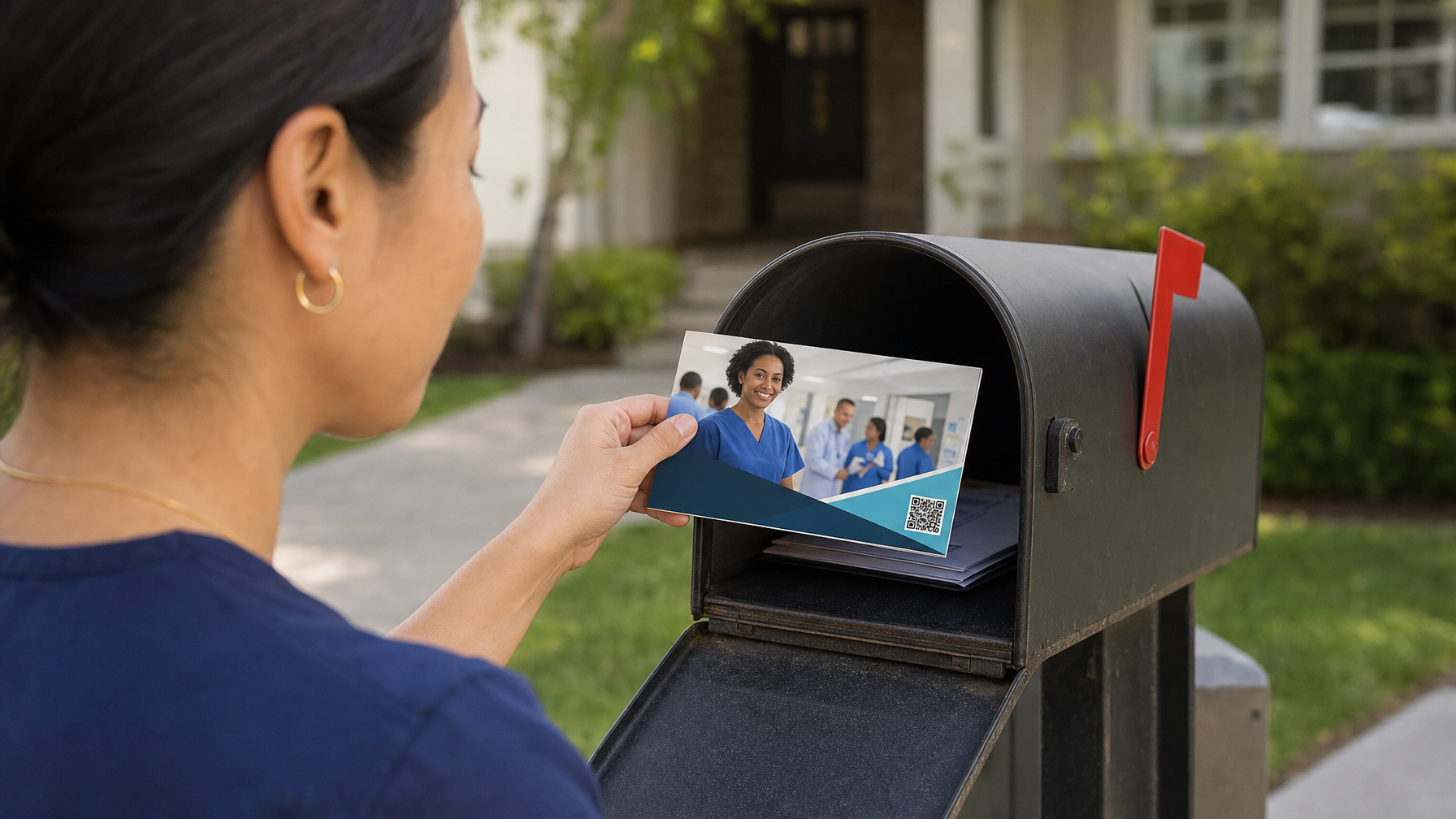
Provide employer brand elements and a single call to action. The card is built around four parts: the recipient first name, a specialty-specific message, credible employer branding, and one clear action (QR plus a short URL).
2. Review the matched list and creative
You confirm that the audience and the card layout match the brief before anything is printed.
Confirm the audience match
Check that the list follows the license, specialty, and geography criteria you provided. The audience is built from license, specialty, and geography matching. This is a managed campaign, not a purchased mailing list handed off for you to produce alone.
Approve the four-part layout
Approve a layout that places the personalized first name, specialty message, brand, and QR together. Keep one action so the reader is not asked to choose among competing next steps.
3. Approve production and mailing
You authorize print, postage, and delivery once the files and addresses are final.
Finalize personalized print files
Lock the print files so each card carries the recipient first name and the approved creative. RecruitCard handles targeting, creative, print, postage, delivery, and response tracking as one service.
Authorize print, postage, and delivery
Authorize the print run, postage application, and delivery to the approved addresses. The same model can cover a single market or a nationwide rollout. Recruitment marketing agencies can use a white-label option if they want the channel under their own brand.
When the brief, list, and card are ready, book a 15-minute call to walk the handoff from audience to mailbox to digital response.
4. Track the digital responses
You measure what the mailing produced through QR scans and landing page traffic rather than guessing.
Monitor scans and visits
Watch QR code scans and landing page visits that come from the mailed cards. Those signals show that a recipient moved from the physical piece to a digital destination.
Review traffic by segment
Review the traffic data to see which segments responded. Use that view to compare license, specialty, or geography slices without inventing a result that the campaign did not report.
5. Evaluate and adjust for the next cycle
You use the response data to tighten the next brief, creative, or market, then run the same sequence again.
Refine the next brief or creative
Feed scan and landing page patterns back into license, specialty, geography, message, or call to action choices. Direct mail recruiting can support one hard-to-fill requisition, ongoing high-volume local hiring, hiring events, apprenticeship awareness, or a longer pipeline before the next vacancy opens.
Repeat for more markets or roles
Apply the same workflow to additional markets or role types as needed. Licensed healthcare hiring is the deepest expertise. The same targeting and card model can extend to engineering and skilled-trade employers who need licensed or certified candidates.
Sources
Enjoyed this? There's more from RecruitCard.
Book a 15-minute call →