What Changes When You Add Night Shift or Rural Geography to a Nursing Audience

Adding night shift or rural geography to a nursing audience makes the pool smaller and the message more important. The targeting gets more precise, and so does the question every candidate asks: why would I choose this role in this place?
- Smaller pool: Each constraint you add removes candidates who were never going to fit the role.
- Different message: A generic "join our team" card does not address why someone would work nights or live in a rural area.
- Layering matters: License type, specialty and geography define the audience. Shift is part of the role story you need to plan for.
- Small is workable: A small audience can still support a full campaign with QR and landing-page tracking.
This article is for hospital and health-system HR and talent acquisition teams with a night shift or rural nursing requisition that is not closing through normal channels.
How does night shift change who you are trying to reach?
Night shift narrows the realistic candidate pool, because many licensed nurses prefer days or move away from nights as their careers progress. That is a general pattern in nursing, not a figure we can put a number on here.
Less competition, higher bar for the message
A smaller group of willing candidates usually means fewer employers competing for their attention. It also means the message has to land with the people who are actually open to nights. A card that could be sent to any nurse on any schedule will not do that.
Why nurses are on nights
Passive candidates working nights are often there for a reason. Some chose it for pay, for a lifestyle fit, or because certain units run quieter overnight. Others are there because of circumstance, such as childcare, transportation or a second job. Your message should respect both situations and not pretend nights are a minor detail.
A note on how shift fits into targeting
RecruitCard builds audiences by license type, specialty and geography. Night shift is a feature of your role, and it shapes the card's message and the brief behind it. If you want to know how far shift can influence who is selected, raise it when you talk through the audience before the campaign is built.
What does rural geography do to your candidate pool?
Rural geography generally shrinks the pool, because there are fewer licensed nurses living within reach of a rural facility than in an urban or suburban market.
Distance filters people out
A rural audience usually brings commute distance or relocation into the decision. Candidates who will not relocate or cannot drive the distance are not your audience, and a card that ignores that wastes both your postage and their attention.
Rural practice is a lifestyle choice
Rural roles often come with a different clinical environment, different professional networks and different family and community infrastructure. Candidates who have already thought through those trade-offs are more likely to engage than those who have not.
Smaller, but still precise
A rural audience is still targetable by license, specialty and geography. It is simply smaller. That precision is the point: you reach nurses for whom the place and the clinical work could align, not a huge pool that does not match.
How does combining night shift and rural change your message?
When both apply, the message shifts from broad appeal to lifestyle fit and credibility. A nurse who works nights in a rural setting made deliberate choices, and your card should treat them that way.
Name the shift and the place
Say what the role is, which shift it is and where it is located. Then explain what the role offers someone making that choice. Depending on your facility, that might be the clinical opportunity, stability, community or compensation. Only state what is true and approved for your organization.
Why generic copy fails
"Join our team" says nothing about why someone would want nights in a rural setting. The specialty-specific message is the part of the card that does this work.
Employer branding that signals respect
Your branding should signal stability and an understanding of the work. A rural night nurse is judging whether you understand what the job involves, not how large your organization is.
What do smaller audiences mean for the campaign?
A smaller audience means a more focused campaign, not a lesser one. Shrinking the audience as you add constraints is intentional.
Audience size is not the test
The useful question is whether you are reaching the candidates most likely to fit the role and stay in it. A small, relevant audience can support a full campaign, with its own design, printing, postage, delivery and response tracking.
Every card element carries more weight
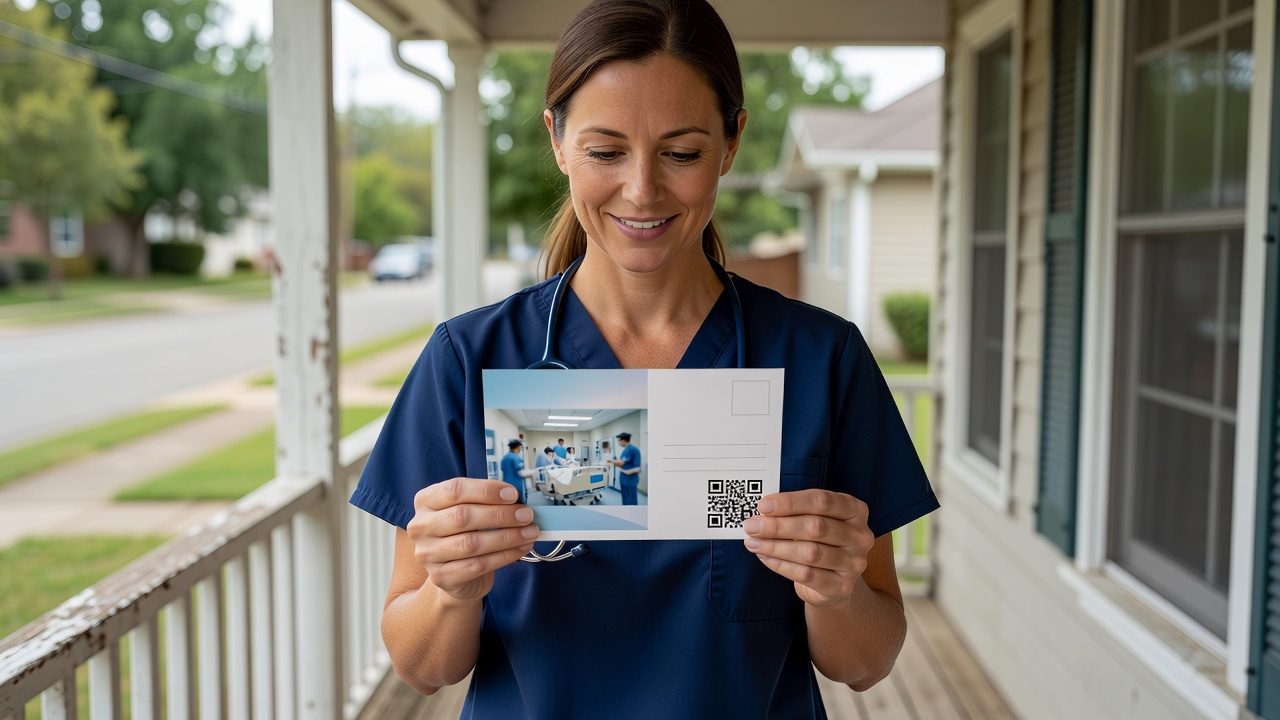
With fewer recipients, each part of the card matters. The four components are the recipient's actual first name, a specialty-specific message, credible employer branding, and one clear action with a QR code and short URL. Generic copy has nowhere to hide.
Several small campaigns can work
You might run one campaign for nights in one market, another for days in a different market, and another for a rural specialty role. Each can stand alone. You do not need a national audience to run a campaign, although nationwide rollouts are also possible.
Planning a night shift or rural nursing campaign? Talk through your requisition, your audience constraints and what the card should say. Book a 15-minute call.
Why do license type and specialty matter more with these filters?
Each added constraint makes the clinical details of the role matter more. An ICU RN on nights in a rural hospital is a different candidate from a med-surg RN on the same schedule.
Layer the criteria
Think of the audience in layers: license type (RN, LPN and so on), specialty (ICU, OR, medical-surgical and so on), and geography. Shift and the rural setting then shape the story you tell. Each layer narrows the pool and increases relevance.
Speak to the clinical work
A nurse who chooses nights in a rural setting is often drawn partly by the work itself. Your card should speak to the role and the specialty, not only the location or the schedule.
Avoid the broad sweep
Mailing every nurse in a rural area without regard to specialty spends postage on people who will never fit. Filtering is how you avoid that.
How do you measure response from a smaller audience?
You measure it the same way as any campaign: QR scans and landing-page traffic. Tracking is built into the card, so you can see who engages.
Read the numbers in proportion
Results will reflect the size and specificity of the audience. A smaller audience gives you a cleaner read on whether your message resonates with the right people. We cannot promise any particular response level, and you should be skeptical of anyone who does.
Scans are a useful signal
Because the audience is narrowed by specialty and geography, and the card is written for a particular shift and setting, someone who scans is responding to those specific conditions. That is useful information for your team.
Compare messages and places
If you run more than one version, track which geographic areas or shift-specific messages draw the most engagement. That shows you which combinations of shift, geography and specialty are most compelling to candidates.
When do night shift or rural considerations make sense?
They make sense when the shift or the location is genuinely part of the job and part of the reason it is hard to fill.
- Night shift: Use it when you have specific night vacancies that are not filling through standard channels, or when nights are central to your recruiting story.
- Rural: Use it when the role is tied to a location, with no remote option and no easy commute from a nearby city.
- Both: Use them together when you want to reach nurses who may already have decided that combination works for them.
- Neither: If shifts are flexible or the location does not constrain the candidate, do not build the campaign around them.
What should your targeting brief include?
Your brief should settle which constraints are firm and which are flexible before anyone recommends an audience.
Questions to answer first
- Is night shift a hard requirement, or are you open to other shifts?
- Which nights are involved: all nights, a rotation or a block schedule?
- Is the rural location the only option, or could a candidate commute from a nearby city?
- How far from the nearest city counts as rural for this role?
Write down the story
Document what makes this shift and this place worth choosing at your organization. The card's message comes from that analysis. If you are unsure whether shift or geography should drive the audience, talk through the trade-offs before the campaign is built.
FAQ
Does a smaller audience mean fewer responses?
Not necessarily, but we cannot promise a specific outcome either. A smaller audience of candidates who actually fit the role is a more relevant group than a large, mismatched one. Precision matters more than volume.
Can I run separate campaigns for night shift and days?
Yes. You can run different campaigns for different roles in the same geography, or the same role across different geographies. Each keeps its own targeting and messaging.
What should I emphasize if the role is both night shift and rural?
Lead with the clinical opportunity or the specific reason a nurse would choose that combination. Acknowledge the shift and the setting, then focus on what makes the role worth it.
How do I know if shift or geography targeting is right for my role?
If the vacancy has been open and is not filling through normal channels, and the shift or location is part of why, then narrowing the audience makes sense. If the work can be done from anywhere or on any shift, there is little reason to narrow it.
What if my rural audience is very small?
A very small audience can still support a campaign. The constraint is the relevance of the message, so the card's copy and design matter even more.
Sources
Enjoyed this? There's more from RecruitCard.
Book a 15-minute call →